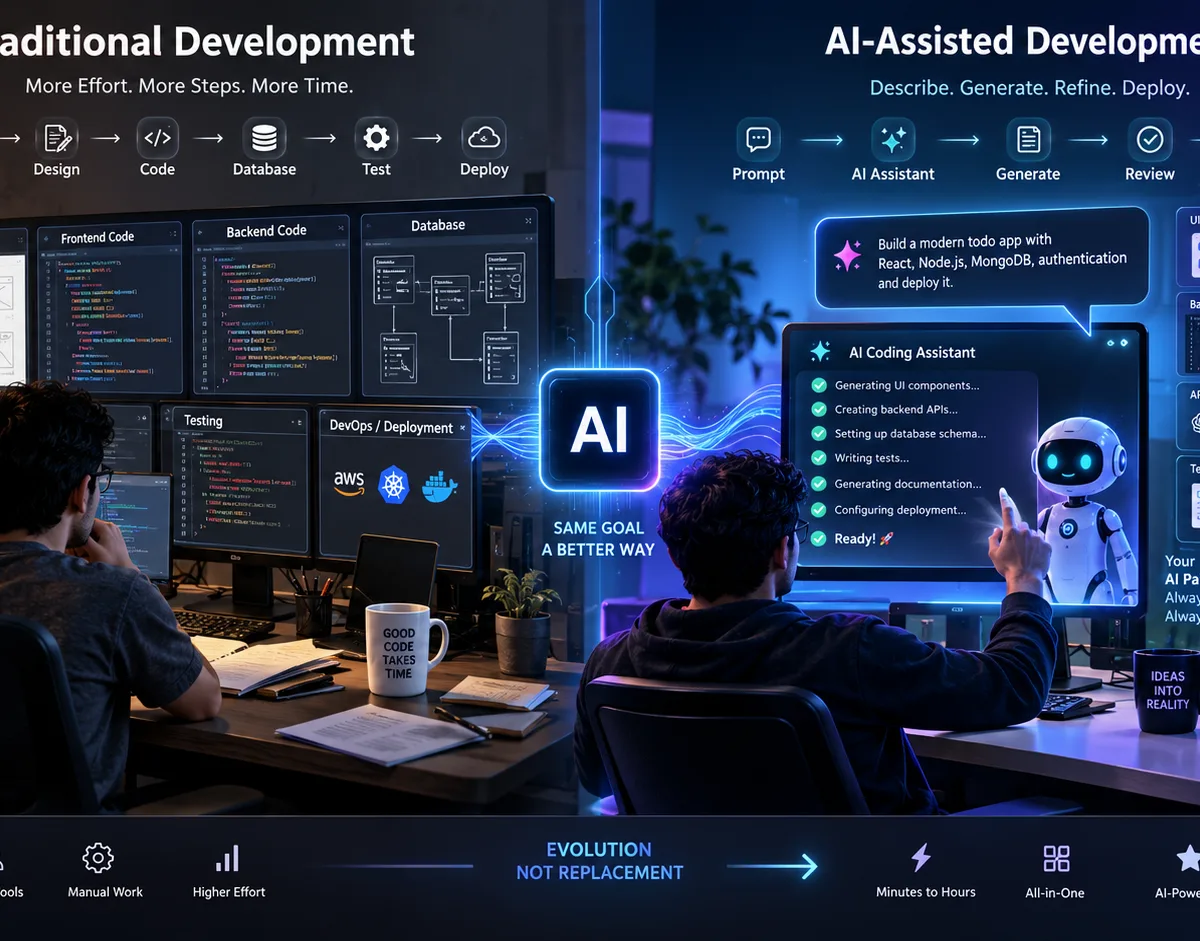
For decades, building an app followed a familiar process: define requirements, create designs, write code, test the application, fix bugs, deploy it, and maintain it. Development teams usually needed designers, frontend developers, backend developers, testers, DevOps engineers, and project managers.
AI app development is changing that workflow.
Today, developers can describe a feature in natural language, generate an initial implementation with AI, test it, identify problems, and iterate much faster. AI can assist with everything from UI generation and code completion to documentation, testing, debugging, database queries, and application architecture.
But this does not mean traditional app development has become obsolete. Instead, AI is becoming another layer of the software development process.
Traditional App Development vs AI App Development
In traditional development, humans perform most development tasks manually. A developer might spend hours creating a React component, writing API endpoints, designing database schemas, creating test cases, and debugging errors.
With AI-assisted development, many of these activities can be accelerated.
A developer can provide a prompt such as:
“Create a responsive React dashboard with authentication, user roles, analytics cards and a PostgreSQL backend.”
An AI coding tool can generate a starting point within minutes. The developer then reviews, modifies, tests, and integrates the implementation.
This changes the developer's role from simply writing code to increasingly directing, reviewing, validating, and integrating software.
AI Has Made Development Faster
The biggest change is development speed.
Google's 2025 DORA research surveyed nearly 5,000 technology professionals and found that AI adoption among software-development professionals had reached around 90%. More than 80% of respondents said AI had improved their productivity, while 59% reported a positive effect on code quality.
Stack Overflow's 2025 Developer Survey tells a similar story. Among more than 49,000 respondents globally, 84% said they were using or planning to use AI tools in their development process, while 51% of professional developers reported using AI tools daily.
That means AI-assisted development is no longer just an experimental workflow. It has become part of mainstream software development.
From Writing Code to Giving Instructions
One of the biggest differences is the interface developers use to build software.
Traditional development is primarily code-first.
AI development is increasingly intent-first.
Instead of starting with:
function calculateTotal()
a developer can start with:
“Build a checkout system that calculates discounts, taxes and shipping costs.”
AI can translate that requirement into code, but the developer still needs to determine whether the result is correct, secure, scalable, and appropriate for the product.
This is why understanding programming fundamentals remains important.
AI App Development Is Also Changing Who Can Build Software
AI-powered app builders are reducing the technical barrier for prototypes and simple applications.
Natural-language interfaces allow entrepreneurs, designers, students, and non-programmers to describe screens and workflows without manually writing every component.
Search demand reflects this growing interest. One current keyword dataset estimates “AI app builder” at roughly 22,000 monthly searches, while broader terms such as “mobile app development” can reach tens of thousands of searches depending on geography and keyword source.
However, generating an app and building a production-ready product are two different things.
Authentication, security, performance, payments, scalability, accessibility, monitoring, compliance, and maintenance still require engineering decisions.
But AI-Generated Code Has a Major Limitation
Speed does not automatically equal quality.
Stack Overflow's 2025 survey found that 46% of developers distrust the accuracy of AI-generated output, compared with 33% who trust it. Another 66% identified AI answers that are “almost right, but not quite” as a major frustration, while 45% said debugging AI-generated code can be more time-consuming.
This reveals an important distinction.
AI can produce code quickly. It cannot remove the need for engineering judgment.
Developers still need to review generated code, understand dependencies, run tests, check security vulnerabilities, validate business logic, and ensure the application behaves correctly in real-world conditions.
The Development Team Is Changing
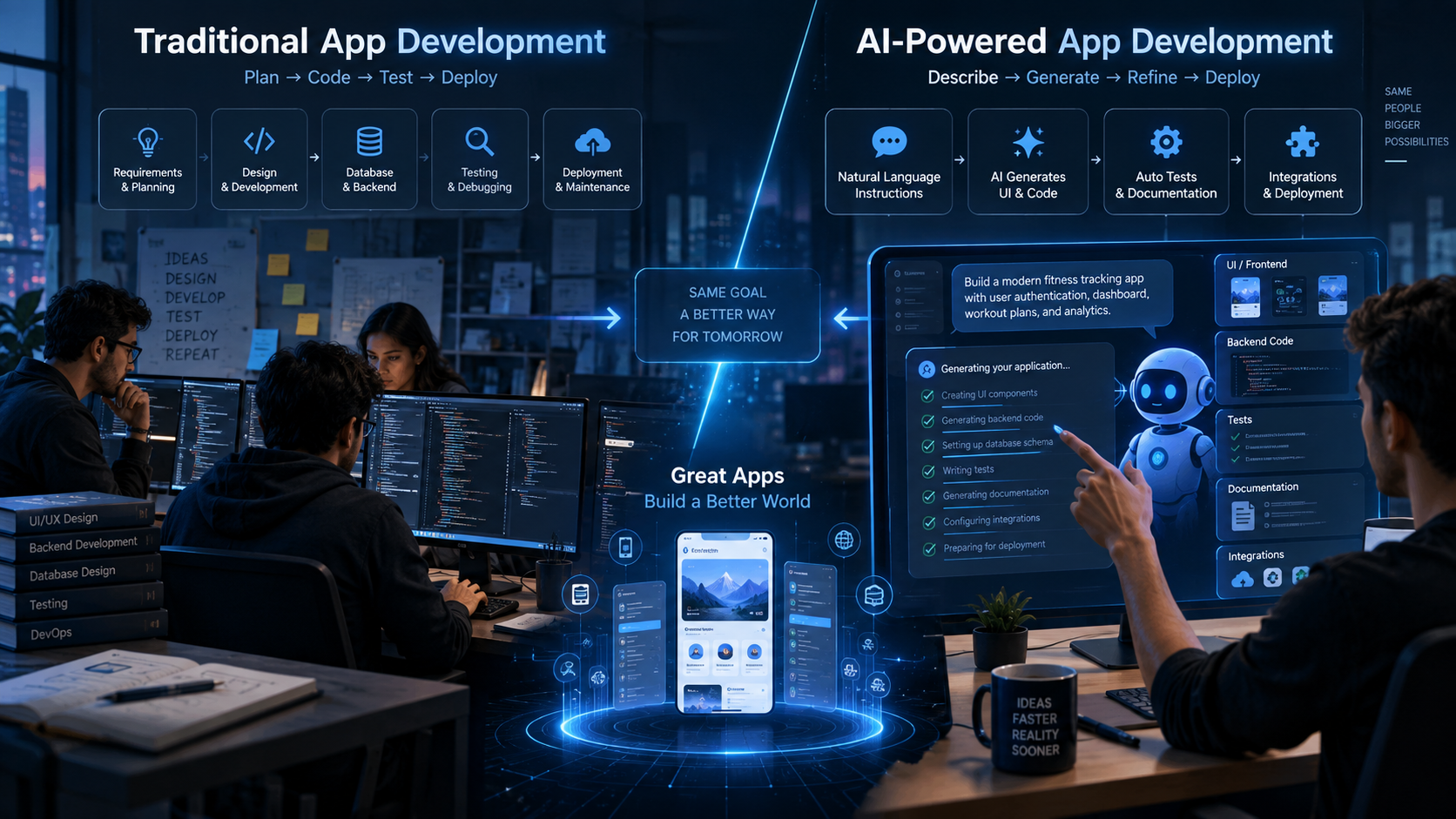
Traditional teams may have separate specialists working sequentially across requirements, design, development, testing, and deployment.
AI-assisted teams can increasingly work in parallel.
A developer can use AI for boilerplate code while focusing on architecture. A designer can generate interface variations. A QA engineer can create test cases with AI. A product manager can turn requirements into technical specifications.
The result is not necessarily fewer people. In many cases, it means more output from the same team.
DORA's research describes AI primarily as an amplifier: it can strengthen effective development systems but can also amplify existing organizational problems.
What Has Actually Changed?
The fundamental difference is not simply AI vs traditional development.
It is manual execution vs AI-assisted execution.
Traditional engineering principles still matter: architecture, databases, APIs, security, testing, version control, deployment, monitoring, and maintainability.
What has changed is how quickly developers can move between these stages.
In 2026, a modern development workflow may look like:
Idea → AI-assisted planning → AI-generated prototype → Human review → Testing → Security validation → Deployment → AI-assisted monitoring and maintenance
The developer remains responsible for the final system.
The Future Is Hybrid
AI will continue changing app development, but the most practical approach is not to abandon traditional engineering.
Instead, companies are combining both.
Use AI for repetitive work, prototyping, documentation, test generation, debugging assistance, and code acceleration. Use human engineers for architecture, product decisions, security, quality control, complex reasoning, and accountability.
The future of app development is therefore unlikely to be completely AI or completely traditional.
It is AI-assisted software engineering, where developers spend less time typing repetitive code and more time solving meaningful problems.
For businesses, this can mean faster experimentation and shorter development cycles. For developers, it means learning how to work effectively with AI while strengthening the engineering fundamentals that AI cannot reliably replace.