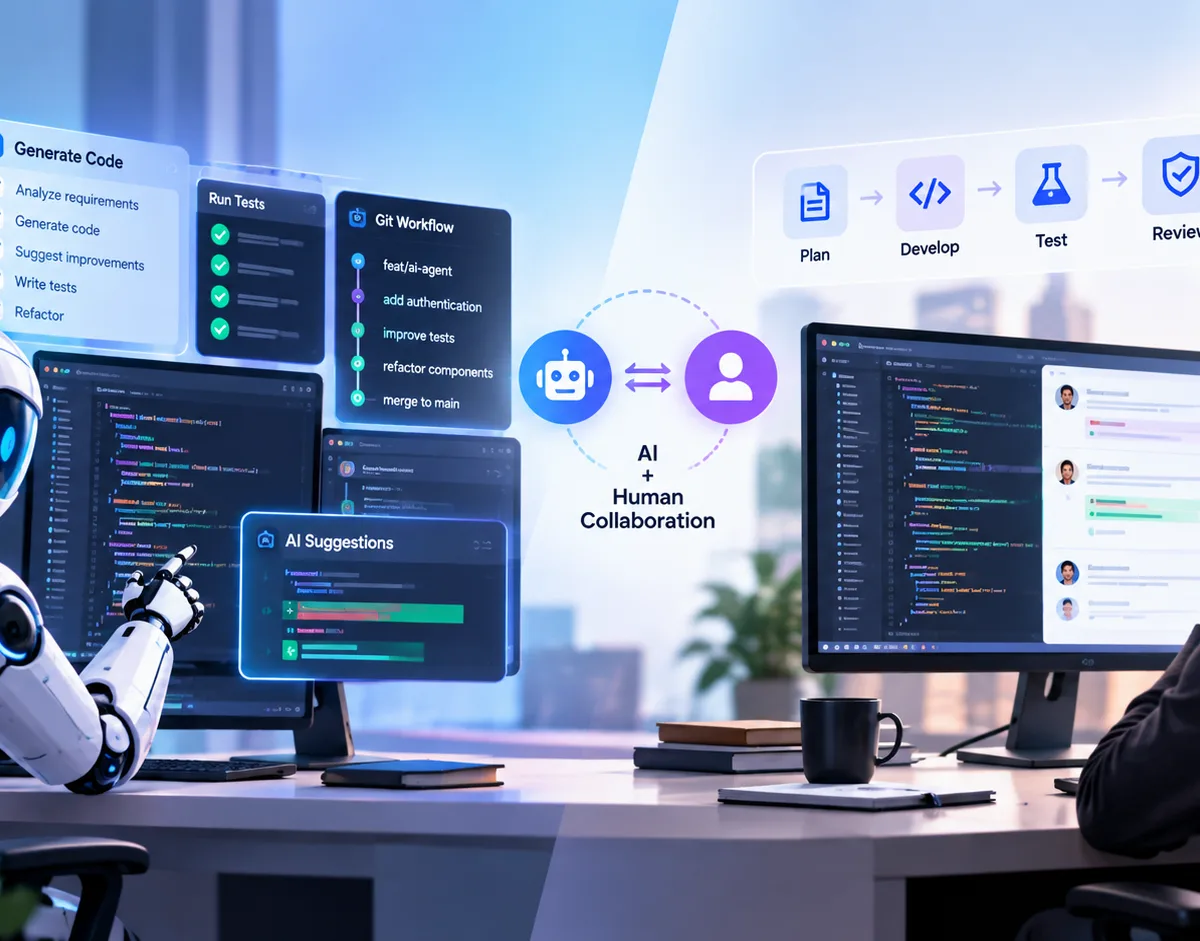
AI coding agents have changed how software is being built.
Instead of only suggesting a line of code, modern coding agents can understand a codebase, implement features, write tests, fix bugs, create pull requests and work across multiple development tasks.
And businesses are starting to notice.
A 2026 JetBrains survey of more than 15,000 professional developers found that 90% were using AI coding agents at work at least weekly, while 68% were using them daily.
But this creates an important question for businesses:
Should you build software with AI coding agents, traditional developers, or a combination of both?
The answer depends less on the technology itself and more on the type of software you're building, the risks involved and how much human oversight is required.
What Are AI Coding Agents?
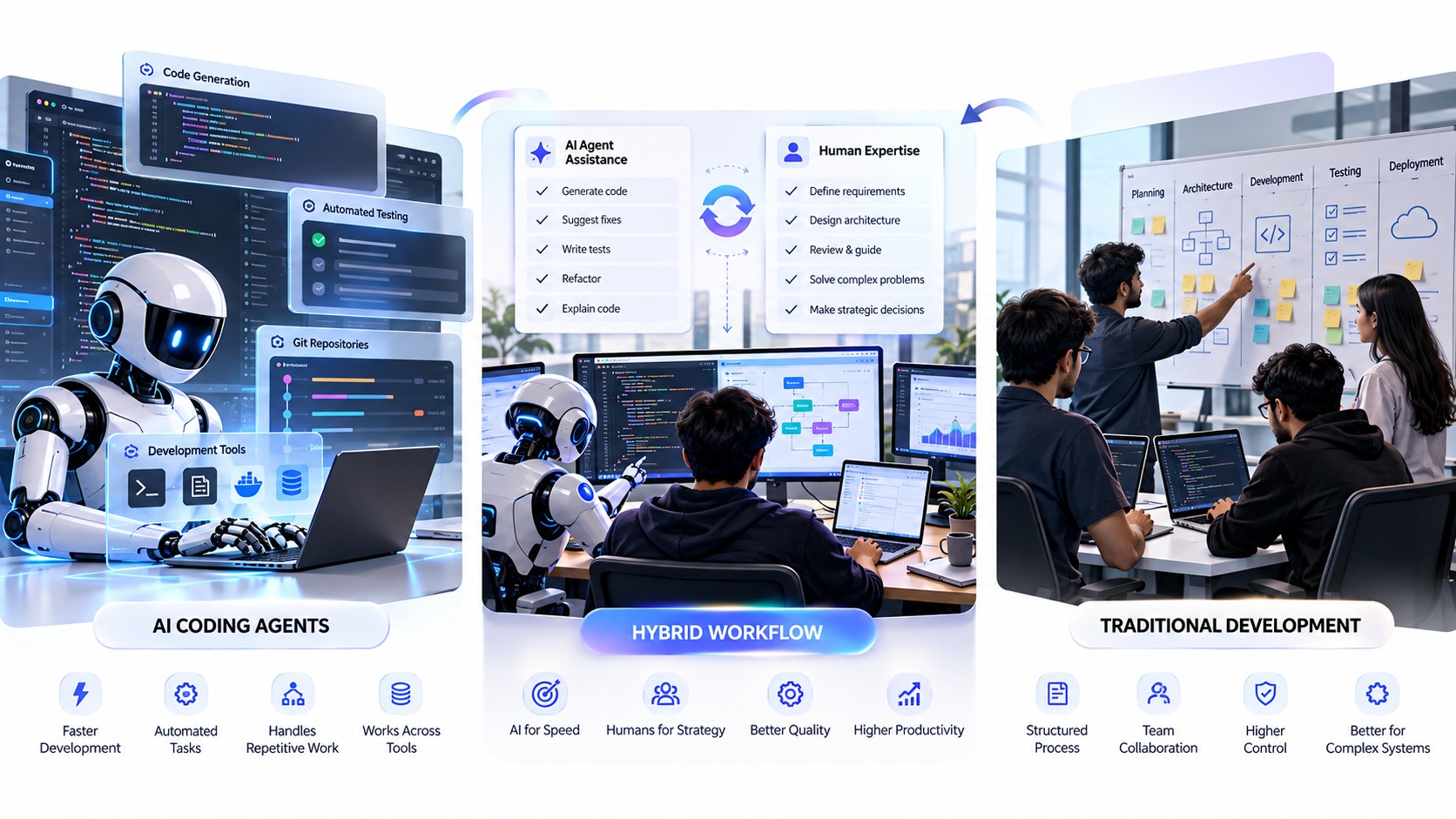
AI coding agents are AI systems designed to perform software development tasks with a higher level of autonomy than traditional code autocomplete tools.
Instead of asking:
"Write this function."
A developer can give an agent a larger task such as:
"Add user authentication, update the database schema, write tests and create a pull request."
The agent can then inspect the project, modify multiple files, run commands, test its changes and return the completed work for review.
This is different from older AI coding assistants that primarily suggested individual lines or functions.
In 2026, the market has moved toward agentic software development, where AI systems can participate across multiple stages of the software development lifecycle. Gartner describes this shift as moving from AI-assisted coding toward agent-driven development.
AI Coding Agents vs Traditional Development
Traditional development generally follows a human-led workflow:
Requirements → Planning → Architecture → Coding → Testing → Review → Deployment
AI-assisted development adds AI into parts of that workflow.
Agentic development goes further:
Task → AI Agent → Code → Tests → Review → Human Approval → Deployment
The important difference is not that developers disappear.
The developer's role increasingly moves toward planning, reviewing, validating, debugging and controlling the work produced by AI agents.
Anthropic's 2026 agentic coding research describes this broader shift as software development moving from writing code toward orchestrating agents that write code.
What Can AI Coding Agents Actually Do?
Modern coding agents can assist with tasks such as:
Generating new features
Understanding existing code
Fixing bugs
Refactoring code
Writing tests
Creating documentation
Updating dependencies
Debugging errors
Creating pull requests
Working with Git
Building prototypes
Connecting APIs
Performing repetitive development tasks
This makes them particularly useful for work that is well-defined, repetitive and easy to validate.
For example:
"Add pagination to this API and write tests for it."
is easier for an AI agent to handle reliably than:
"Design the architecture for our entire banking platform."
The difference is context, complexity and risk.
Does AI Coding Mean Businesses No Longer Need Developers?
Not necessarily.
AI can generate code very quickly, but software development isn't only about writing code.
Someone still needs to decide:
What should be built?
Why should it be built?
How should the system be architected?
What data can the application access?
What security controls are required?
How should failures be handled?
How should the software be tested?
Who approves changes to production?
This becomes especially important when software handles customer data, payments, healthcare information, financial systems or critical business operations.
Current security research around AI coding agents highlights risks including prompt injection, exposed secrets, unsafe dependencies and excessive permissions. Least-privilege access, secrets management, runtime controls and auditability are therefore important when agents are used in production environments.
AI Coding Agent Security Best Practices
When Should Businesses Use AI Coding Agents?
AI coding agents can be particularly useful when the work is clearly defined and has a reliable way to verify the result.
Good examples include:
Prototyping
If you want to test an idea quickly, an AI coding agent can help create an initial working prototype.
Internal Tools
Simple dashboards, admin panels and internal workflows can often be developed faster with AI assistance.
Repetitive Development
Tasks such as boilerplate code, test generation, documentation and routine refactoring are good candidates.
Existing Applications
Agents can help developers understand unfamiliar codebases, investigate bugs and make smaller changes.
MVP Development
For startups trying to validate an idea, AI-assisted development can reduce the time required to reach an initial version.
The key is still human review.
When Is Traditional Development More Important?
Some projects require much more than generating code.
Traditional human-led engineering becomes especially important when the project involves:
Complex architecture
Sensitive customer data
Financial transactions
Healthcare systems
Large-scale infrastructure
Legacy systems
Strict compliance requirements
Complex business rules
High availability requirements
Mission-critical software
For these projects, AI can still be useful.
But it should operate inside a development process with experienced engineers, testing, security controls and clear approval processes.
What About AI Coding Agents for Enterprise Software?
Enterprise development introduces another challenge: governance.
An enterprise may have hundreds of repositories, multiple teams, legacy systems, security policies and regulatory requirements.
An AI agent cannot simply be given unrestricted access to everything.
Businesses may need:
Permission controls
Repository restrictions
Secrets management
Code review
Audit logs
Testing requirements
Agent policies
Human approval
Monitoring
Gartner expects enterprise AI coding agents to increasingly span the software development lifecycle, making governance and validation important parts of how organizations deploy them.
Are AI Coding Agents Actually Faster?
They can be, but faster code generation doesn't automatically mean faster software development.
An agent might generate a feature in minutes.
But the team still needs to:
Understand the changes
Review the code
Run tests
Check security
Verify edge cases
Fix incorrect assumptions
Deploy safely
JetBrains' 2026 research shows that AI coding agents are already widely used by professional developers, but its research also shows that developers have not simply handed over all coding to AI. The amount of fully AI-generated code varies significantly across developers and workflows.
So the real productivity question isn't:
"How much code can AI write?"
It's:
"How much of the complete software development process can AI help us complete reliably?"
What Is the Hybrid Development Model?
For many businesses, the practical approach is not:
AI OR Developers
It's:
AI + Developers
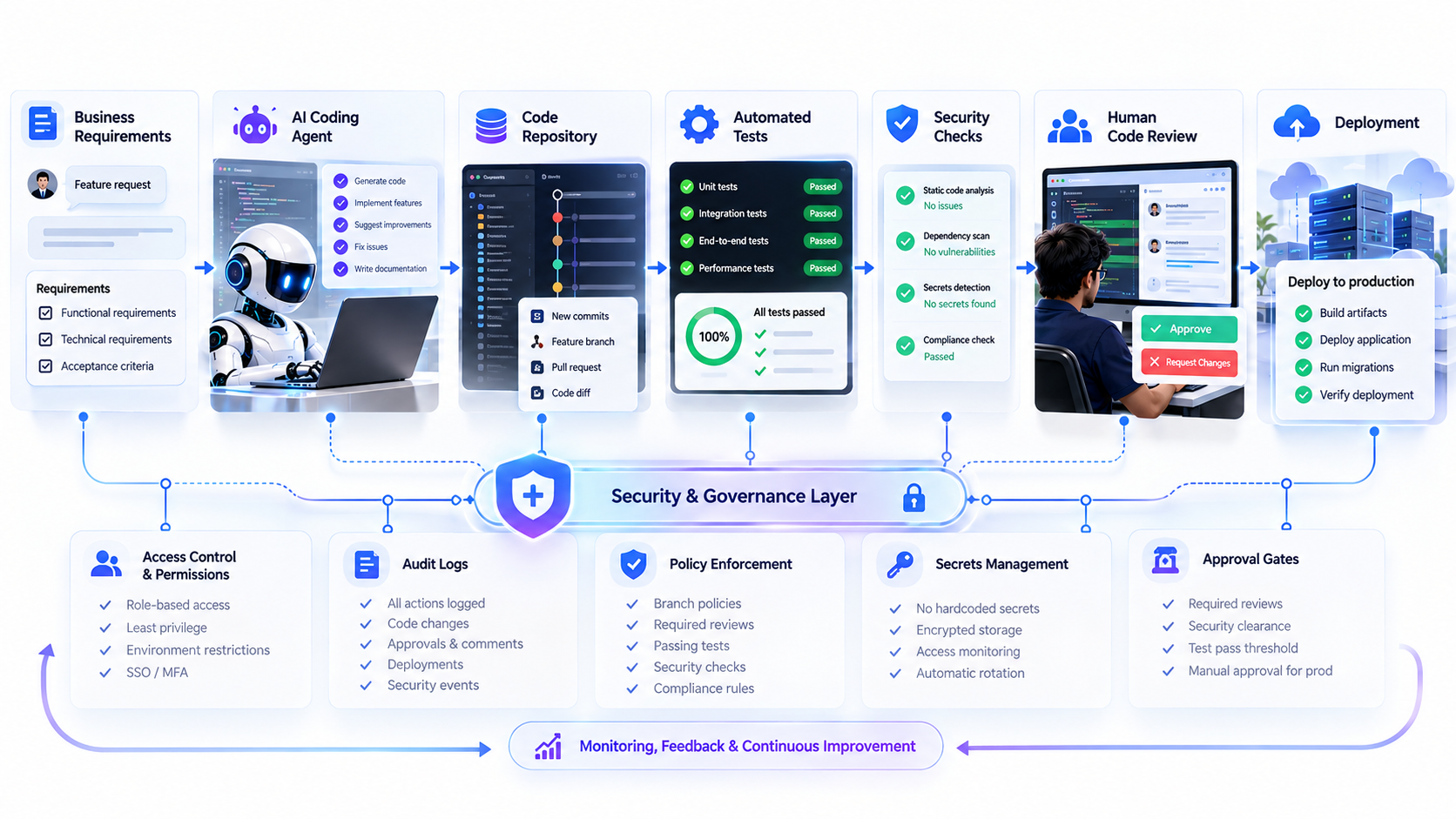
A hybrid workflow might look like:
Business requirement
↓
Human defines the problem
↓
AI agent creates an implementation
↓
Automated tests
↓
Developer reviews the code
↓
Security and quality checks
↓
Human approval
↓
Deployment
This lets businesses use AI where it provides speed while keeping human responsibility around architecture, security and important decisions.
AI Coding Agents vs Traditional Development: What Should Businesses Consider?
Before choosing an approach, ask these questions:
1. How complex is the software?
A simple internal tool is very different from an enterprise platform.
2. How sensitive is the data?
The more sensitive the data, the more important access controls and human oversight become.
3. Can the result be easily tested?
AI works better when the output can be objectively checked.
4. Does the project require complex architecture?
If the answer is yes, experienced engineering involvement becomes more important.
5. Is the project a prototype or production system?
A prototype can tolerate more experimentation.
Production software requires stronger testing, security and reliability.
6. Does the team already have technical expertise?
AI coding agents work much better when someone understands the system they're modifying.
Can AI Coding Agents Reduce Software Development Costs?
They can reduce the time required for certain development tasks, but businesses shouldn't assume that AI automatically makes an entire software project cheap.
The final cost still includes:
Product planning
UI/UX
Architecture
Development
Testing
Security
Cloud infrastructure
Deployment
Maintenance
Monitoring
AI may reduce effort in some areas while creating additional requirements in others, particularly around review, governance and security.
The better question is:
"Where can AI reduce engineering effort without reducing software quality?"
What Does the Future of Software Development Look Like?
The direction in 2026 is increasingly moving toward human developers working with multiple AI agents rather than developers simply using AI for autocomplete.
Gartner predicts that by 2027, more than 65% of engineering teams using agentic coding will treat traditional IDEs as optional, with more control shifting toward automated platforms.
That doesn't mean traditional software engineering disappears.
Instead, the workflow is changing.
Developers may spend less time manually writing repetitive code and more time on:
Architecture
Product decisions
Reviewing AI-generated changes
Testing
Security
System design
AI orchestration
Managing complex software systems
Frequently Asked Questions
Are AI coding agents better than traditional developers?
AI coding agents and developers perform different roles. Agents can automate and accelerate many coding tasks, while developers provide product understanding, architecture, judgment, testing and accountability.
Can AI coding agents build an entire application?
They can build significant portions of an application, especially prototypes and well-defined products. Production applications still require testing, security, architecture and human review.
Will AI coding agents replace software developers?
The role of software developers is changing as AI becomes more capable. Current industry research shows widespread adoption of AI coding agents, but developers are still involved in reviewing, directing and validating the generated work.
Are AI coding agents safe for business software?
They can be used safely with appropriate controls, but giving an agent unrestricted access to production systems, secrets or sensitive data creates additional risks. Permissions, testing, monitoring and human approval are important.
Can startups use AI coding agents to build an MVP?
Yes. AI coding agents can be useful for prototypes and MVPs, particularly when requirements are clearly defined and the generated software is reviewed properly.
Should businesses completely switch to AI coding agents?
There isn't a single approach that fits every project. The appropriate workflow depends on complexity, security, data sensitivity, team expertise, timeline and the consequences of software failure.
Final Takeaway
The question in 2026 isn't really:
AI coding agents or traditional development?
For many businesses, the more useful question is:
Where should AI take over repetitive development work, and where should experienced engineers remain responsible?
AI coding agents can accelerate prototyping, repetitive development, testing and maintenance.
Human engineers remain important for architecture, product decisions, security, complex systems and accountability.
The emerging workflow looks more like:
Human strategy → AI execution → Automated testing → Human review → Secure deployment
Businesses don't necessarily need to choose between AI and developers.
They need to build a development process where AI increases engineering capacity without removing engineering responsibility.
If you're planning to build a new application, SaaS product or AI-powered software in 2026, Burnt Stack can help you choose the right development approach and build the product around your actual business requirements.
JetBrains 2026 AI Coding Agent Adoption Research
Anchor: 2026 developer research on AI coding agents
Source: JetBrains — 15,000+ professional developers.
Google People-First Content Guidance]
Anchor: Google's people-first content guidance
Source: Google Search Central.