Quick question: if you had to ship a mobile app in the next four months, with a team of three developers and a budget that makes your CFO nervous, would you know which framework to bet the company on?
Most founders don't. They Google "Flutter vs React Native," land on a spec-sheet comparison, and close the tab more confused than when they opened it. So let's skip the spec sheet. Here's what actually decides this fight in 2026 — the myths, the real numbers, and a quick way to find your answer.
The Myth That Won't Die
Myth: "React Native is basically a web app wearing a mobile costume — slow, laggy, not 'real' native."
Fact: That reputation is from 2019. React Native's New Architecture — Fabric, TurboModules, and JSI — ripped out the old bridge that caused the lag everyone remembers, and it's been production-stable since 2024. Meta didn't quietly retire React Native; they rebuilt its engine.
Myth: "Flutter apps all look the same — that flat, slightly plasticky 'Flutter look.'"
Fact: That was true when every tutorial copy-pasted Material Design defaults. Flutter draws every pixel itself, which means it can look like anything — the visual sameness was a design choice, not a technical limit. Google Pay, BMW, and Alibaba don't look alike, and all three run on Flutter.
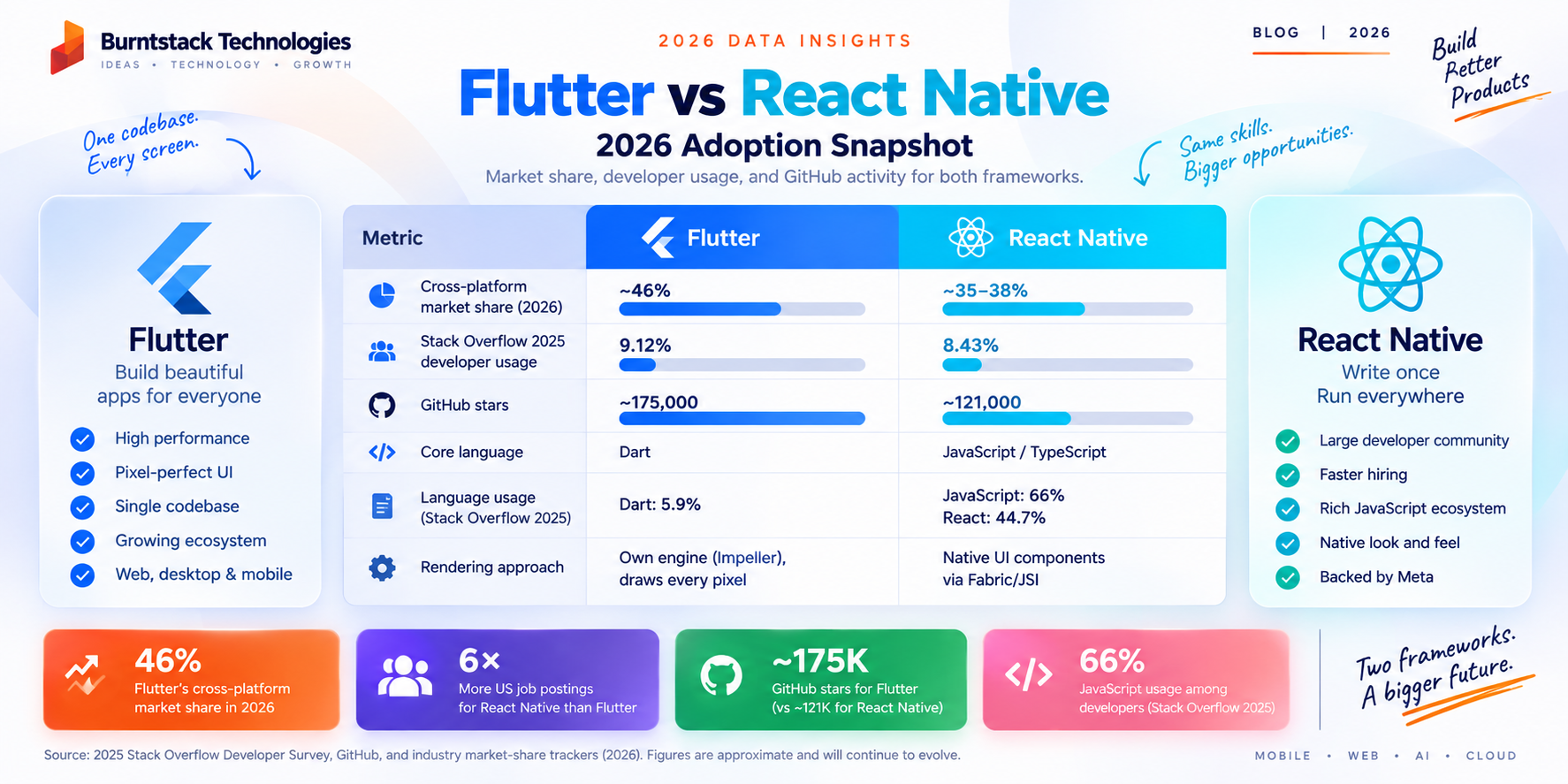
🔍 Did You Know? Flutter now holds roughly 46% of the cross-platform framework market to React Native's 35–38% — yet React Native still pulls in about 6 times more US job postings. Two frameworks, two completely different kinds of winning.
Why That Stat Isn't a Contradiction
Here's the part most comparisons skip: market share and hiring ease are answering two different questions.
Flutter's growth comes from new projects choosing it fresh — no legacy code, no existing team to accommodate. Its own Impeller rendering engine draws every widget from scratch, which is why it holds a real edge in animation-heavy, graphics-intensive apps.
React Native's job-market dominance comes from something Flutter structurally can't match: JavaScript is already the most widely known language on the planet. Any team that's built a React web app is halfway to a React Native mobile app. Flutter asks you to hire for Dart specifically — a smaller, more specialized pool that's growing fast (roughly 2.8 million active developers worldwide, up about 30% year over year) but will never out-number JavaScript's reach.
What this means for you: if you're a solo founder or small team without an existing web stack, the "which is better" question barely matters — what matters is which one you can staff. If you already have React engineers, that's not a preference, that's a shortcut.
A Real-World Scenario
A logistics startup we advised spent six weeks debating Flutter vs React Native in mid-2025. Their team: four engineers, all React web developers, none with mobile experience. They almost chose Flutter because a blog post called it "the performance winner."
They shipped React Native instead — and had a working beta in five weeks, because their existing React knowledge carried over almost directly. The "better" framework, on paper, would have cost them a hiring cycle they didn't have time for.
That's the trade nobody puts in the headline: Flutter often wins on raw capability; React Native often wins on how fast your specific team can actually ship.
Three Mistakes Teams Make Choosing Between Them
Picking based on a benchmark video, not their own team. A framework that renders 120fps in a demo app means nothing if nobody on your team can debug it under deadline pressure.
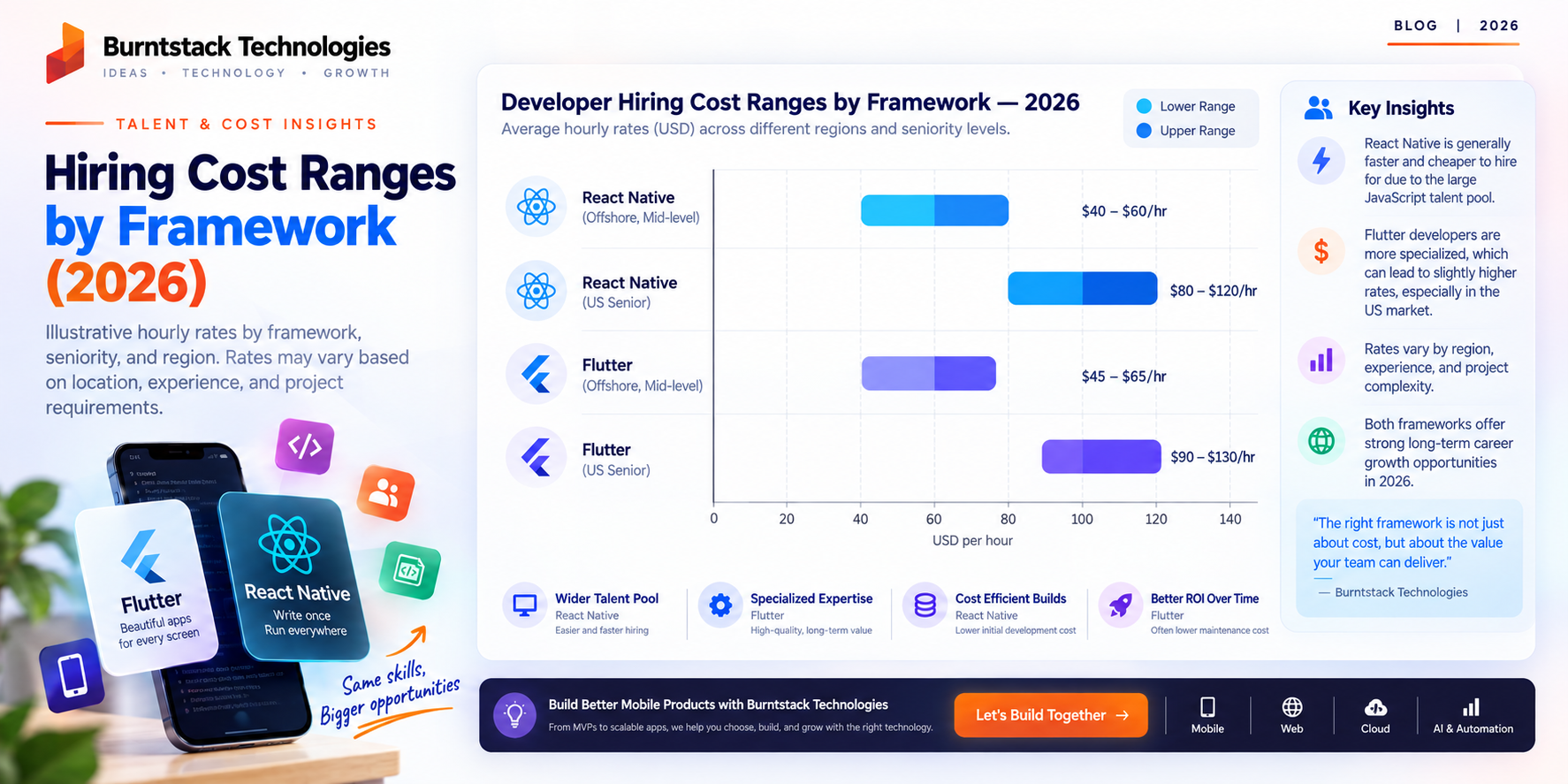
Ignoring the multi-year cost, not just the launch cost. React Native is typically cheaper to start (around $40K for a 6-month MVP vs. roughly $45K for Flutter) — but Flutter tends to cost less to maintain over 3+ years, because it owns its rendering layer and racks up fewer platform-specific bugs.
Assuming it has to be permanent. ByteDance, the company behind TikTok, runs both frameworks in production — Flutter where pixel-perfect UI matters, React Native where speed and JavaScript reuse matter more. It's not a marriage; it's a tool choice per project.
Quick Quiz: Which One Fits You?
Answer Yes or No:
Does your team already know React or JavaScript well?
Does your app depend on smooth, complex animation or a custom visual identity?
Do you need to launch on web, desktop, or embedded devices from the same codebase?
Is hiring speed a bigger constraint right now than long-term maintenance cost?
Your Result:
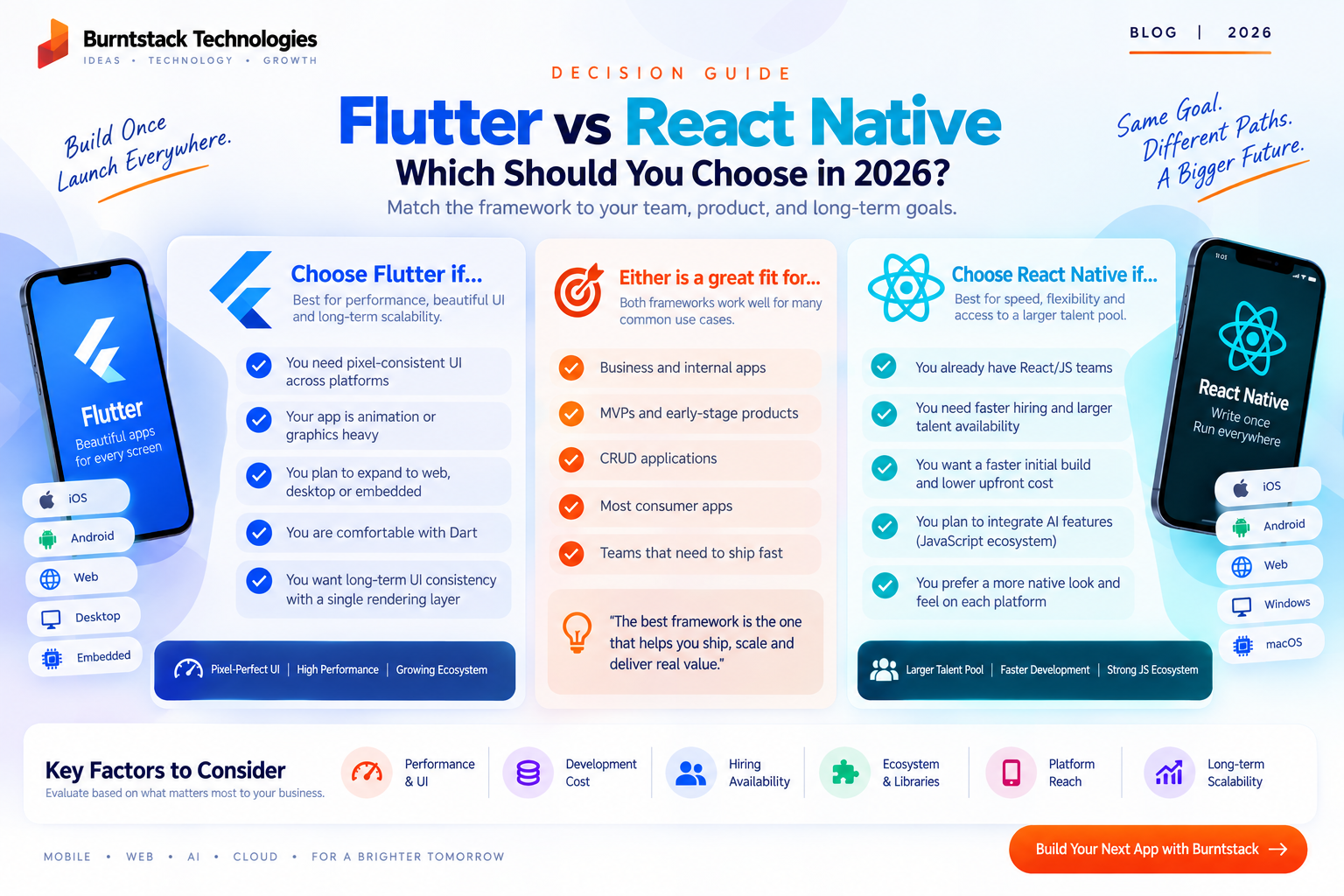
Mostly Yes on 1 and 4: Choose React Native. Your team and timeline favor it.
Mostly Yes on 2 and 3: Choose Flutter. Its rendering engine and multi-platform reach are built for exactly this.
Mixed answers: Prototype small pieces in both for two weeks before committing — the "right" answer is usually obvious once your own team has typed real code in each.
FAQ
Is Flutter or React Native better in 2026? Neither, categorically — Flutter has more cross-platform market share and a performance edge for graphics-heavy apps; React Native has a far larger hiring pool and shares code with existing React web teams. The right one depends on what you're optimizing for.
Which is cheaper to build with? React Native is usually cheaper to launch. Flutter is often cheaper to maintain past year one. Which matters more depends on how long you expect to run the product.
Can a non-technical founder make this decision alone? Not well. The right call depends on your existing team's skills more than any feature comparison — loop in whoever will actually build it before you decide.
Whichever framework you land on, the decision matters less than most comparison posts make it sound — both are genuinely production-grade in 2026. What matters is being honest about which one your team, timeline, and budget can actually execute.