AI agents are becoming one of the most practical applications of artificial intelligence in 2026. Unlike traditional chatbots that mainly answer questions, AI agents can understand goals, make decisions, use tools, access business data, and complete tasks with limited human involvement.
Businesses are using AI agents for customer support, sales, lead qualification, appointment booking, data analysis, document processing, software development, and workflow automation.
But one important question comes before development: How much does it cost to build an AI agent in 2026?
The answer depends heavily on the agent's complexity, integrations, AI model, data requirements, security, and level of autonomy. Current Indian development estimates range from a few lakh rupees for focused agents to ₹40 lakh or more for complex enterprise systems.
AI Agent Development Cost in 2026
A practical estimate for custom AI agent development in India is:
Basic Knowledge Agent: ₹2 lakh – ₹5 lakh
RAG-Based AI Agent: ₹3 lakh – ₹8 lakh
Single-Task AI Agent: ₹4 lakh – ₹10 lakh
Workflow AI Agent: ₹7 lakh – ₹15 lakh
Multi-System AI Agent: ₹10 lakh – ₹25 lakh
Multi-Agent AI System: ₹15 lakh – ₹40 lakh+
Enterprise AI Agent Platform: ₹30 lakh – ₹50 lakh+
These are indicative market ranges rather than fixed prices. Actual development costs depend on the project's technical scope and business requirements.
1. Basic AI Knowledge Agent — ₹2 Lakh to ₹5 Lakh
A basic AI agent is designed to answer questions using a company's existing information.
For example, a business could create an AI agent that answers questions about its products, services, pricing, policies, or documentation.
Typical features include:
AI chatbot interface
Knowledge-base integration
Document search
Basic RAG implementation
Conversation history
Website integration
This type of agent is suitable for businesses that want to automate repetitive questions without giving the AI permission to perform complex actions.
2. RAG-Based AI Agent — ₹3 Lakh to ₹8 Lakh
A Retrieval-Augmented Generation (RAG) agent can search a company's documents or database before generating an answer.
For example, an employee could ask:
"What is our company's leave policy for employees with more than three years of service?"
Instead of relying only on the model's general knowledge, the system retrieves the relevant company information and generates an answer based on it.
Development costs increase because the project may require:
Document processing
Embeddings
Vector databases
Retrieval pipelines
Data cleaning
Access control
Evaluation and testing
3. Single-Task AI Agent — ₹4 Lakh to ₹10 Lakh
A single-task agent goes beyond answering questions and performs a specific business operation.
For example, a sales agent could:
Receive a customer enquiry
Understand the customer's requirements
Check available products
Update the CRM
Generate a response
Notify the sales team
The agent may need API integrations, authentication, error handling, logging, and human approval.
4. Workflow AI Agent — ₹7 Lakh to ₹15 Lakh
Workflow agents handle multiple connected steps.
Imagine an e-commerce workflow where an AI agent receives a return request, checks the order, verifies eligibility, creates a return request, updates the database, and sends confirmation to the customer.
At this stage, development becomes less about simply connecting an LLM and more about designing a reliable software system.
Factors such as workflow orchestration, permissions, retries, monitoring, and testing significantly affect the price.
5. Multi-System AI Agent — ₹10 Lakh to ₹25 Lakh
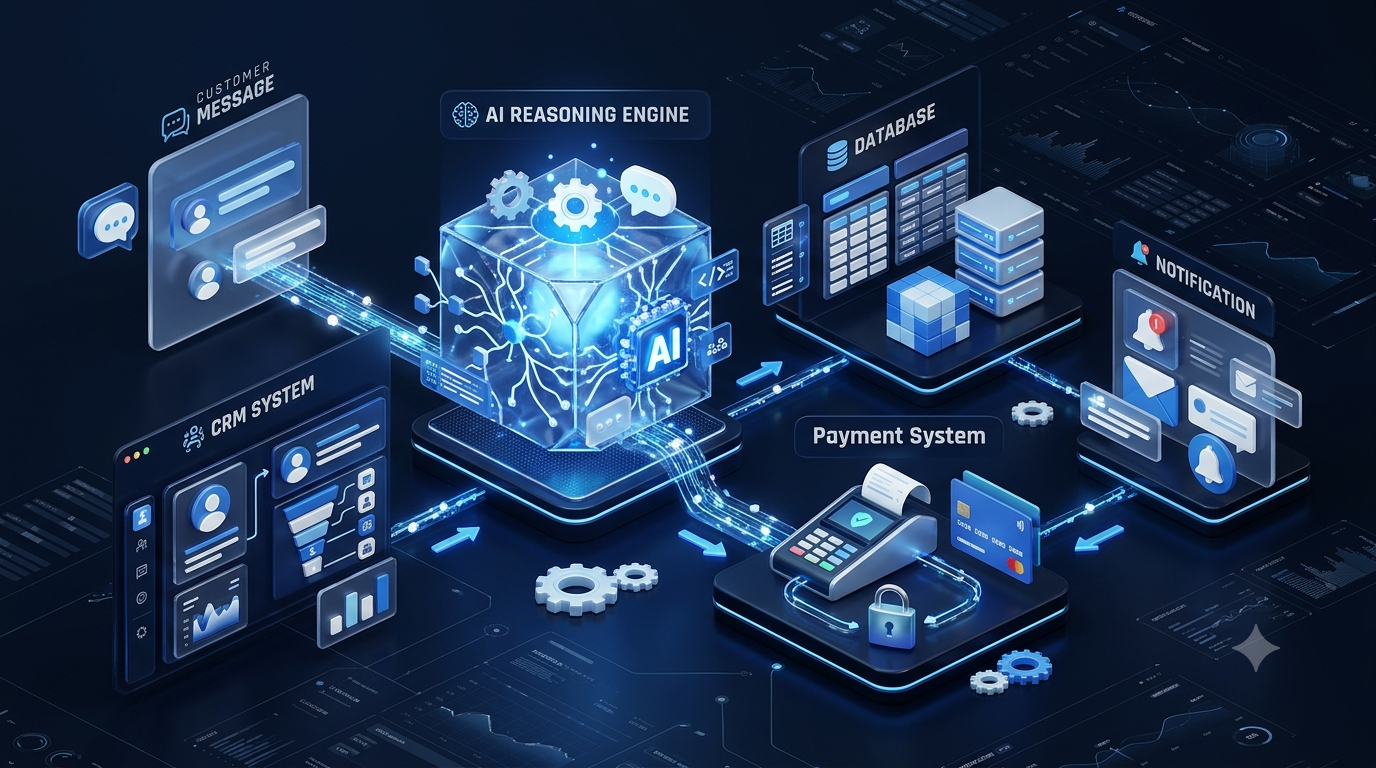
A multi-system AI agent connects with several business applications.
For example, a company's AI agent could interact with:
CRM
ERP
Database
WhatsApp
Email
Payment gateway
Inventory system
Internal APIs
Every additional integration introduces development and testing requirements. Recent Indian pricing guides identify integration complexity as one of the major factors affecting AI-agent development costs.
An agent connected to five different systems is considerably more complex than an agent operating on a single website.
6. Multi-Agent AI System — ₹15 Lakh to ₹40 Lakh+
A multi-agent system uses multiple specialized AI agents working together.
For example:
Customer Agent → Research Agent → Data Agent → Decision Agent → Supervisor Agent
Each agent can have a specific responsibility while a central orchestration layer manages the overall workflow.
These systems are useful for complex business operations, but they require more sophisticated architecture, testing, observability, security, and failure handling.
Enterprise systems can go beyond ₹40 lakh depending on scale and requirements.
What Factors Affect AI Agent Development Cost?
The development cost is not determined by the AI model alone.
AI Model
The choice between different commercial and open-source models affects performance and ongoing inference costs.
Number of Integrations
Connecting one application is relatively straightforward. Connecting multiple APIs, databases, CRMs, payment systems, and communication platforms requires additional engineering.
Data and RAG
If the agent needs to work with thousands of documents or private company information, data preparation, indexing, retrieval, and evaluation increase development effort.
Level of Autonomy
An agent that only recommends an action is simpler than one that can automatically execute transactions or modify business records.
Security
Agents handling customer or company data may require authentication, authorization, audit logs, encryption, monitoring, and compliance controls.
User Interface
A simple chat interface costs less than a complete application with dashboards, analytics, workflow controls, user management, and administration features.
What Are the Monthly Running Costs?
Building the AI agent is only the initial expense.
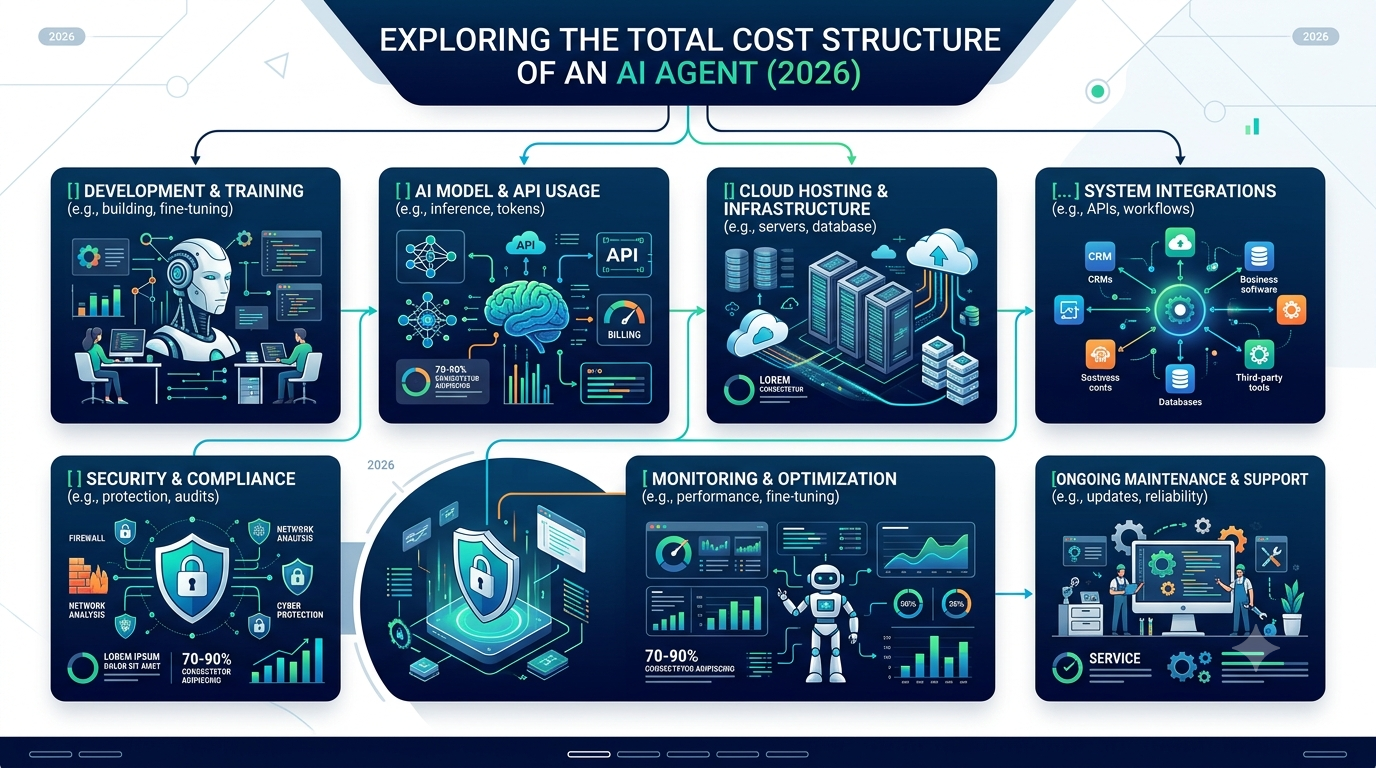
After launch, businesses may pay for:
LLM/API usage
Cloud hosting
Vector database
Database storage
Monitoring
Security
Maintenance
Third-party APIs
WhatsApp or communication services
Some 2026 Indian estimates place ongoing costs anywhere from several thousand rupees per month for smaller agents to ₹1 lakh+ for high-volume systems.
The actual amount depends on how many users interact with the agent, how many tokens it processes, which models are used, and how much infrastructure is required.
How Long Does It Take to Build an AI Agent?
Development timelines vary according to complexity.
A simple AI knowledge agent may take around 3–6 weeks, while workflow and multi-system agents can require several months. Complex enterprise multi-agent platforms can take 4–8 months or longer.
A typical development process includes:
Discovery → Architecture → AI/RAG Development → Integration → Testing → Security → Deployment → Monitoring
Skipping testing and evaluation can create expensive problems after launch, especially when the agent is allowed to take real-world actions.
How Much Should Your Business Budget?
For a small business testing AI automation, a focused agent in the ₹2 lakh–₹5 lakh range may be a reasonable starting scope.
For businesses requiring CRM, ERP, WhatsApp, databases, and multiple automated workflows, budgets can move into the ₹7 lakh–₹25 lakh range.
Large organizations requiring multiple coordinated agents, enterprise security, complex integrations, approval workflows, and dedicated infrastructure may need ₹25 lakh–₹50 lakh+.
The best approach is usually to start with one valuable workflow rather than trying to automate the entire business at once.
Final Thoughts
The cost to build an AI agent in 2026 can range from a few lakh rupees to tens of lakhs depending on what the agent needs to understand, access, and execute.
A simple knowledge agent may require only an LLM, RAG pipeline, and user interface. A production enterprise agent can require APIs, databases, security, monitoring, multiple AI models, workflow orchestration, and human approval systems.
The most important question is therefore not simply "How much does an AI agent cost?"
Instead, ask:
"What business process should the AI agent automate, and how much complexity is required to automate it reliably?"
Once the workflow is clearly defined, the technology, development timeline, and budget become much easier to estimate.