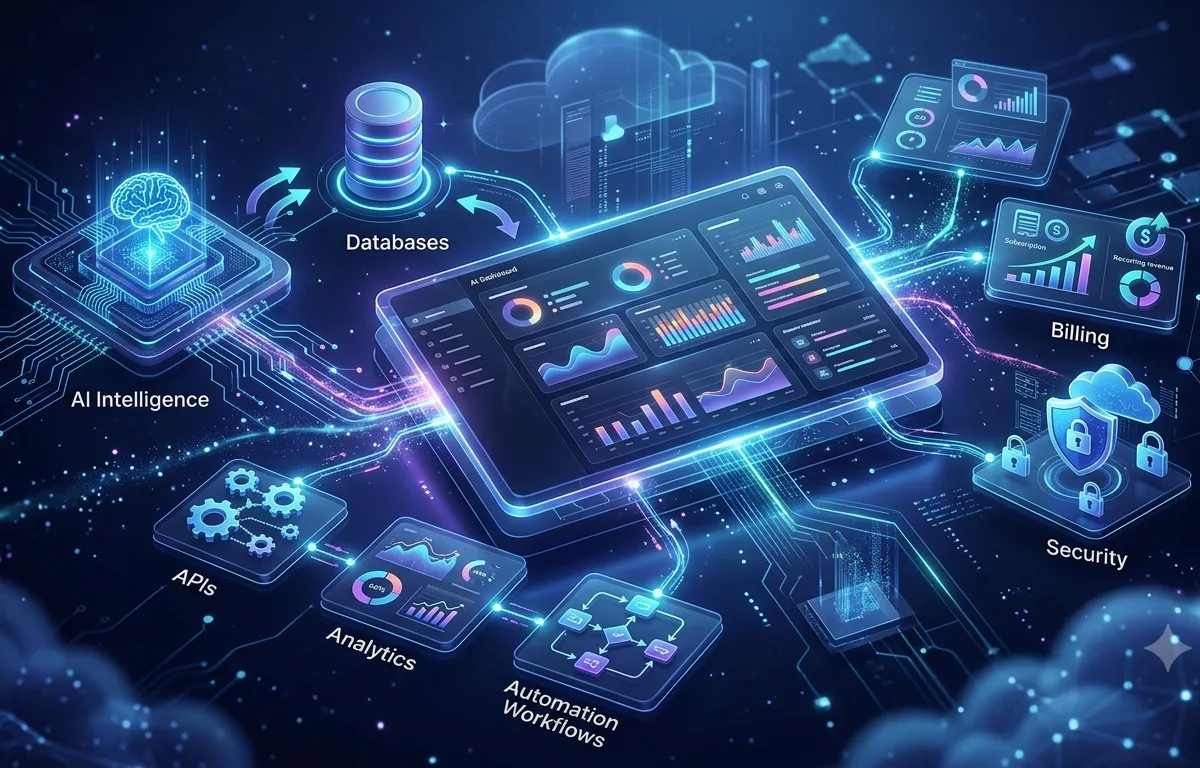
Building an AI-powered SaaS product in 2026 can cost anywhere from $10,000 for a focused MVP to $500,000+ for an enterprise-grade platform. The final budget for founders depends on product complexity, AI architecture, integrations, security, data requirements, development team, and expected scale. Recent 2026 estimates place many AI SaaS MVPs in the $10,000–$80,000 range. Treat these as planning ranges.
For founders, the key question is what to build first and what investment the business model can justify.
AI SaaS Development Cost in 2026
A practical budget framework looks like this:
• Basic AI SaaS MVP: $10,000–$40,000
• RAG-powered SaaS: $15,000–$60,000
• AI agent SaaS: $20,000–$80,000+
• Production-ready SaaS V1: $50,000–$150,000+
• Enterprise AI SaaS platform: $150,000–$500,000+
Published 2026 estimates vary because “AI SaaS” can mean anything from an API-powered writing tool to a multi-tenant enterprise automation platform.
What Does an AI SaaS MVP Include?
A lean MVP normally includes a responsive web application, authentication, subscription or payment functionality, admin controls, database, core AI workflow, API integrations, analytics, and basic security.
For example, an AI document assistant might allow users to upload files, ask questions, receive AI-generated answers, and manage subscriptions. You do not necessarily need custom model training, complex agents, or expensive GPU infrastructure at launch.

Main Factors That Affect AI SaaS Development Cost
1. Product Complexity
A single AI feature is simpler than an application containing AI agents, workflow automation, real-time collaboration, advanced analytics, multiple roles, and many integrations.
2. AI Architecture
Calling an existing LLM API is generally simpler than building retrieval-augmented generation, multi-agent workflows, fine-tuned models, or custom machine-learning pipelines.
3. Data and RAG
If your product needs private documents or proprietary knowledge, you may need document processing, chunking, embeddings, vector search, retrieval logic, evaluation, and access controls. Data preparation can become a major expense.
4. Integrations
Connecting Stripe, CRM systems, Slack, Google Workspace, Microsoft services, WhatsApp, ERP platforms, or internal APIs adds development and testing effort.
5. Security and Compliance
B2B and enterprise products often require stronger authentication, role-based permissions, audit logs, encryption, backups, monitoring, and compliance controls. Regulated applications can require additional work.
6. Development Team
Your cost changes based on whether you hire freelancers, an in-house team, an offshore development company, or a specialized AI SaaS development agency.
AI SaaS Cost Breakdown
For a typical MVP, budget across several areas:
Discovery and architecture: $2,000–$10,000
UI/UX design: $2,000–$10,000
Frontend and backend development: $8,000–$35,000
AI/LLM integration: $5,000–$25,000
RAG or data pipeline: $5,000–$30,000
Payments and subscriptions: $1,000–$5,000
Testing and security: $2,000–$10,000
Cloud deployment and DevOps: $1,500–$10,000
Current 2026 guides similarly show wide differences between API-based MVPs and advanced AI platforms.

Ongoing AI SaaS Costs After Launch
Your monthly operating budget may include LLM usage, cloud hosting, database storage, vector database costs, monitoring, email, payment processing, analytics, support, security tools, and ongoing engineering.
AI inference is especially important because usage creates variable costs. A product with thousands of users making frequent model requests can have very different unit economics from one where users make only a few requests each month.
Before launch, calculate cost per active customer and compare it with your subscription price.
How to Reduce AI SaaS Development Cost
Start with one valuable workflow instead of building an enormous platform. Use established AI APIs when they satisfy your requirements. Avoid custom model training unless your business genuinely needs it. Design the architecture so models can be replaced later. Track token usage from day one. Build reusable components for authentication, billing, logging, and permissions.
Validate demand before investing heavily in advanced features. Paying customers provide evidence for the next development budget.
Build vs. Buy: What Should Founders Choose?
For most early-stage products, a hybrid approach is practical: build your unique business logic yourself or with a development partner, while using mature third-party services for payments, authentication, cloud infrastructure, email, analytics, and foundation models.
Custom infrastructure makes sense when it creates a measurable advantage in cost, performance, privacy, latency, or proprietary data.
AI SaaS Development Timeline
A focused MVP can take roughly 6–12 weeks. A sophisticated RAG or agentic platform may require 3–6 months, while enterprise systems can take 6–12 months or longer. The timeline depends on scope, team size, technical complexity, integrations, testing, and compliance requirements.

Final Budget for an AI-Powered SaaS Product
If you are a founder planning an AI SaaS product in 2026, a realistic starting point is often $10,000–$40,000 for a focused MVP. Products requiring RAG, complex automation, multiple integrations, or advanced AI agents can move into the $40,000–$150,000+ range. Enterprise platforms with custom infrastructure, extensive security, and advanced AI capabilities can exceed $150,000 and reach $500,000 or more. These figures reflect ranges reported by multiple 2026 development guides rather than universal market prices.
The right budget matches your product scope, customer needs, technical risk, and unit economics. Before requesting a development quote, prepare your core workflow, target users, AI requirements, integrations, security expectations, and launch goals. A detailed specification can turn a vague AI SaaS estimate into an actionable project budget.