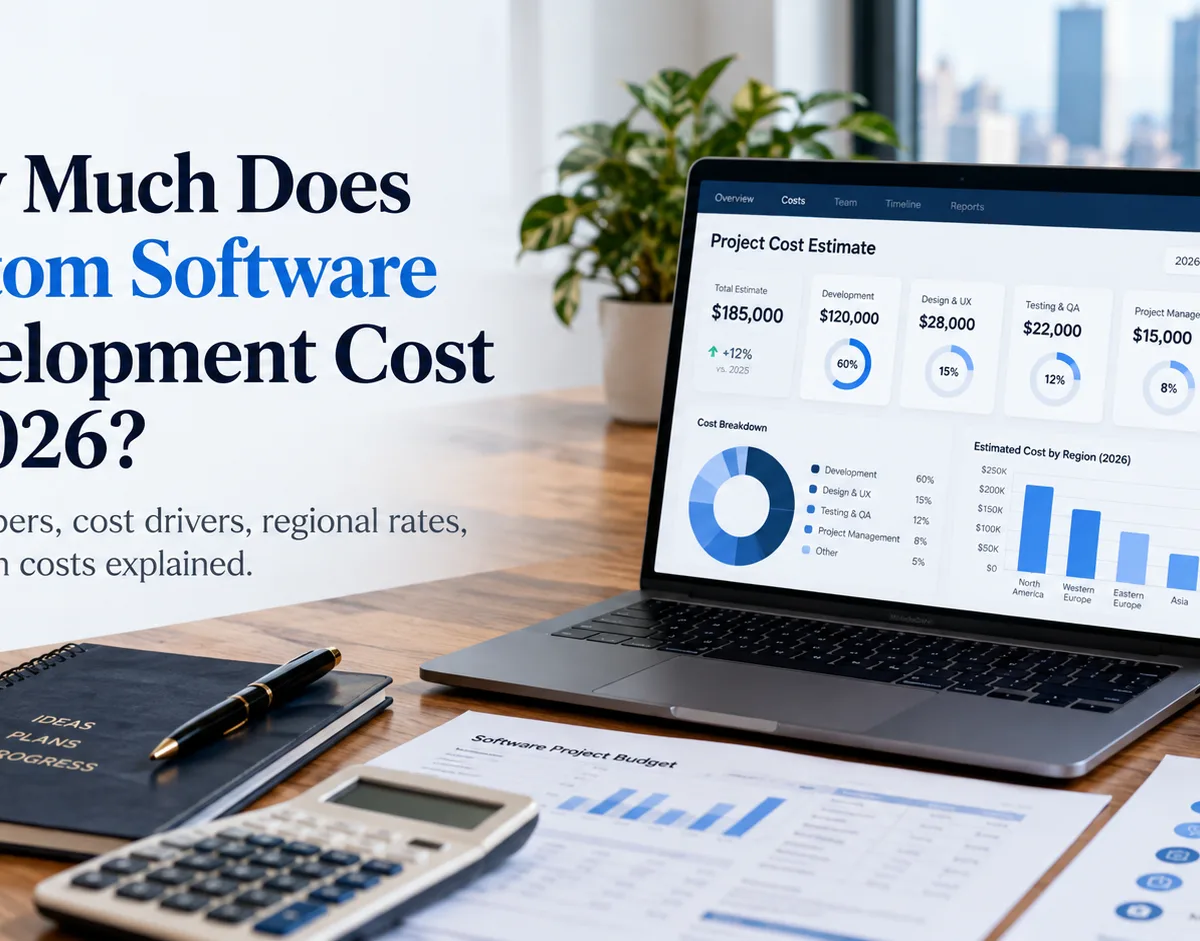
Ask five vendors what custom software costs and you'll get five answers that don't agree with each other, sometimes by a factor of five. "$10,000 to $1,000,000, depending on complexity" is technically true and completely useless for budgeting. The real answer has structure to it: cost depends on a small number of variables you can actually reason about before you request a single quote, project scope, team location, seniority mix, number of integrations, and how well the requirements were defined before anyone wrote code.
This guide breaks those variables down with real 2026 numbers, so you can tell whether a quote you've received is reasonable, high, or missing something important.
The Real 2026 Cost Ranges, by Project Tier
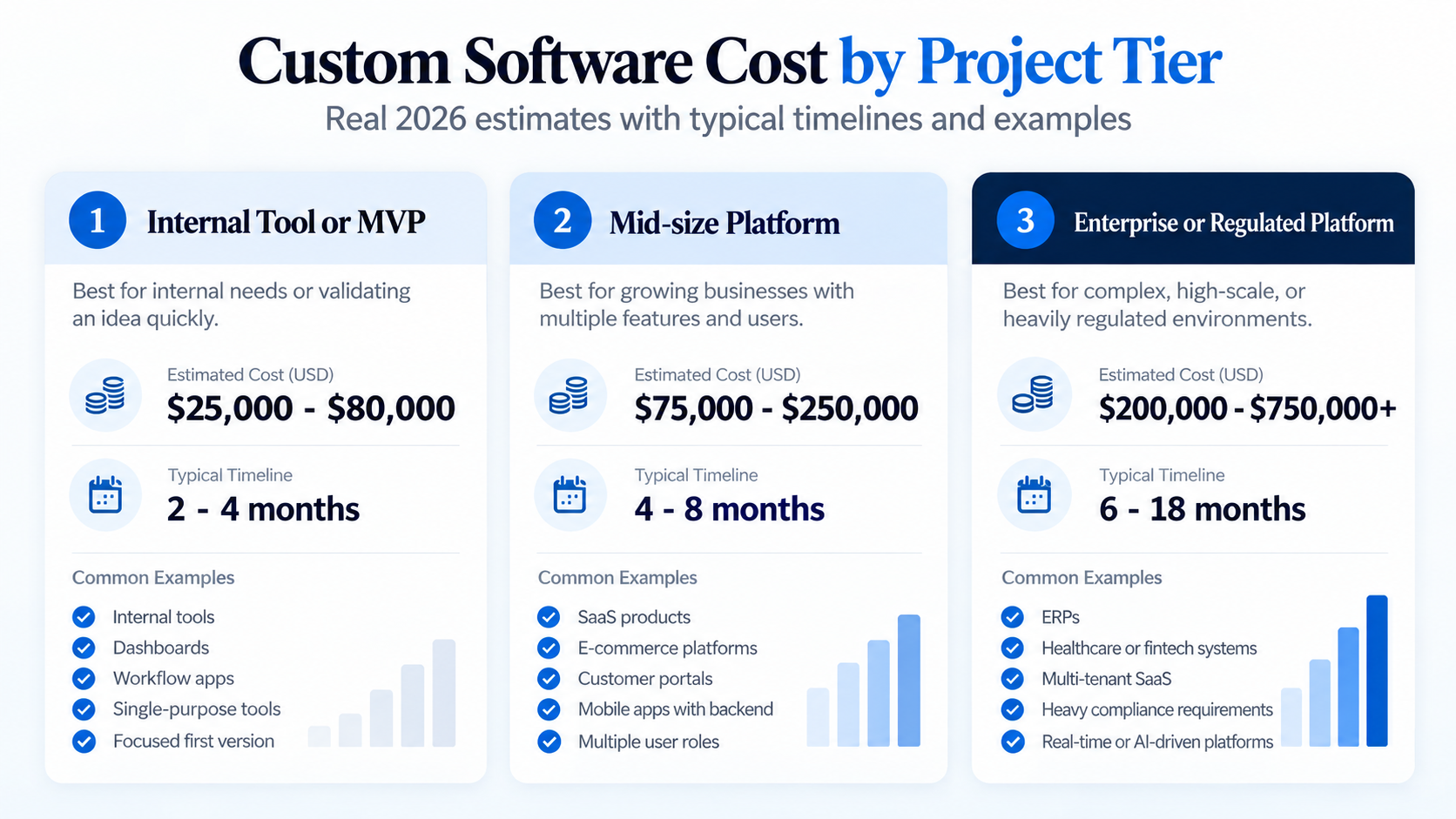
Internal tool or MVP ($25,000 to $80,000, 2 to 4 months): lightweight CRMs, internal dashboards, workflow apps, single-purpose tools, a focused first version of a product
Mid-size customer-facing platform ($75,000 to $250,000, 4 to 8 months): SaaS products, e-commerce platforms, customer portals, mobile apps with a real backend
Enterprise or regulated platform ($200,000 to $750,000 or more, 6 to 18 months): ERPs, healthcare or fintech systems, multi-tenant SaaS, anything with heavy compliance or real-time/AI requirements
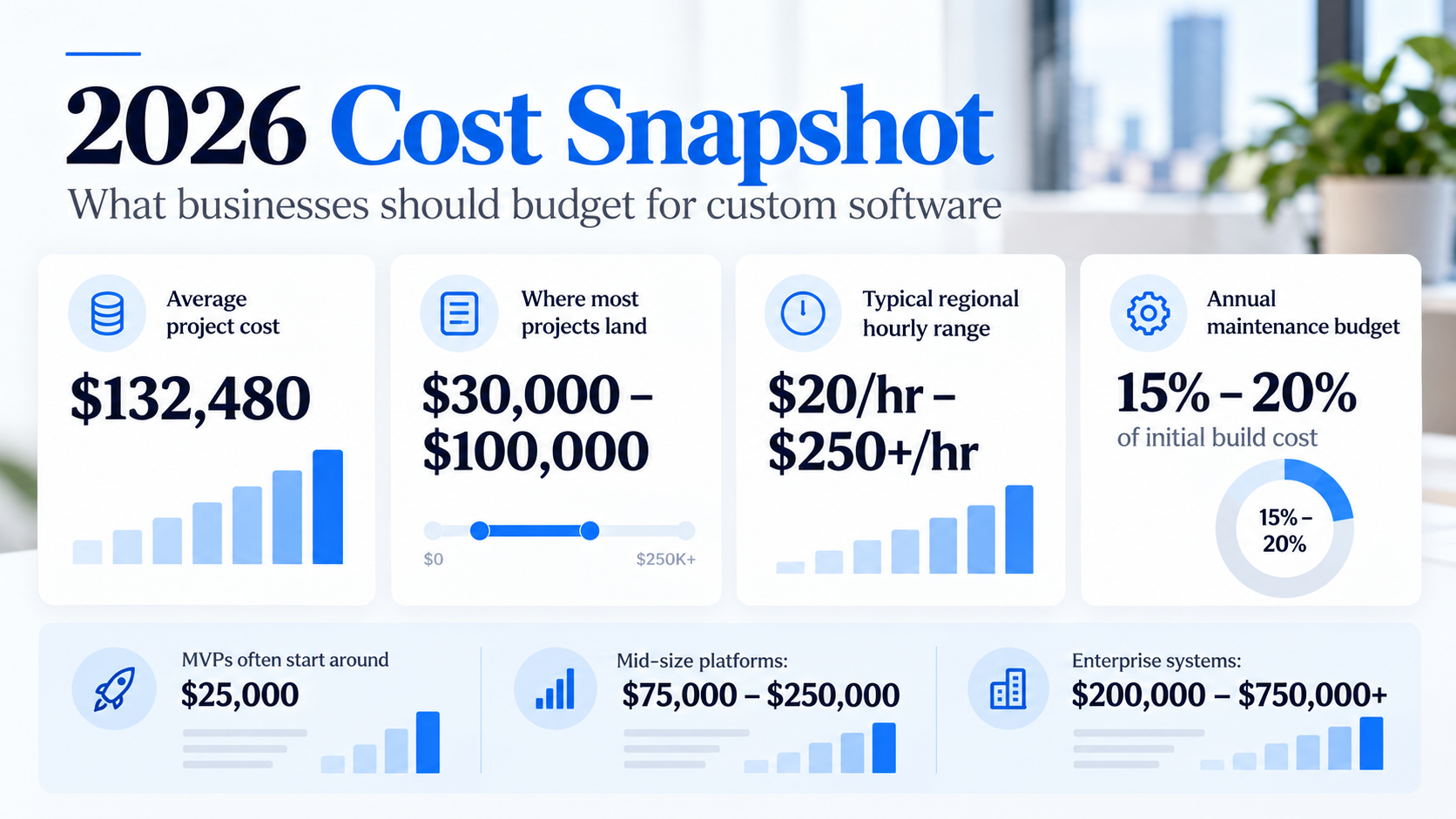
For context on where most businesses actually land: a GoodFirms industry survey found close to two-thirds of custom software projects fall between $30,000 and $100,000, and Clutch's pricing data puts the average custom software project at $132,480 with a typical delivery timeline of around 13 months.
What Drives the Hourly Rate: Cost by Region
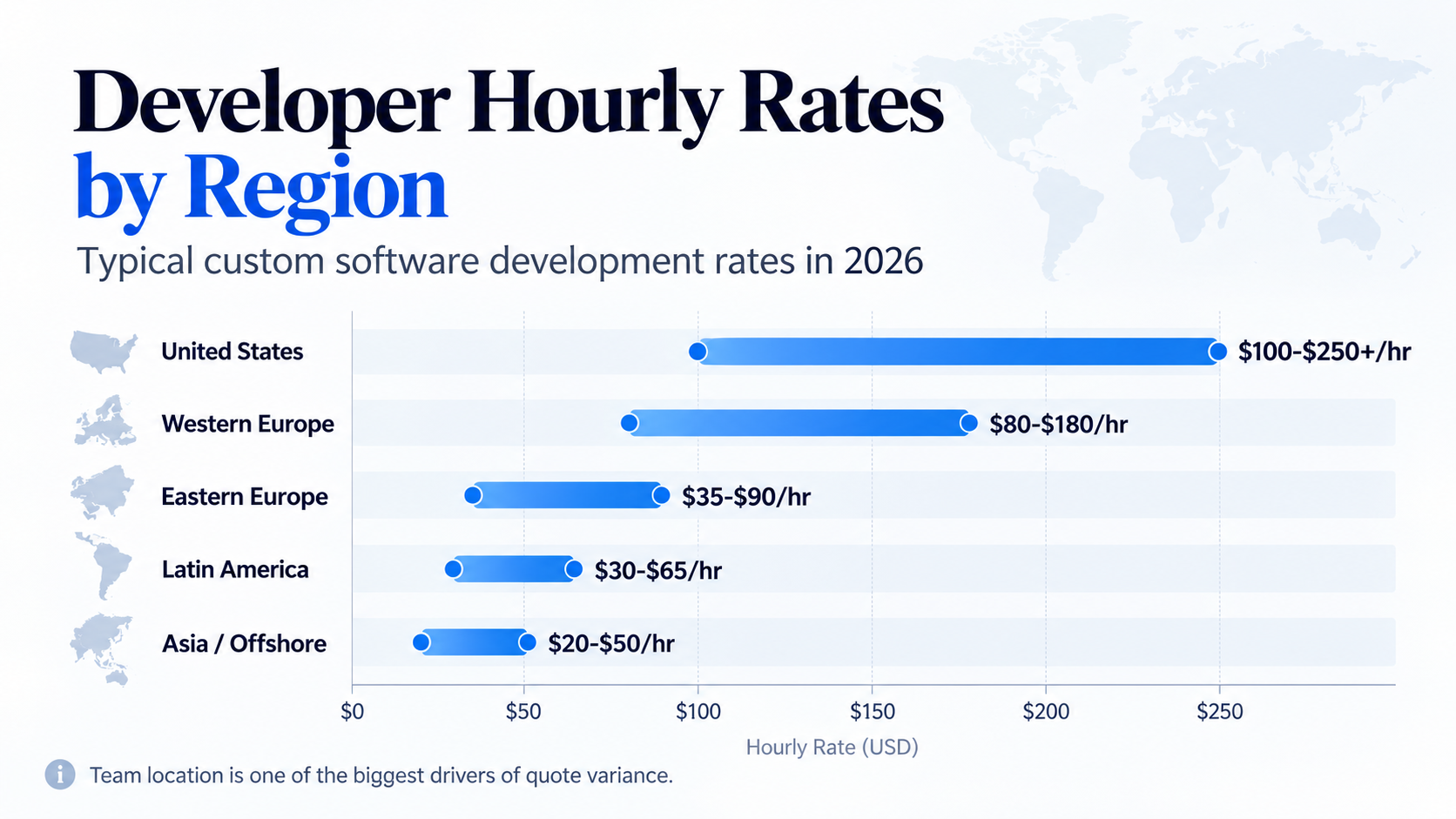
The single biggest lever on your final number is where your development team is located:
United States: $100 to $250+ per hour, with senior engineers at the top of that range
Western Europe: $80 to $180 per hour, premium pricing in mature markets like DACH and Switzerland
Eastern Europe: $35 to $90 per hour, strong technical talent with EU-standard compliance at a meaningful discount to Western Europe
Latin America: $30 to $65 per hour, with the advantage of overlapping US time zones
Asia / offshore (India, Southeast Asia): $20 to $50 per hour, the lowest headline cost, with more variability in delivery speed
That regional spread explains most of the variance you'll see across vendor quotes for what's nominally the same project.
The Offshore Trap: Why the Cheapest Rate Isn't Always the Cheapest Project
Here's the number that tends to surprise people budgeting purely on hourly rate: one nearshore benchmarking study found a single feature-change request took roughly 48.5 elapsed hours to complete with an offshore India-based team, compared to about 8 elapsed hours with a nearshore Latin America team working closer to US business hours. The offshore option was only marginally cheaper in direct spend, but took dramatically longer to actually ship, almost entirely due to the time zone gap and the coordination overhead it creates.
The cost that matters isn't the hourly rate on the invoice. It's the hourly rate multiplied by how many hours it actually takes to ship, including the hours lost to time zone handoffs, rework, and miscommunication.
A developer billing a low hourly rate who needs far more hours and multiple rounds of rework to hit the same scope can easily end up costing more, and taking longer, than a higher-rate team that gets it right the first time.
The Hidden Costs Nobody Puts in the Initial Quote
The number on the proposal is rarely the full cost of ownership. The most commonly missed categories:
Maintenance and updates: budget 15% to 20% of your initial development cost annually for security patches, bug fixes, and keeping the software compatible with new platform versions
Scaling and infrastructure: server capacity, database improvements, and cloud costs that grow with your user base, sometimes faster than expected
Third-party services and APIs: payment processing, mapping, messaging, and data services often start on a free tier and scale in cost with usage
Training and onboarding: getting your own team productive on new software has a real time cost that rarely appears in a development quote
Technical debt from a rushed or underpriced build: a cheaper build that turns out to need significantly more in annual maintenance because of poor code quality isn't actually the cheaper option once you add up a few years of ownership
What Actually Moves Your Price Beyond the Base Rate
Scope and feature count: the number of user-facing features and workflows is still the single biggest driver of total hours
Number of integrations: every connection to a CRM, payment gateway, or external system adds real scoping, testing, and maintenance surface area
Compliance requirements: healthcare, finance, and other regulated industries add audit, security, and documentation work that shows up directly in the quote
Team seniority mix: a team of all-senior engineers costs more per hour but often needs fewer hours and less rework than a junior-heavy team at a lower rate
How well-defined the requirements are before development starts: vague requirements are the single most common reason a quote turns out to be wrong once the project is underway
Burntstack's Approach to Quoting
We treat a cost estimate as a commitment we intend to keep, not an opening offer:
Scope before price. We define what's actually being built, in enough detail to estimate accurately, before we put a number in front of you.
No hidden hourly surprises. You'll know upfront whether you're being quoted a fixed price, a capped estimate, or a time-and-materials rate, and what happens if scope changes.
Right-sized team, not the most expensive one. We match seniority to the actual complexity of the work instead of defaulting to an all-senior team on every task.
Maintenance is part of the conversation from day one, not a surprise line item six months after launch.
Phased delivery. Where it makes sense, we scope an MVP first so you're validating real value before committing to the full build.
FAQ
How much does custom software cost in 2026? Most projects fall between $30,000 and $100,000, with a focused MVP starting around $25,000 and enterprise-grade platforms running $200,000 to $750,000 or more. The average custom software project costs approximately $132,480 according to Clutch's 2026 pricing data.
Why do vendor quotes for the same project vary so much? Mostly team location (a $50/hour team and a $200/hour team can both be entirely reasonable, depending on where they're based), and how well the requirements were scoped before the quote was written. A vague request produces a vague, unreliable quote.
Is offshore development actually cheaper? Often in hourly rate, not always in total project cost. Time zone gaps can add significant coordination overhead and rework time, which can erase most of the headline rate advantage. Nearshore teams in a closer time zone are frequently a better value than the lowest hourly rate available.
How much should I budget for maintenance after launch? Plan for 15% to 20% of your initial development cost per year. Skipping this in your budget is one of the most common reasons software costs feel like they've spiraled after launch, when in reality the maintenance cost was simply never planned for.
Getting an Estimate You Can Actually Trust
The businesses that stay on budget aren't the ones that found the cheapest hourly rate. They're the ones that scoped the project properly before asking for a number, and picked a team whose location and seniority mix actually matched the complexity of what they were building. Burntstack Technologies scopes every custom software project in detail before quoting it, so the number you get is one we can actually stand behind.
This post reflects publicly available market research and industry pricing benchmarks as of September 2026. Actual costs vary by vendor, scope, and region and should be confirmed with a detailed project quote before budgeting.