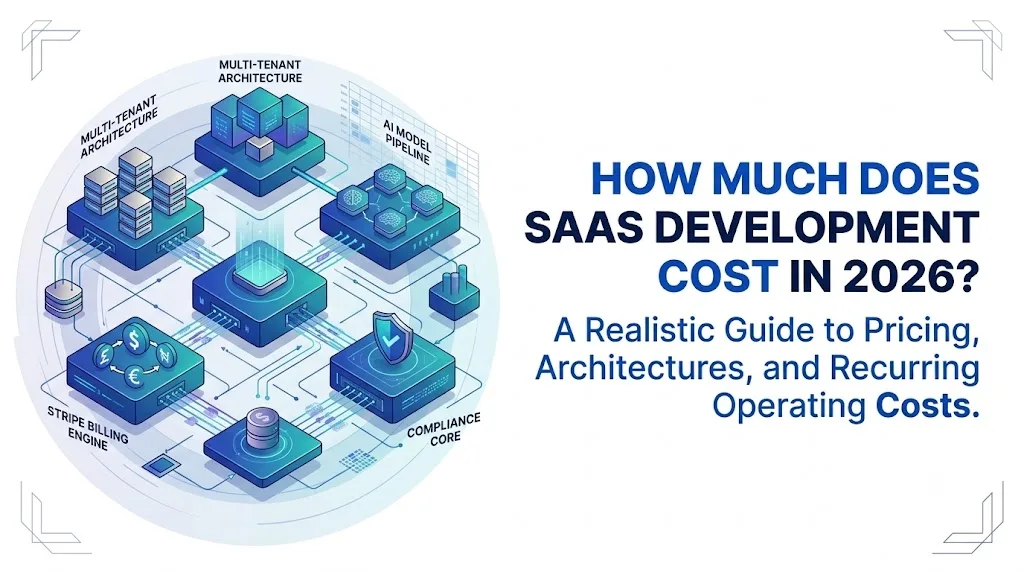
How Much Does It Really Cost to Build a SaaS in 2026?
Ask three development agencies what it costs to build a SaaS, and you will likely receive three wildly incompatible figures: $25,000, $90,000, and $350,000.
That gap is rarely just arbitrary markup. Building software varies radically depending on what you are actually putting into production. A lean micro-SaaS with a single automated workflow requires a completely different engineering commitment than a multi-tenant platform needing SOC 2 certification, fine-grained access control, and specialized AI retrieval pipelines.
Developer tools and AI coding assistants have sped up early scaffolding, but engineering rates remain high, compliance standards are stricter, and user patience for clumsy interfaces has dropped to near zero.
Here is a realistic, direct breakdown of what SaaS development costs in 2026, where the money actually goes, and how to avoid bleeding capital before launch.
SaaS Costs by Complexity
Most products fall into three common tiers:
1. The Lean MVP ($25,000 – $55,000)
Timeline: 2 to 3 months
Best for: Early-stage validation, bootstrapping, and proving willingness to pay.
Scope delivered: Managed user authentication, a single core workflow, Stripe subscription billing, a clean relational database, and a basic internal admin dashboard.
2. Mid-Market SaaS ($60,000 – $160,000)
Timeline: 4 to 6 months
Best for: Products targeting established small-to-medium businesses (SMBs) with multiple team seats.
Scope delivered: Scalable multi-tenant architecture, role-based access control (RBAC), custom reporting analytics, 3 to 5 third-party integrations, and an ultra-responsive UI.
3. Enterprise Platform ($180,000 – $450,000+)
Timeline: 7 to 12+ months
Best for: Platforms selling to enterprise procurement teams, healthcare, or financial institutions.
Scope delivered: Enterprise Single Sign-On (SSO/SAML), encrypted audit logging, granular user permissions, SOC 2/HIPAA compliance readiness, custom workflows, and high-availability cloud architecture.
Where the Budget Actually Goes
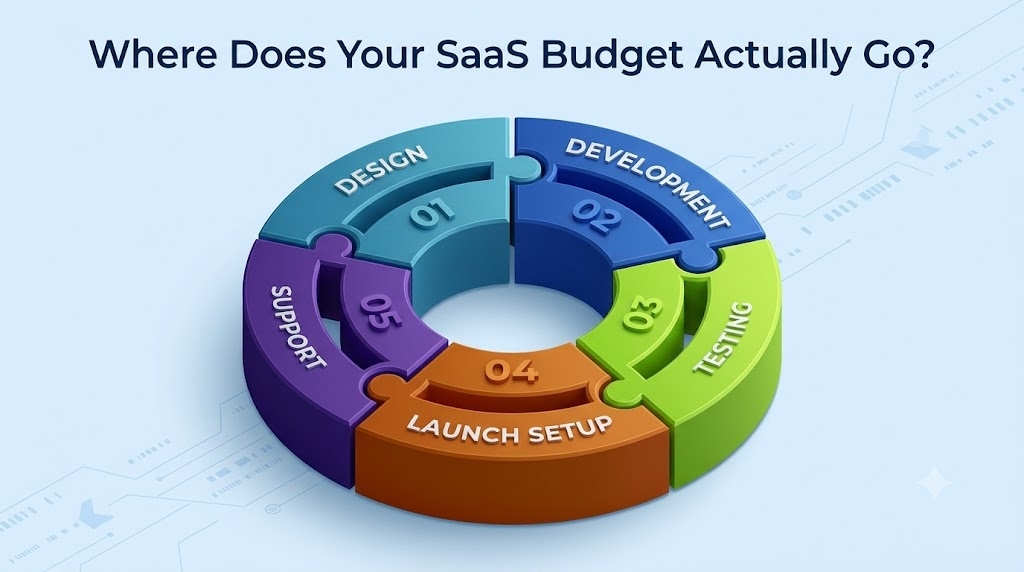
Software budgets rarely get derailed by standard development tasks. They blow up on unmapped edge cases, security requirements, and third-party plumbing.
1. Product Discovery & UI/UX Design ($4,000 – $12,000)
Hiring engineers before finalizing user flows means paying senior developer rates for conceptual brainstorming. Solid discovery work untangles messy workflow logic—such as prorated subscription shifts, team member invites, and data export errors—in Figma, where fixes take minutes instead of days of database refactoring.
2. Core Architecture & Backend ($8,000 – $28,000)
This covers data modeling, multi-tenancy, background job queues, and caching. Making the right architectural calls early on prevents having to rebuild your database layer when your customer count outgrows single-tenant configurations.
3. Frontend Development ($10,000 – $35,000)
Fast, reliable UI accounts for a major chunk of engineering time. If your SaaS requires real-time data streaming, dynamic dashboards, or interactive workspaces, expect frontend effort to rise significantly to maintain sub-second responsiveness.
4. Billing, Auth & Access Control ($4,000 – $12,000)
Integrating Stripe or Lemon Squeezy with tools like Clerk or Supabase Auth is rarely just copy-pasting code. You must manage seat-based tiers, failed invoice retries, regional tax calculations, and permission hierarchies (Admin, Member, Billing Manager).
5. Third-Party Integrations ($5,000 – $20,000)
Modern software cannot live in isolation. Basic webhook support or Zapier triggers cost $1,500 to $3,000. Full two-way, real-time synchronizations with enterprise suites like Salesforce or HubSpot can run $8,000 to $12,000 each due to conflict-resolution logic.
2026 Cost Drivers: AI and Compliance
Two features regularly double initial estimates:
The AI Layer ($5,000 – $40,000+): Connecting an app to an LLM for simple drafting or tagging is relatively cheap ($2,000–$5,000). But building reliable Retrieval-Augmented Generation (RAG) with vector indexing, semantic search, evaluation benchmarks, and guardrails runs easily into five figures.
Compliance ($12,000 – $50,000+): If you sell to enterprise teams or handle sensitive medical/financial data, compliance is non-negotiable. Encrypted audit logging, strict data isolation, and vendor security audits must be accounted for during development, not after.
Agency & Regional Rates
Where you source talent determines the baseline of your invoice:
US / Western Europe Agencies: $110 – $200+/hr (Typical MVP: $50,000 – $100,000+) — Highest cost, zero language friction, strategic advisory included.
Eastern Europe / Latin America Agencies: $45 – $80/hr (Typical MVP: $22,000 – $45,000) — Strong technical depth, solid time-zone overlap, proven mid-market balance.
South Asia Agencies: $25 – $45/hr (Typical MVP: $14,000 – $28,000) — Most cost-effective, high scalability; requires clear technical specifications and active management.
Freelance Specialists: $40 – $100/hr (Typical MVP: $15,000 – $55,000) — Flexible, but requires you to act as the project manager and QA lead.
Day-Two Running Costs
Development does not stop at deployment. Monthly operational costs start immediately:
Cloud Hosting & Databases: $150 – $600/month for early traction (AWS, GCP, Supabase, Render).
Developer Tooling & SaaS Stack: $200 – $700/month (monitoring via Sentry, transactional emails via Postmark, analytics via PostHog).
Ongoing Maintenance: Expect to spend 15% to 20% of your initial build budget every year on security patches, framework updates, and dependency maintenance.
Practical Ways to Keep Costs Lean
Ship One Workflow Exceptionally Well: Narrow your initial release down to a single core problem. Solve it ten times better than an Excel sheet rather than building five mediocre sub-features.
Use Production-Ready Boilerplates: Building login flows, team invites, and subscription scaffolding from zero wastes dozens of hours. Modern SaaS starter kits let developers skip straight to the unique value proposition.
Write Precise Specs: Agencies add financial buffers when requirements are vague. Detailed wireframes, user stories, and acceptance criteria yield sharper, lower-risk bids.
For most modern applications, plan on $30,000 to $55,000 for a dependable, market-ready MVP. Keep the scope tight, validate your customer demand early, and treat your development budget as an investment in learning, not a vanity project.