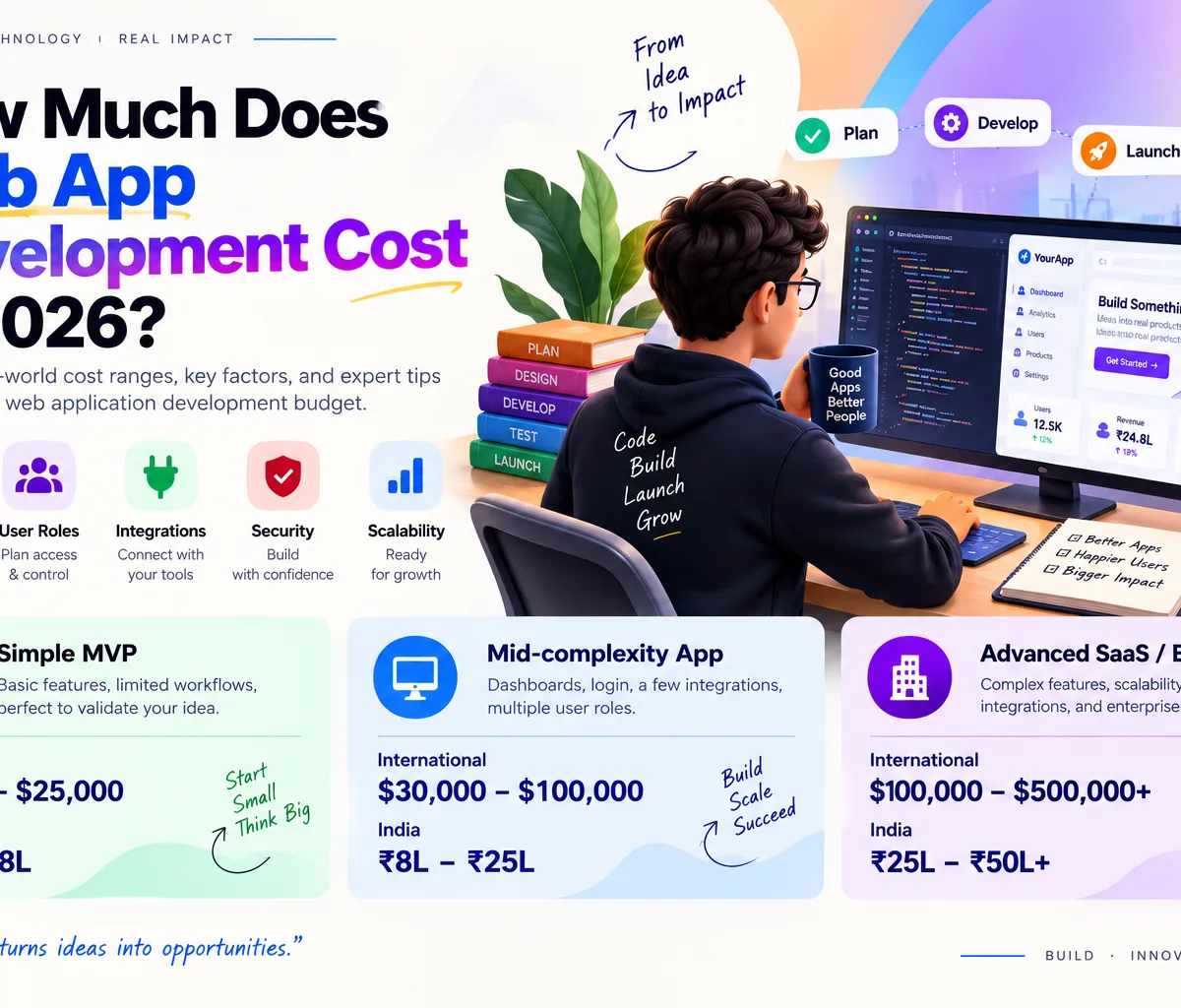
There's no fixed price for building a web app. Web app development cost in 2026 depends on features, complexity, integrations, security, scalability, development team, and location.
A simple MVP can cost a few lakh rupees, while a production-ready SaaS or enterprise application can cost tens of lakhs or more. Current 2026 market estimates show that even similar-looking apps can have very different budgets because the underlying workflows, integrations, user roles, and technical requirements are different.
This guide explains realistic web application development costs in India and international markets, what affects pricing, ongoing expenses, and how to plan your budget before hiring a development team.
Web App Development Cost Ranges (2026)
Simple MVP
International: $8,000 – $25,000
India: ₹4L – ₹10L
Suitable for a focused product with essential features, authentication, a basic dashboard, database functionality, and one or two core workflows.
Mid-complexity Web App
International: $30,000 – $100,000
India: ₹10L – ₹30L
Typically includes multiple user roles, advanced dashboards, business workflows, APIs, payments, third-party integrations, reporting, and a stronger production setup.
Advanced SaaS / Enterprise App
International: $100,000 – $500,000+
India: ₹30L – ₹1Cr+
Suitable for multi-tenant SaaS platforms, enterprise systems, complex integrations, advanced security, high scalability, analytics, audit logs, and large numbers of users.
Note: These are broad planning ranges, not direct USD-to-INR conversions. Current 2026 market sources show wide variation: India SaaS MVP estimates can fall around ₹5L–₹15L, while more complete SaaS products can start around ₹12L and increase significantly with billing, integrations, multi-tenancy, security, and enterprise requirements.
What Drives the Cost
Features — More screens, workflows, dashboards, business rules, and custom functionality require more development and testing.
User roles — A simple application with one user type costs less to build than a system with separate admin, employee, customer, vendor, and manager permissions.
Integrations — Payment gateways, CRMs, email, SMS, maps, analytics, accounting software, and external APIs add development and testing work.
Design and user experience — Custom UI/UX, responsive layouts, accessibility, animations, and complex user journeys increase the project scope.
Security and compliance — Fintech, healthcare, and other applications handling sensitive information may require stronger authentication, encryption, audit logs, security testing, backups, and compliance work.
Scalability — Applications expected to handle thousands of users or large transaction volumes may require better databases, cloud infrastructure, caching, monitoring, and architecture.
Team and location — Freelancer, agency, product studio, and enterprise development rates differ. Current Clutch data shows India custom software development companies commonly listed around $25–$49/hour, while US companies are commonly listed at $50–$99/hour or higher depending on the provider.
Web App vs. Website
A website primarily provides information, while a web application allows users to log in, interact with data, and complete tasks.
For example, a business website may contain services, company information, contact details, and blogs. A web application may include customer accounts, dashboards, databases, payments, file uploads, reports, notifications, and role-based access.
Because web applications require backend systems, databases, authentication, APIs, and business logic, they generally cost more than a basic informational website.
Costs After Launch
Development is only the initial investment. You should also budget for:
Hosting: Cloud costs can start relatively low for small applications and increase with traffic, storage, databases, bandwidth, and infrastructure requirements.
Maintenance and bug fixes: Ongoing costs depend on application complexity and the support agreement with your development team.
Third-party APIs: Payment gateways, email, SMS, maps, analytics, and other services may charge according to usage.
Security updates: Dependencies, servers, authentication systems, backups, and vulnerabilities require ongoing attention.
Feature improvements: New features, integrations, design changes, and business requirements after launch create additional development costs.
The important point is that the development invoice is not necessarily the total cost of owning a web application.
MVP or Full Build?
Build an MVP first if you're testing a new idea or validating customer demand.
An MVP focuses on the core problem and essential features instead of building every planned feature from day one. This can reduce the initial scope, shorten the development cycle, and provide real user feedback before larger investments.
Current 2026 India estimates place many SaaS MVP projects around ₹5L–₹15L, although simpler or more complex MVPs can fall outside that range.
Go straight to a full build when you're replacing an existing business system, have validated requirements, or need advanced functionality from the beginning because of operational, security, or regulatory requirements.
The right approach depends on how much of the product has already been validated and how much functionality users need on day one.
Questions to Ask Before You Get a Quote
What's included in the development cost, and what's billed separately?
Who owns the source code and intellectual property?
Are hosting, deployment, testing, and integrations included?
What happens if the project scope changes?
What does post-launch support cover?
Are security updates and bug fixes included?
What is the expected development timeline?
How are additional features priced?
Is GST included in the quoted price?
What milestones and deliverables are included?
Getting clear answers to these questions makes it easier to compare proposals and avoid unexpected costs.
Frequently Asked Questions About Web App Development Cost
How much does it cost to build a web app in 2026?
A simple MVP can typically require around ₹4L–₹10L in India, while mid-complexity applications may require ₹10L–₹30L. Advanced SaaS and enterprise applications can reach ₹30L–₹1Cr or more depending on functionality, integrations, security, and scalability.
How much does web app development cost in India?
There is no single India-wide price. Current published estimates range from a few lakh rupees for simple applications to ₹25L, ₹50L, or significantly more for complex SaaS and enterprise systems. Team experience and project scope have a major impact on the final quote.
Is a web app more expensive than a website?
Generally, yes. A web application usually requires backend development, databases, authentication, APIs, business logic, dashboards, and testing, while a basic website primarily presents information.
How much does an MVP web app cost?
A focused MVP can start around ₹4L–₹5L, while a production-ready SaaS MVP with authentication, billing, dashboards, roles, and integrations can reach ₹10L–₹20L or more. The exact price depends on the feature set and development team.
How long does it take to build a web application?
A simple MVP may take several weeks. A production-ready SaaS application can take several months, particularly when it includes payments, multiple user roles, integrations, security requirements, and advanced testing.
What increases web app development costs?
The biggest factors are features, user roles, UI/UX complexity, integrations, security, database architecture, scalability, testing, infrastructure, and the development team's rates.
Bottom Line
Budget for development + hosting + integrations + maintenance + security, not just the initial development invoice.
The best way to get an accurate web app development estimate is to define your features, user roles, integrations, technical requirements, expected users, and security requirements before requesting a quote.
If you're testing a new idea, start with a focused MVP and validate the product before expanding it. If you're building an established business system, prepare a detailed requirements document so development teams can provide a more accurate timeline and cost estimate.