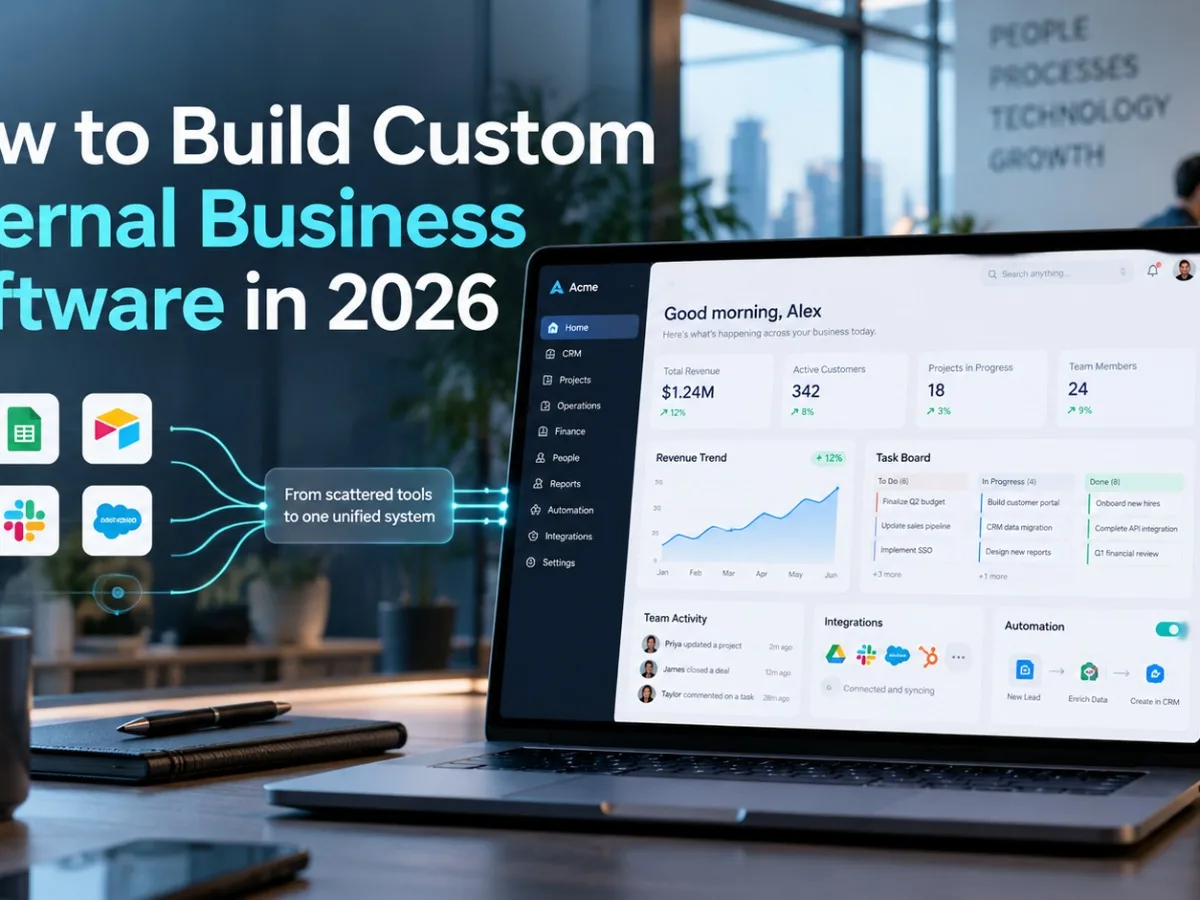

Open the laptop of any operations manager and count the tabs. A spreadsheet for orders. Another for stock. A WhatsApp group for approvals. An email thread nobody can find.
That patchwork is where your team's time goes. Around 40% of workers spend at least a quarter of their week on manual, repetitive tasks. Meanwhile, the average company juggles 305 software apps and uses only about 54% of the licences it pays for.
Custom internal business software fixes this by building one tool around the way your team already works. This guide shows you when to build, the 7-step process, what it costs in 2026, and how to make sure people actually use it.
What is custom internal business software?
It's software built for your own team, not your customers. It automates a process, connects your existing data, and gives each role exactly the screens it needs.
Department Typical internal tool What it replaces Operations Order and dispatch tracker Shared spreadsheets, phone calls Sales CRM with your own pipeline stages Excel lead lists Finance Expense and approval workflow Email chains, paper forms HR Onboarding and leave portal Google Forms, manual follow-ups Inventory Stock and reorder dashboard Weekly manual counts Leadership Live KPI dashboard Monthly reports stitched by hand
Build, buy or no-code? Decide in 60 seconds
Not every problem needs custom code. Find your situation in the left column and read across.
Your situation Best fit Standard process (payroll, email, accounting) Buy off-the-shelf Under 10 users, simple data, short-lived tool No-code or low-code The process is part of your competitive edge Custom build 25+ users or several roles with different permissions Custom build Must connect several legacy or existing systems Custom build Strict data, security or compliance rules Custom build
Over time, the numbers often favour building. In one five-year comparison of a manufacturing tool, a custom build cost about $165,000 in total. The equivalent SaaS came to about $244,000 once licences and add-ons were counted. Subscriptions also carry surprises: 76.6% of IT leaders report unexpected costs after signing.
How to build custom internal business software: 7 steps
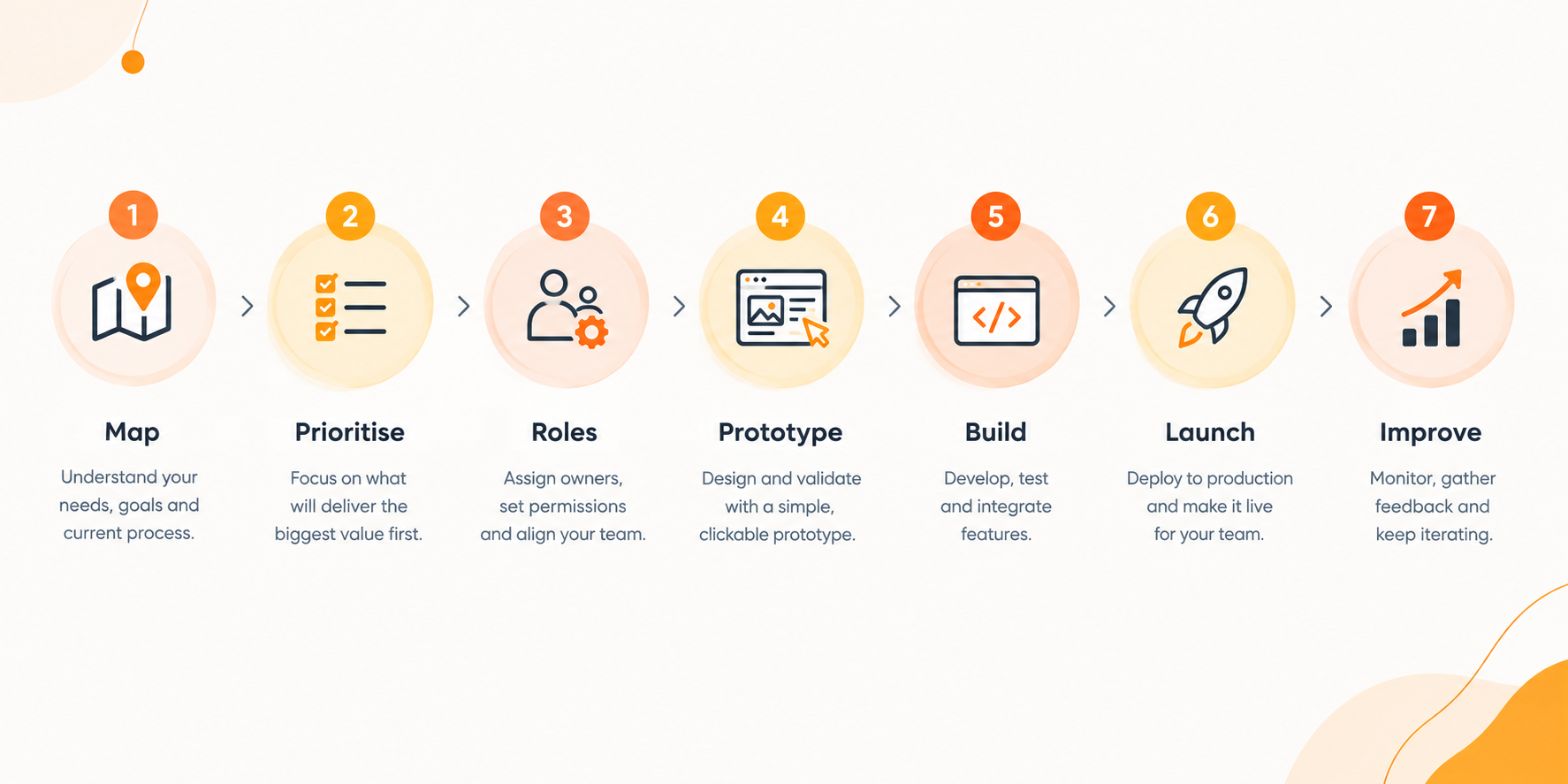
Map the real process. Sit with the people doing the work. Write down every step, handoff and workaround, including the ones nobody admits to.
Pick one painful workflow. Don't digitise the whole company at once. Start with the process that costs the most hours or causes the most errors.
Define roles and permissions. Who creates, who approves, who only views? The answers shape every screen.
Prototype before you code. A clickable prototype tested with five real users catches most usability problems for a fraction of the build cost.
Build on your existing data. Connect to the tools you already use, such as Tally, Zoho, Google Workspace or your ERP, instead of forcing double entry. In 2026, this is also where AI earns its place: let it read invoices or summarise requests wherever people now retype information.
Launch with training and a champion. Pick one respected person per department to lead adoption. Internal tools fail from low usage more often than from bugs.
Measure and improve. Track hours saved, error rates and approval times. Add features only when the data asks for them.
Step 1 is where most projects go wrong, and where outside eyes help most. BurntStack Technologies runs a discovery phase with your team before any development begins. We map the workflow, spot what can be automated, and turn it into a clear feature list with a fixed scope.
How much does internal business software cost in 2026?
Tool type Example International India Timeline Single-workflow tool Leave approvals, expense claims $15,000 – $40,000 ₹4L – ₹10L 6 – 10 weeks Multi-role operations app Order-to-dispatch system $40,000 – $100,000 ₹10L – ₹25L 3 – 5 months Company-wide platform Custom ERP, multi-department portal $100,000 – $250,000+ ₹25L – ₹75L+ 6 – 12 months
Planning ranges, not fixed quotes. Budget another 15–20% of the build cost each year for hosting, maintenance and updates.
What pushes the price up? Three things move the number most: how many user roles you need, how many systems you connect, and how much reporting you want. AI features, such as reading documents or summarising requests, typically add 15–30% to the build.
5 signs you've outgrown spreadsheets
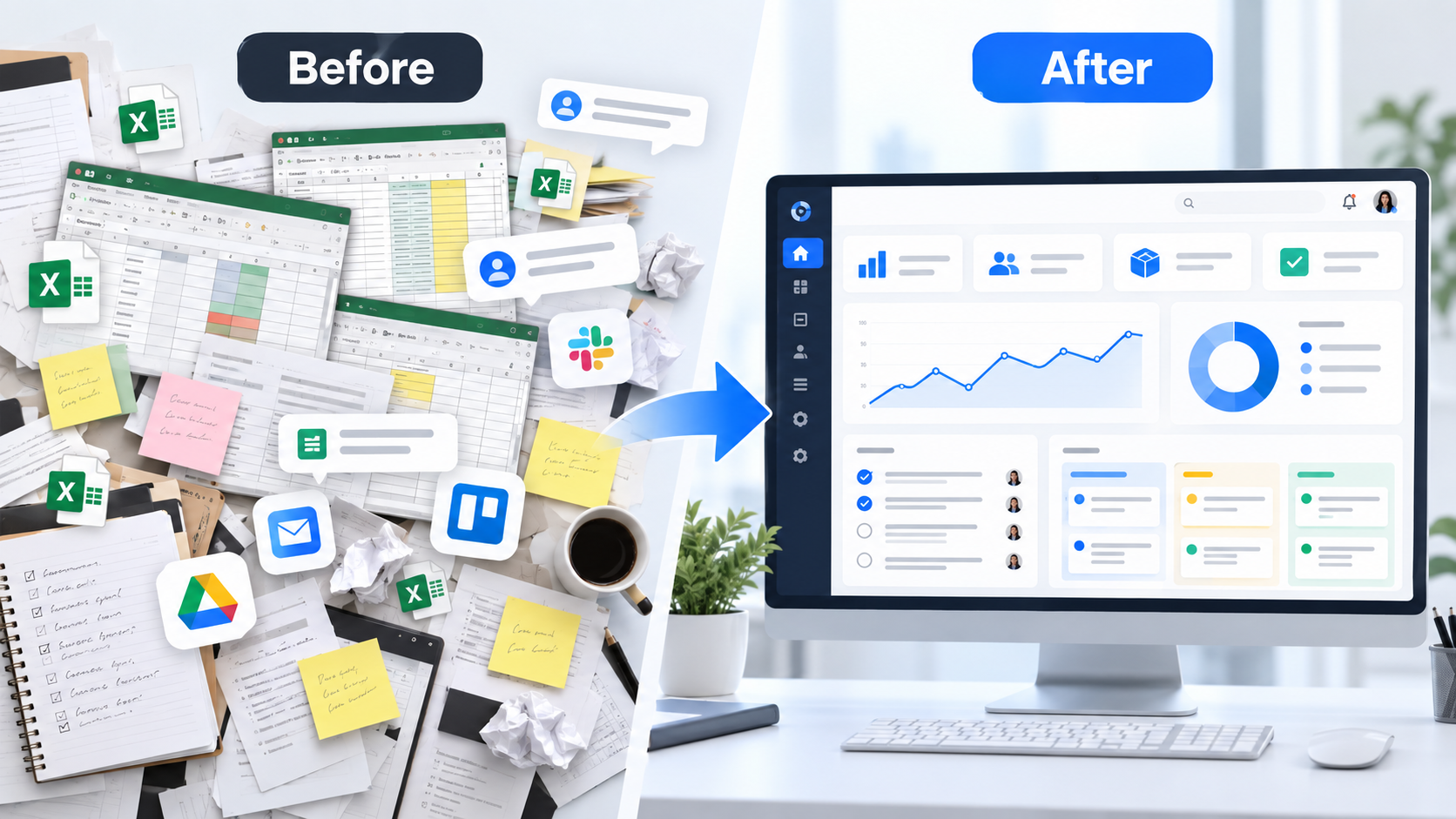
How many of these sound familiar?
Two people edited the same file this month, and one version got lost.
Approvals sit in someone's inbox or WhatsApp for days.
Someone spends hours every week copying data between tools.
You can't answer "where do things stand right now?" without asking three people.
A new hire needs weeks to learn "how we do things here".
Three or more? Your team is paying a hidden tax in hours every week, and a custom tool is worth scoping.
At BurntStack, we build web, mobile and cloud software that replaces exactly these workarounds: dashboards, approval workflows and portals shaped around how your team already works. Browse our portfolio to see the kind of products we deliver.
Mistakes that sink internal tools, and the fix
Mistake The fix Building every feature for every department at once Launch one workflow, then expand Designing without the people who will use it Test the prototype with real users Ripping out systems that already work Integrate first, replace only when needed No owner after launch Assign a product owner and a maintenance plan Loose access control Role-based permissions and audit logs from day one
FAQ
How long does it take to build internal business software?
A single-workflow tool takes about 6–10 weeks. Multi-role apps take 3–5 months, and company-wide platforms take 6–12 months.
Is it better to build or buy internal software?
Buy for standard processes. Build when the process is unique, has many users, or must connect several systems.
Can no-code tools replace custom internal software?
For small teams and short-lived tools, often yes. They hit limits with complex logic, many integrations or strict permissions.
How much does it cost to maintain internal software?
Plan for about 15–20% of the original build cost every year.
Conclusion: build the tool your team opens every morning
The best internal software in 2026 isn't the one with the most features. It's the one your team opens every morning because it makes the day easier. Start with one painful workflow, build it around real users, and grow from there.
Ready to replace the spreadsheets? BurntStack Technologies designs and builds custom internal business software for growing companies. Book a free consultation with our team and get a clear scope, timeline and estimate for your first tool.