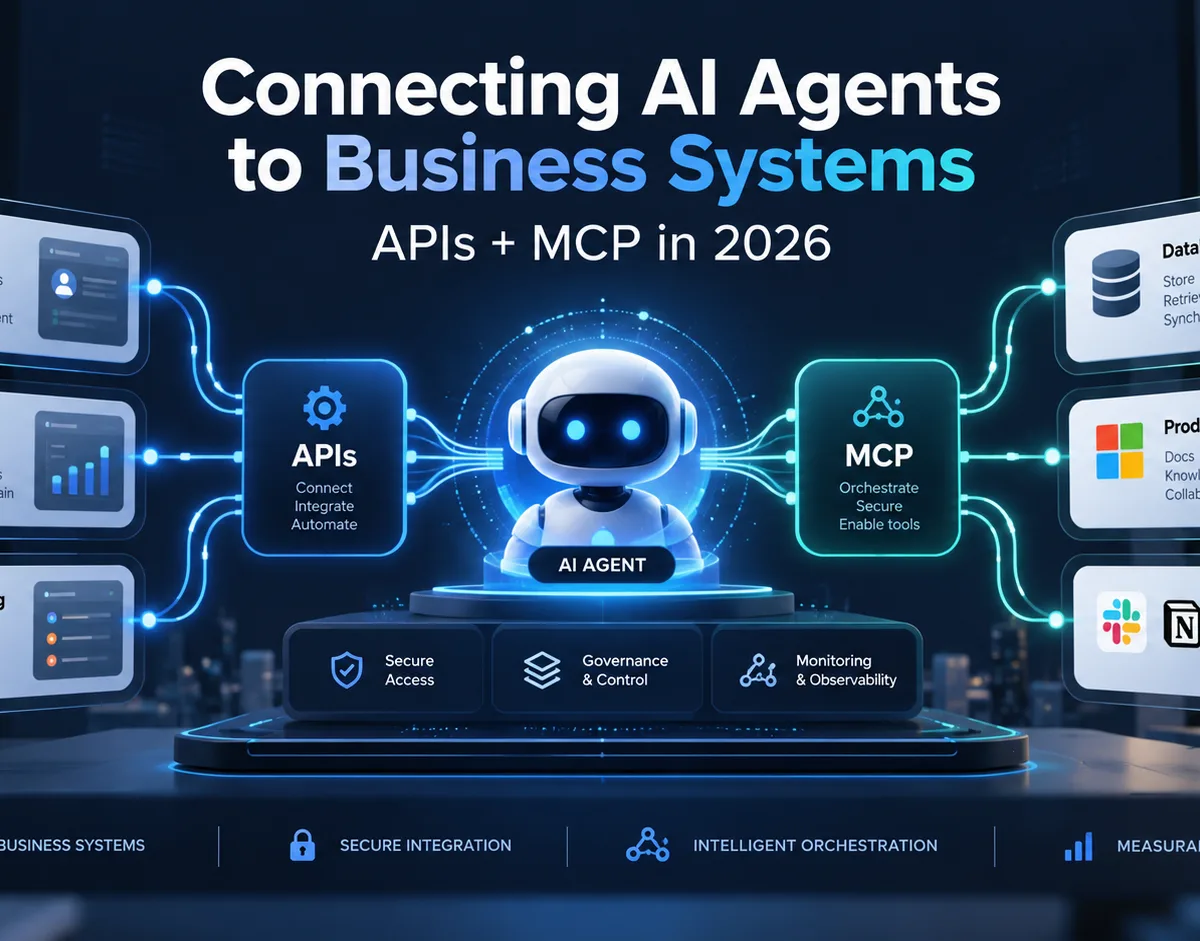
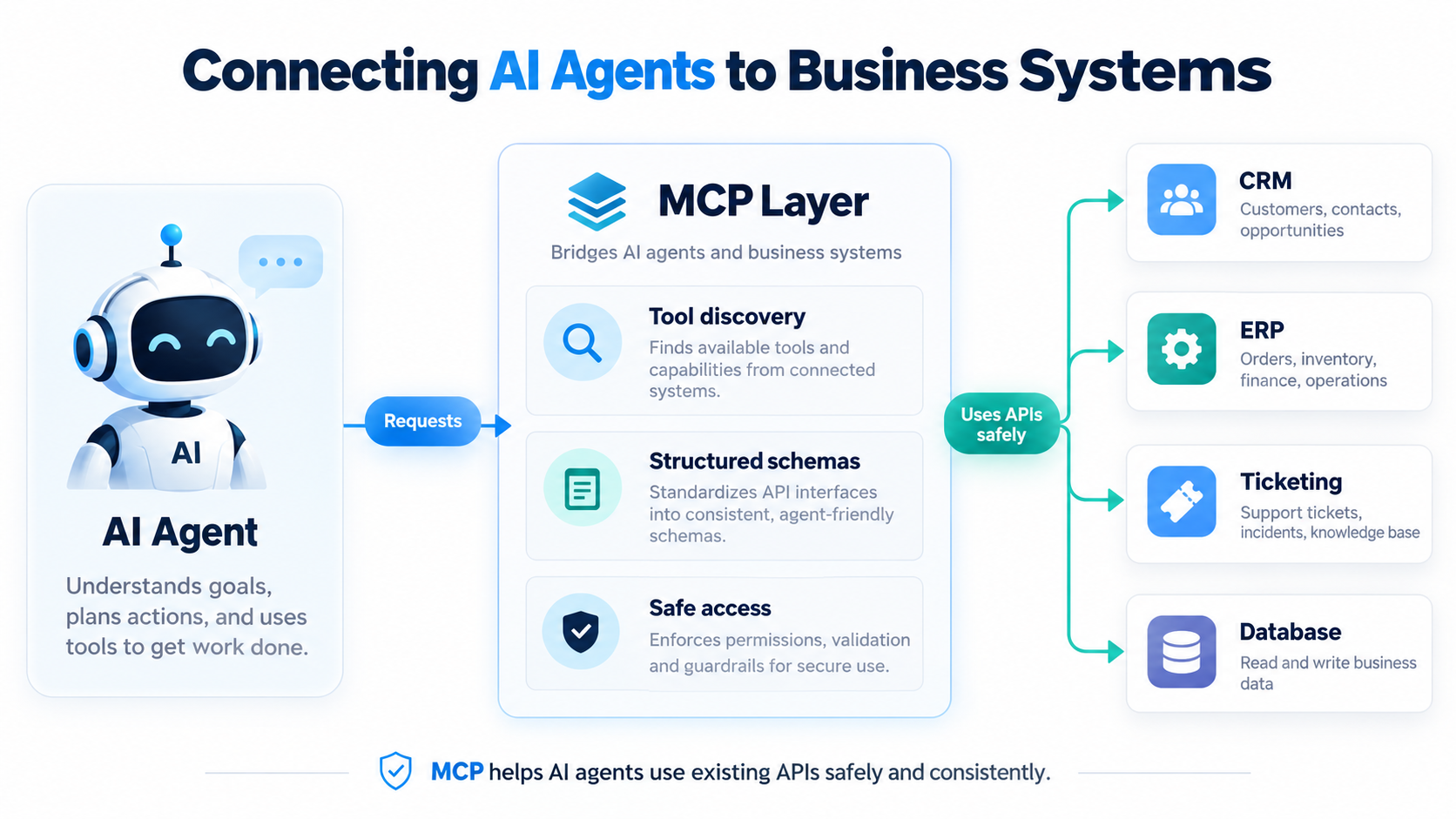
An AI agent that can't reach your systems is just a very articulate chatbot. It can explain what a customer refund policy says, but it can't look up the customer's order, check the inventory, or issue the refund. The real value of an agent shows up the moment it can read from and act on the software your business already runs on: the CRM, the ERP, the ticketing system, the internal database.
That connection is where most AI projects quietly stall. The model works. The demo works. Then someone asks how the agent will actually talk to the five different systems it needs, and the project turns into a pile of custom integrations that nobody wants to maintain. In 2026, there's a better way to approach it, and it involves two pieces that work together: the APIs your systems already expose, and a newer standard called the Model Context Protocol, or MCP.
Why This Problem Matters Right Now
AI adoption inside businesses is widespread, but real impact is not. McKinsey reported in late 2025 that 88% of enterprises use AI in some form, yet only 39% see measurable business impact from it. Gartner projects that 40% of enterprise applications will include task-specific AI agents by the end of 2026. The gap between "we use AI" and "AI changes how we operate" is largely a connection problem: models that can't reliably reach live business data can't do much beyond talk about it.
MCP is the industry's answer to that gap. Anthropic released it as an open standard in November 2024, and by March 2026 its official SDKs were being downloaded roughly 97 million times a month. In December 2025, Anthropic donated the protocol to the Agentic AI Foundation, a fund under the Linux Foundation co-founded by Anthropic, Block, and openAI, and every major AI provider now supports it, including openAI, Google, and Microsoft. In stacklok's 2026 survey of software organizations, 41% were already running MCP in production in some capacity, with another 30% in active pilots.
APIs vs. MCP: What Each One Actually Does
These two get confused constantly, so it's worth being precise.
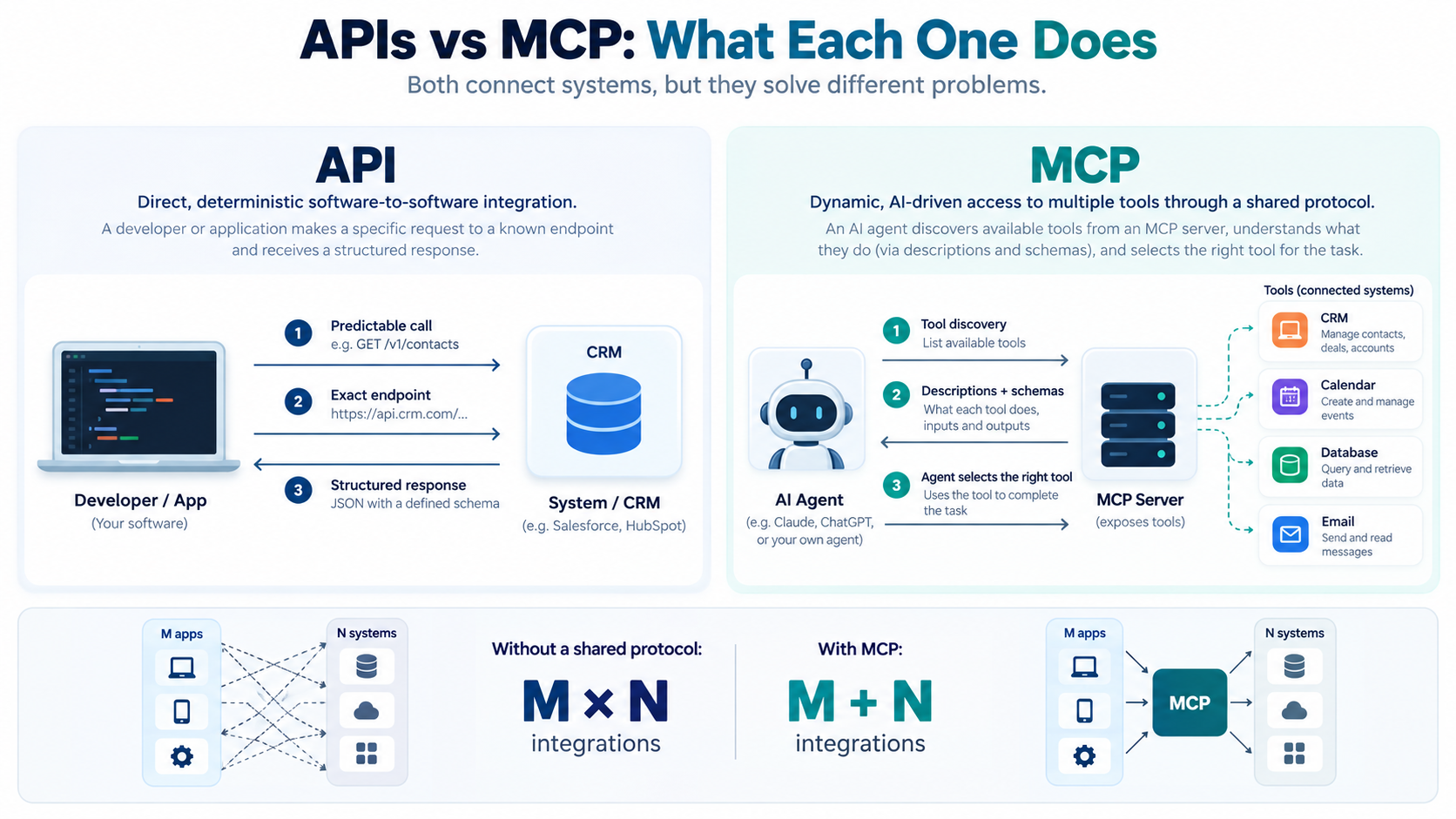
An API is how one piece of software talks to another. It's built for deterministic, predictable calls: a developer writes code that requests exactly this data in exactly this format. Your CRM already has one.
MCP is a standard way for an AI agent to discover and use tools. Instead of a developer hardcoding which API call to make, an MCP server describes what tools are available (in plain language and structured schemas), and the agent decides which one to use based on what it's trying to do.
The important point: MCP doesn't replace your APIs. In almost every business setup, an MCP server is a thin layer that sits in front of an existing API and presents it to an agent in a form the agent can understand and safely use. You keep the APIs you have. MCP just makes them usable by AI agents without a custom integration for every model and every tool.
The math is what made the standard spread. Without a shared protocol, connecting M different AI models to N different tools takes M times N custom integrations. With MCP, each side implements the protocol once, and the work drops to M plus N. Build the connection to your CRM once, and any MCP-compatible agent can use it.
How to Connect an AI Agent to a Business System: A Practical Approach
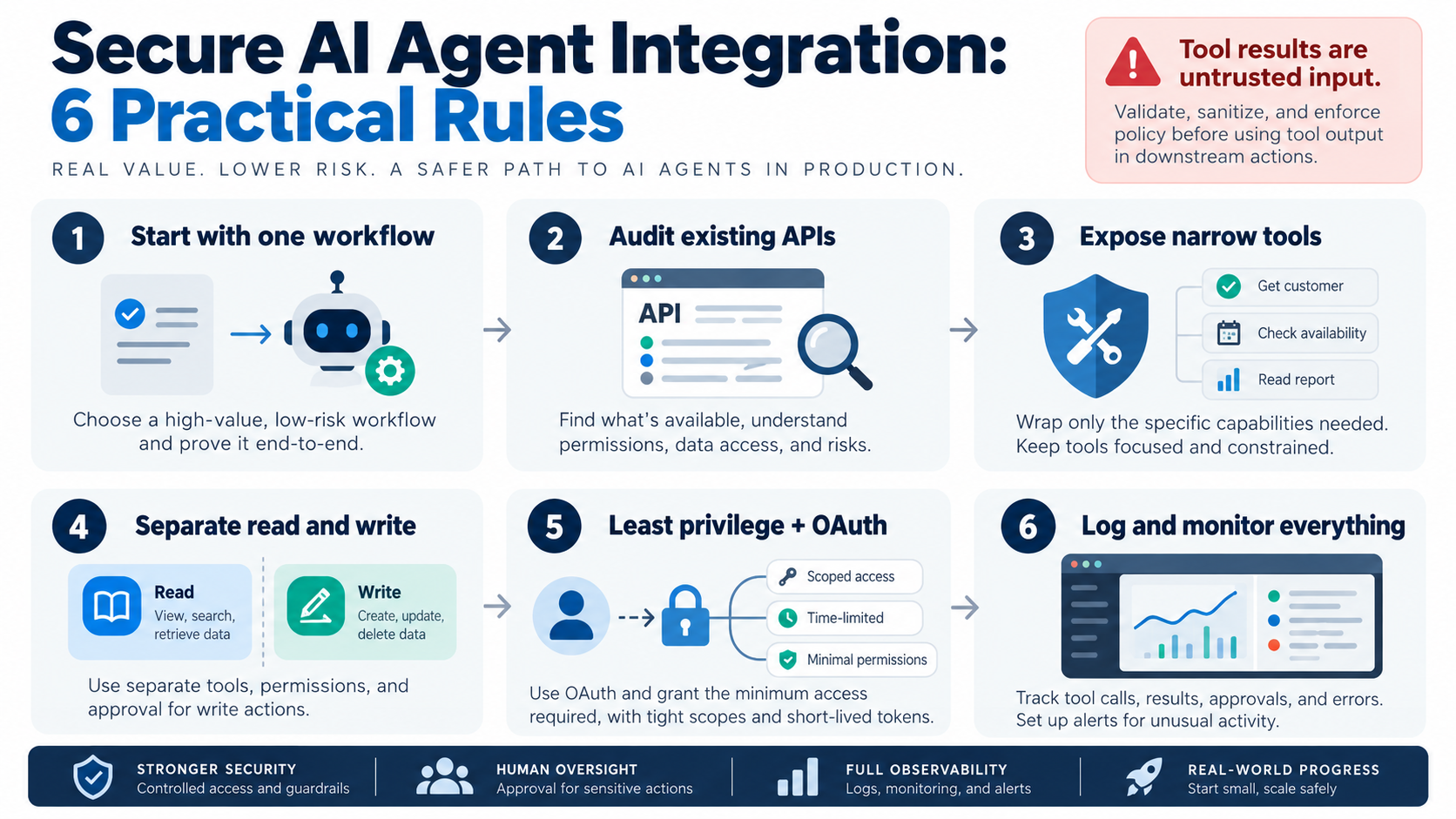
1. Start with one workflow and one or two systems. Pick a single process where an agent would save real time, such as looking up order status, triaging support tickets, or drafting quotes from CRM data, and identify the specific systems it needs. Do not start with "connect the agent to everything."
2. Audit the APIs you already have. Before building anything, check what your existing systems expose. Most modern CRMs, ERPs, and ticketing tools have documented REST APIs. If a system has no usable API, that gap needs solving first, because MCP sits on top of an API rather than replacing it.
3. Design a small set of well-described tools. This is where many teams go wrong. An MCP server should not expose your entire API surface. Expose a handful of narrow, clearly named tools, such as "get customer order by ID" or "create support ticket," each with a precise description. Agents choose tools based on those descriptions, so vague or overlapping tools lead to wrong choices.
4. Separate read access from write access. Give the agent read-only tools first. Put anything that changes data, sends money, or contacts a customer behind a separate set of tools with stricter controls and, where the stakes justify it, a human approval step.
5. Apply least privilege and proper authentication. The agent should have only the permissions its specific task needs, scoped to the narrowest access that works. Use standard OAuth-based authentication, and note that the MCP specification is adding enterprise-managed authorization support, with a July 2026 release candidate built around OAuth 2.0 and OIDC. Do not reuse a broad admin credential just because it's convenient.
6. Log everything and monitor from day one. Record every tool call the agent makes, with inputs, outputs, and which user or session triggered it. You need this for debugging, for audits, and for catching problems before customers do.
MCP Security Is Not the Same as API Security
This is the section most teams skip, and it's the one that matters most. Traditional API security assumes structured, predictable payloads: a request either matches the expected format or it's rejected. MCP traffic doesn't work that way. The content flowing between an agent and its tools is largely natural language, which means a whole category of attack that API security tools were never designed to catch.
The most underestimated risk is prompt injection through tool results. When a tool returns content, such as a document excerpt, a support ticket, or a database row, that content lands in the agent's context and can contain instructions the agent may follow. Security researchers documented a real case in 2026 involving the Windsurf development environment, tracked as CVE-2026-30615, where malicious instructions embedded in web content led to unauthorized changes to the local MCP configuration and command execution with no further user action.
The practical defenses are not exotic:
Treat every tool response as untrusted input, especially content that originates from external or user-controlled sources
Keep read and write tools separate so an injected instruction in a read result can't directly trigger a destructive action
Require human approval for any action that moves money, deletes data, or contacts customers
Audit third-party MCP servers before connecting them, since a connected server can influence what your agent does, and many servers in use today predate the current security standards
When to Use a Direct API and When to Use MCP
Use a direct API call when the interaction is deterministic and built by your own developers: a mobile app fetching a user profile, a scheduled job syncing records between two systems. There is no agent deciding anything, so there's no reason to add a protocol layer.
Use MCP when an AI agent needs to discover tools, choose between them, and combine them to complete an open-ended task. This is where the standard earns its place.
In practice, use both. The most common production pattern is an MCP server that wraps your existing API, so the agent gets a safe, described interface while your systems keep the API they already have.
Common Mistakes When Connecting AI Agents to Business Systems
Exposing the whole API as tools. More tools means more chances for the agent to pick the wrong one, and a much larger attack surface.
Using one broad credential. If the agent's access is wider than its task, every mistake and every injected instruction has more room to do damage.
Skipping the read-only phase. Starting with write access removes the safest way to learn how the agent actually behaves on your data.
Treating MCP traffic like ordinary API traffic. Running it through the same gateway and assuming existing controls cover it leaves the natural-language attack surface unmonitored.
No logging until something breaks. Without a record of what the agent did and why, you can't diagnose a bad outcome or prove what happened afterward.
How Burntstack Approaches AI Agent Integration
We treat agent connectivity as production infrastructure, not a demo. Five principles guide every integration we build:
One workflow first. We scope around a single, measurable process before connecting anything else.
Wrap, don't replace. We build MCP servers on top of the APIs you already have, so your existing systems stay stable.
Narrow tools, least privilege. We expose only what the task needs, with the tightest permissions that work.
Read before write. New integrations start read-only, and write actions earn access with approval steps.
Logged and monitored from launch. Every tool call is recorded, so problems are visible before customers see them.
FAQ
What is MCP in simple terms? The Model Context Protocol is an open standard that lets AI agents connect to tools and data sources in a consistent way. Instead of building a custom integration for every model and every tool, you build one MCP server for a system, and any MCP-compatible agent can use it.
Does MCP replace APIs? No. MCP typically sits in front of an existing API and presents it to an AI agent in a form the agent can discover and use safely. Your APIs stay in place, and most MCP servers are built on top of them.
Is MCP secure enough for business systems? It can be, but security has to be designed in deliberately. MCP introduces risks that ordinary API security doesn't cover, especially prompt injection through tool results and over-permissioned agents. Least privilege, separated read and write tools, human approval for sensitive actions, and full logging are the baseline.
How long does it take to connect an AI agent to a business system? A focused integration around one workflow and one or two systems can often be done in a matter of weeks, particularly when the system already has a usable API. Timelines stretch when scope isn't bounded or when the underlying system has no API to build on.
Where to Start
The businesses getting real value from AI agents in 2026 are not the ones with the most connections. They're the ones that picked one workflow, exposed a small set of well-described tools, kept permissions tight, and logged everything from the start. Burntstack Technologies builds AI agent integrations the same way: APIs and MCP working together, scoped narrowly, and secured before they scale.
This post reflects publicly available industry research and vendor documentation as of September 2026. MCP adoption figures and security guidance vary by source and are evolving quickly, so verify current specifications before deploying to production.