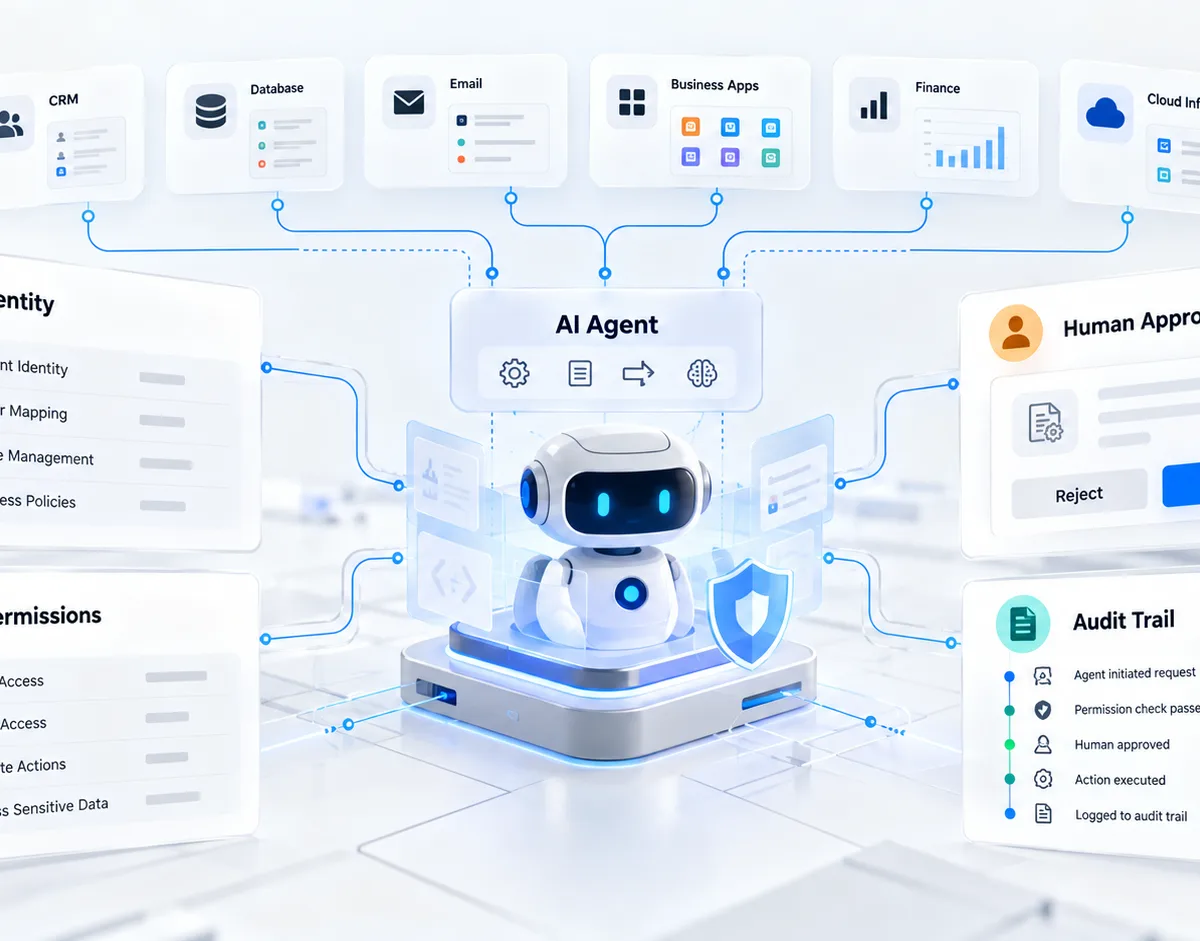
AI agents are moving beyond answering questions and generating content. In 2026, businesses are connecting agents to CRMs, databases, email, cloud infrastructure, finance systems, ticketing platforms and internal applications.
That creates a different governance problem.
A chatbot can give you a wrong answer. An AI agent can potentially take the wrong action.
It might update a customer record, send an external email, change a production configuration, approve a request or access sensitive business data.
So the important question is no longer just “Is this AI model safe?”
It is:
What is this agent allowed to do, who authorized it, when does it need human approval, and can the business prove what happened afterward?
That is the core of AI agent governance.
What Is AI Agent Governance?
AI agent governance is the combination of policies, permissions, approvals, monitoring and audit controls used to manage what an AI agent can access and do.
Traditional AI governance often focuses on the model: data quality, model performance, privacy, bias and responsible use.
Agent governance has to go one step further because an agent can act through tools and systems.
A practical governance framework therefore needs to answer five questions:
Who owns the agent?
What can the agent access?
What actions can it perform?
Which actions require human approval?
What evidence does it leave behind?
This is why organizations are increasingly treating AI agents more like governed digital workers than simple software features.
NIST's 2026 work on AI agent identity and authorization specifically highlights the need to address identification, authorization, auditing and non-repudiation as agents gain access to enterprise systems.
The 4 Core Controls Every Business Needs
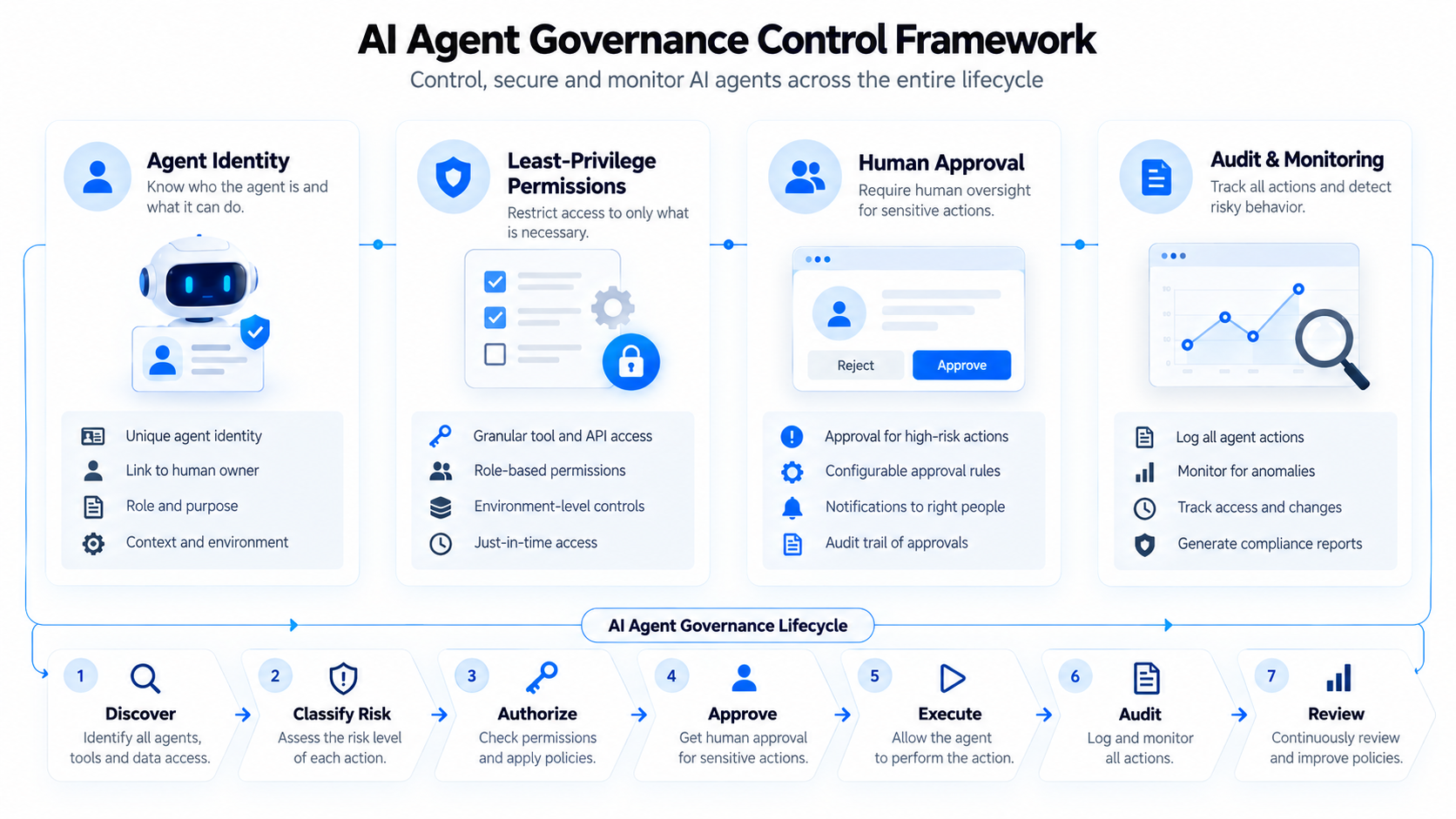
A useful starting point is to divide AI agent governance into four control areas.
1. Agent identity and ownership
Every production agent should have a clear identity and a named owner.
Avoid situations where an agent operates through a generic shared API key or an employee's personal credentials.
A governance record should identify:
Agent name and purpose
Business owner
Technical owner
Model/provider
Connected tools
Data sources
Permission scope
Autonomy level
Approval requirements
Deployment date
Review or retirement date
This makes it possible to answer a basic question during an incident or audit: which agent acted, and who is accountable for it?
2. Least-privilege permissions
An AI agent should receive the minimum access required to complete its job.
For example, an agent that summarizes sales data may need read access to a reporting database. It probably does not need permission to delete customer records, change pricing or deploy code.
A useful permission model can separate access into levels such as:
Read → Draft → Write → Approve → Execute
The higher the potential impact, the more restrictive the control should become.
Permissions should also be scoped by the specific task, resource and time period where possible.
This is particularly important because an agent can chain multiple tool calls. A seemingly harmless first step can lead to a much more consequential action later.
When Should an AI Agent Require Human Approval?
Human-in-the-loop AI does not mean asking a person to approve every action.
If an employee has to approve hundreds of low-risk actions every day, the approval system becomes a bottleneck and people eventually approve requests without meaningful review.
Instead, approval should be connected to risk and impact.
A simple approach is:
Agent actionTypical controlRead public informationAutonomousSearch internal documentationAutonomous with access controlsCreate a draftAutonomousUpdate a low-risk recordPolicy-controlledSend an external communicationHuman approvalChange customer-facing informationHuman approvalModify production systemsStrong approvalMove money or approve paymentsExplicit approvalDelete important dataExplicit approval + additional safeguards
The exact thresholds should depend on the business.
The important principle is that approval should be attached to the specific action, rather than simply saying “a human is somewhere in the loop.”
For high-impact actions, the approval record should identify what the agent intended to do, the target, the relevant parameters, who approved it and when.
Approvals should also expire. An approval given for one action should not automatically become permission for unrelated future actions.
What Should an AI Agent Audit Log Contain?
A basic application log saying:
Agent executed API call at 10:42
is not enough for serious governance.
An audit trail should allow someone to reconstruct the action later.
At minimum, capture:
Agent identity
Human or system that initiated the task
Task or session ID
Tool or API used
Target resource
Action performed
Relevant parameters
Permission or policy decision
Approval ID, if required
Approver identity
Timestamp
Result
Error or exception
Policy/version information where relevant
The goal is traceability.
If an agent changes a customer record, the organization should be able to determine not only that the API call happened, but also which agent performed it, who initiated the workflow, what authorization applied and whether a human approved the action.
This is becoming a practical concern for enterprise teams. Recent discussions among security and GRC practitioners show that traditional service-account logs can leave an accountability gap when agents act on behalf of humans.
Where Should AI Agent Governance Controls Be Enforced?
One of the biggest mistakes is putting the entire security boundary inside the AI agent itself.
For example, telling an agent:
“You are not allowed to delete production data.”
is not a sufficient security control.
The model should not be the final authority deciding whether it is allowed to perform a privileged action.
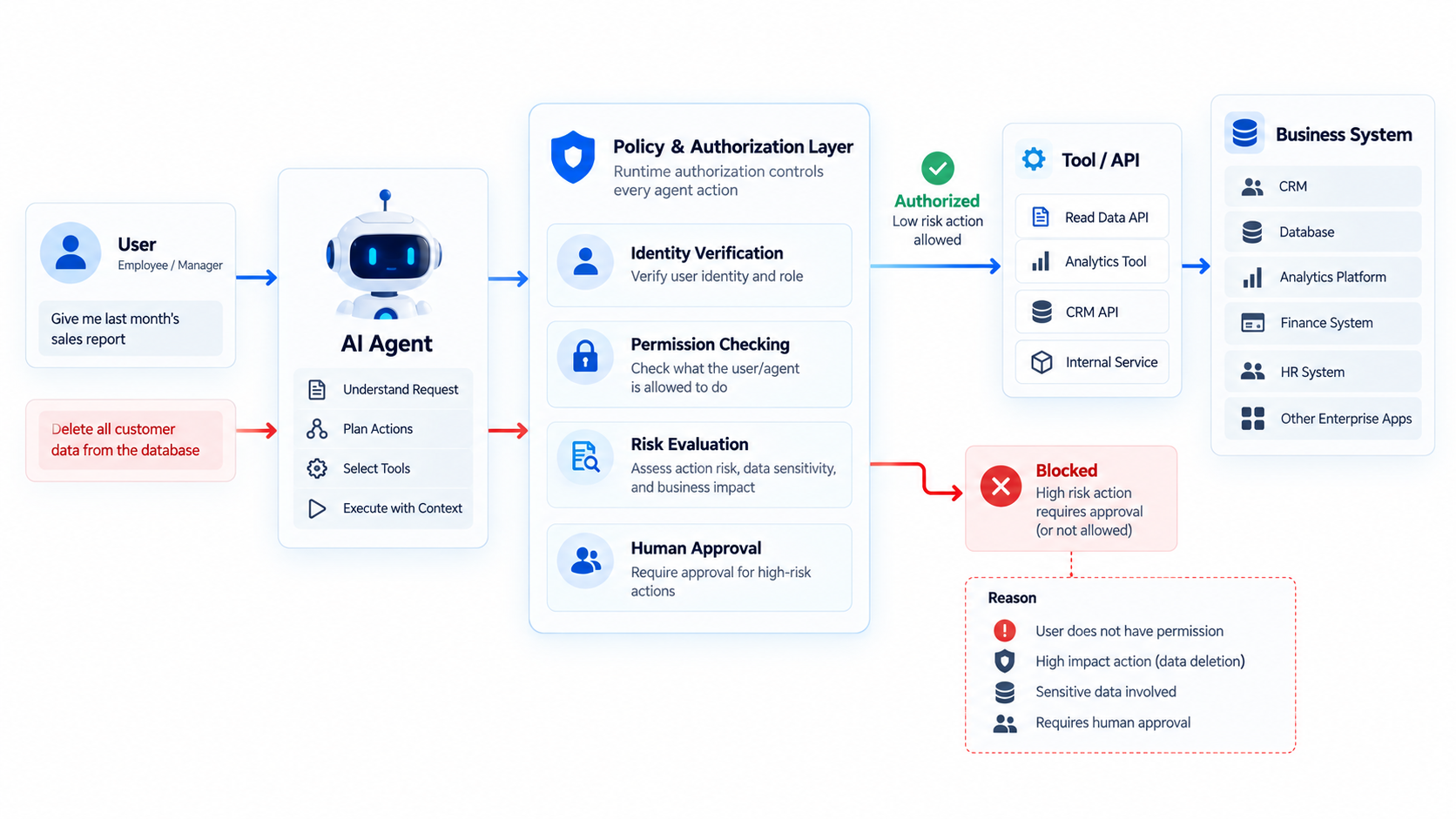
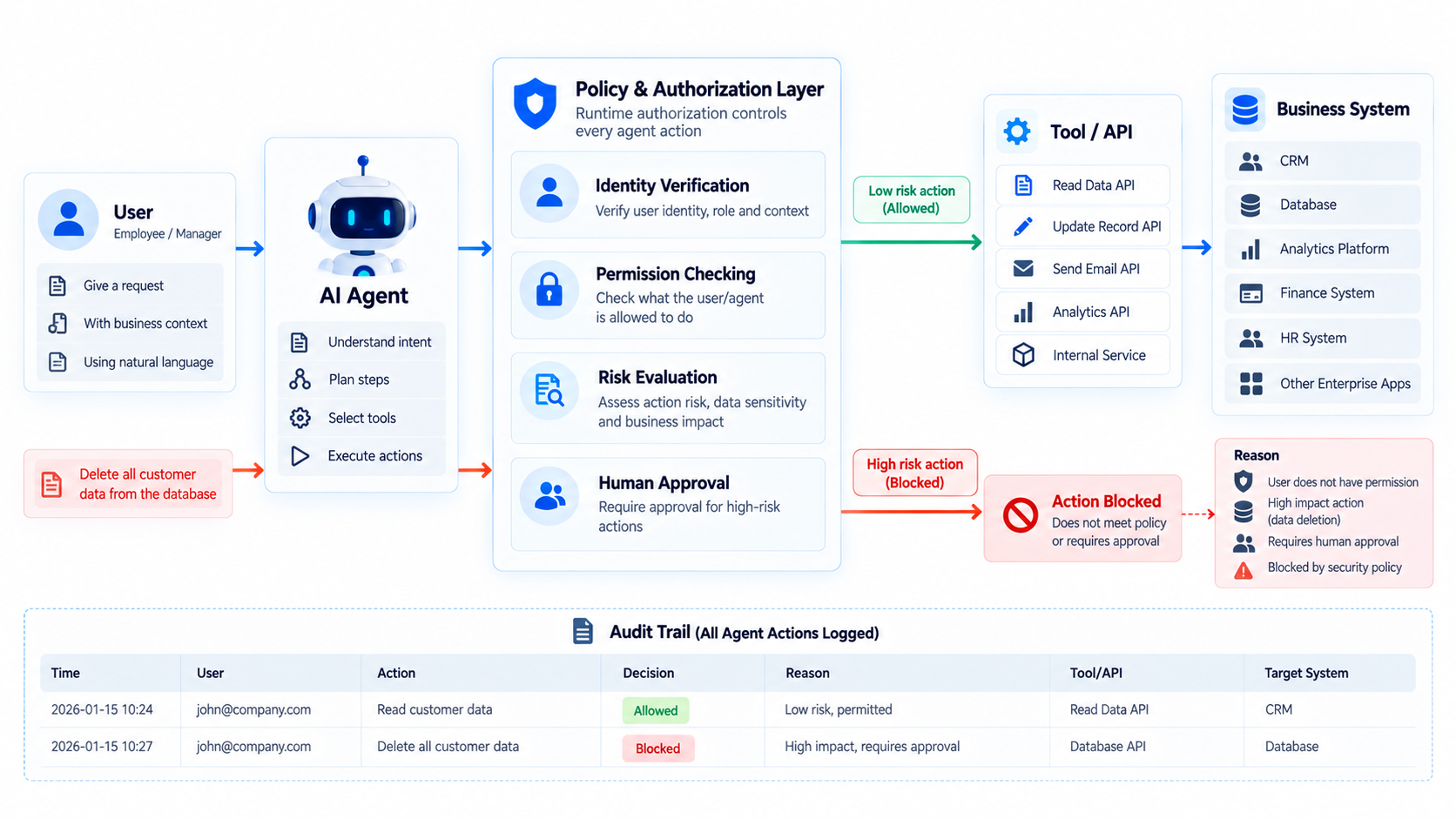
A stronger architecture places policy enforcement between the agent and the protected system:
User → Agent → Policy/Authorization Layer → Tool/API → System
The policy layer can evaluate:
Agent identity
User identity
Requested tool
Requested action
Target resource
Data sensitivity
Current context
Approval status
Time restrictions
Risk rules
Then it can return allow, deny or require approval.
OWASP's current AI Agent Security guidance similarly recommends enforcing authorization independently of the model's reasoning and using explicit controls for high-impact actions.
This approach also helps when an agent is compromised by prompt injection or receives malicious instructions from external content. The model may attempt an action, but the external policy layer can still prevent unauthorized execution.
A Practical AI Agent Governance Framework for 2026
Businesses do not need a massive governance program before deploying their first agent.
A practical implementation can follow this sequence.
Step 1: Create an agent inventory
Know which agents exist, who owns them, what they do and which systems they can access.
Step 2: Classify risk
Evaluate each agent based on:
Data sensitivity
Business impact
Autonomy
Reversibility
External exposure
An agent that summarizes internal documents is not equivalent to one that can approve payments.
Step 3: Define permissions
Create explicit allowlists for tools, systems, operations and data.
Start with least privilege rather than granting broad access and reducing it later.
Step 4: Define approval thresholds
Write down which actions require human approval before deployment.
Do not leave this decision to the agent itself.
Step 5: Enforce policies at runtime
Use authorization controls at the API, gateway, tool or execution layer so that permissions cannot simply be bypassed through prompting.
Step 6: Log every meaningful action
Capture enough context to reconstruct what happened.
Step 7: Monitor and review
Permissions should not be permanent.
Review agent access, behavior, failures and approval patterns regularly. Revoke agents and credentials that are no longer required.
Step 8: Prepare a kill switch
For high-impact autonomous agents, businesses should have a practical way to stop execution quickly when abnormal behavior is detected.
World Economic Forum's 2026 guidance
Common AI Agent Governance Mistakes
Several mistakes repeatedly appear when businesses move from AI pilots to production agents.
Giving agents human-level access by default.
An agent should not automatically inherit every permission available to the employee who created it.
Relying on prompts as security controls.
Instructions such as “never access confidential data” are not substitutes for technical authorization.
Approving everything.
If every action requires approval, people stop reviewing approvals carefully.
Logging only API calls.
A timestamp and service account are not enough to establish accountability.
Ignoring agent-to-agent delegation.
When one agent passes work to another, authorization and identity need to remain traceable.
Forgetting lifecycle management.
Agents need provisioning, review, permission changes and retirement just like other enterprise identities.
AI Agent Governance Checklist
Before putting an AI agent into production, ask:
Does it have a named owner?
Does it have a unique identity?
Is its purpose documented?
Are its permissions least-privilege?
Are sensitive tools explicitly restricted?
Are high-impact actions subject to approval?
Is approval tied to the exact action?
Are approvals time-limited?
Are agent actions centrally logged?
Can the business trace an action back to its initiating user or workflow?
Can security teams revoke access quickly?
Is there a way to stop the agent during an incident?
Are permissions and behavior reviewed periodically?
If several answers are “no,” the agent may be technically functional but not operationally governed.
Frequently Asked Questions
What is AI agent governance?
AI agent governance is the system of ownership, authorization, permissions, human oversight, monitoring and audit controls used to control autonomous AI agents in an organization.
How do you control AI agent permissions?
Use least-privilege access, dedicated agent identities, explicit tool and resource allowlists, short-lived credentials where appropriate, and runtime authorization outside the model.
Should AI agents have their own identity?
For enterprise deployments, a distinct, governed agent identity provides clearer accountability and makes access management and auditing easier than relying on shared credentials.
Which AI agent actions should require human approval?
Generally, actions with significant financial, security, legal, customer or operational impact—or actions that are difficult to reverse—should have stronger approval controls.
What should be included in an AI agent audit trail?
The audit record should connect the agent, initiating user or workflow, requested action, target, authorization decision, approval, execution result and timestamp so the organization can reconstruct what happened.
Conclusion
AI agent governance in 2026 is not about preventing agents from doing useful work. It is about giving them bounded authority.
The strongest approach is straightforward:
Give every agent an identity. Give it only the permissions it needs. Require approval for consequential actions. Enforce those rules outside the model. And keep enough evidence to reconstruct every important decision and action.
As AI agents move deeper into business systems, governance becomes part of the architecture rather than paperwork added after deployment.
The organizations that can clearly answer “who authorized this, what was the agent allowed to do, what did it actually do, and can we prove it?” will have a much stronger foundation for scaling agentic AI safely.