Most companies get the first question about AI wrong. They ask, "How do we add AI to our platform?" It's a question with no real boundary to it, and it tends to produce months of architecture debates and nothing actually shipped. The businesses getting measurable value from AI in 2026 ask a narrower question instead: which single workflow costs us the most in slow, manual, error-prone human effort right now, and what would fixing just that one thing look like?
That reframing matters because of an assumption that quietly kills most AI projects before they start: the belief that adding AI means rebuilding the software you already have. It usually doesn't. Industry data on AI shipping patterns shows the large majority of AI capabilities that reached production in the last two years got there through integration into existing systems, not through full rebuilds.
Why 2026 Is the Year This Stopped Being Optional
AI adoption inside businesses has moved past the experimentation phase. Multiple 2026 industry surveys now put overall enterprise AI adoption in the high 80s to low 90s percent range, and Gartner projects that 40% of enterprise applications will include embedded, task-specific AI agents by the end of 2026, up from less than 5% just a year earlier. When AI works, the payoff is real: McKinsey's Global AI Survey found organizations see an average 5.8x return within 14 months of a production AI deployment.
But adoption and success aren't the same thing. As of early 2025, only about 1% of company executives described their generative AI rollouts as "mature," and Gartner expects more than 40% of agentic AI projects to be cancelled by the end of 2027 due to runaway costs, unclear business value, or weak risk controls. The gap between companies that get real value and companies that burn a budget on a pilot that never ships almost always comes down to how the integration itself was approached.
The Real Barrier Isn't the AI. It's the Integration.
Ask executives what's actually stopping AI adoption, and the answer usually isn't "the technology isn't good enough." According to Zapier's enterprise AI research, 78% of executive leaders say they're struggling to integrate AI with their existing systems. The top named barriers are a shortage of employee AI skills (35%), difficulty integrating AI with what's already running (29%), and data quality problems (29%).
None of those are model problems. They're integration problems, which is good news: they're solvable with planning rather than a bigger model.
How to Actually Integrate AI Into Existing Software: A Practical Approach
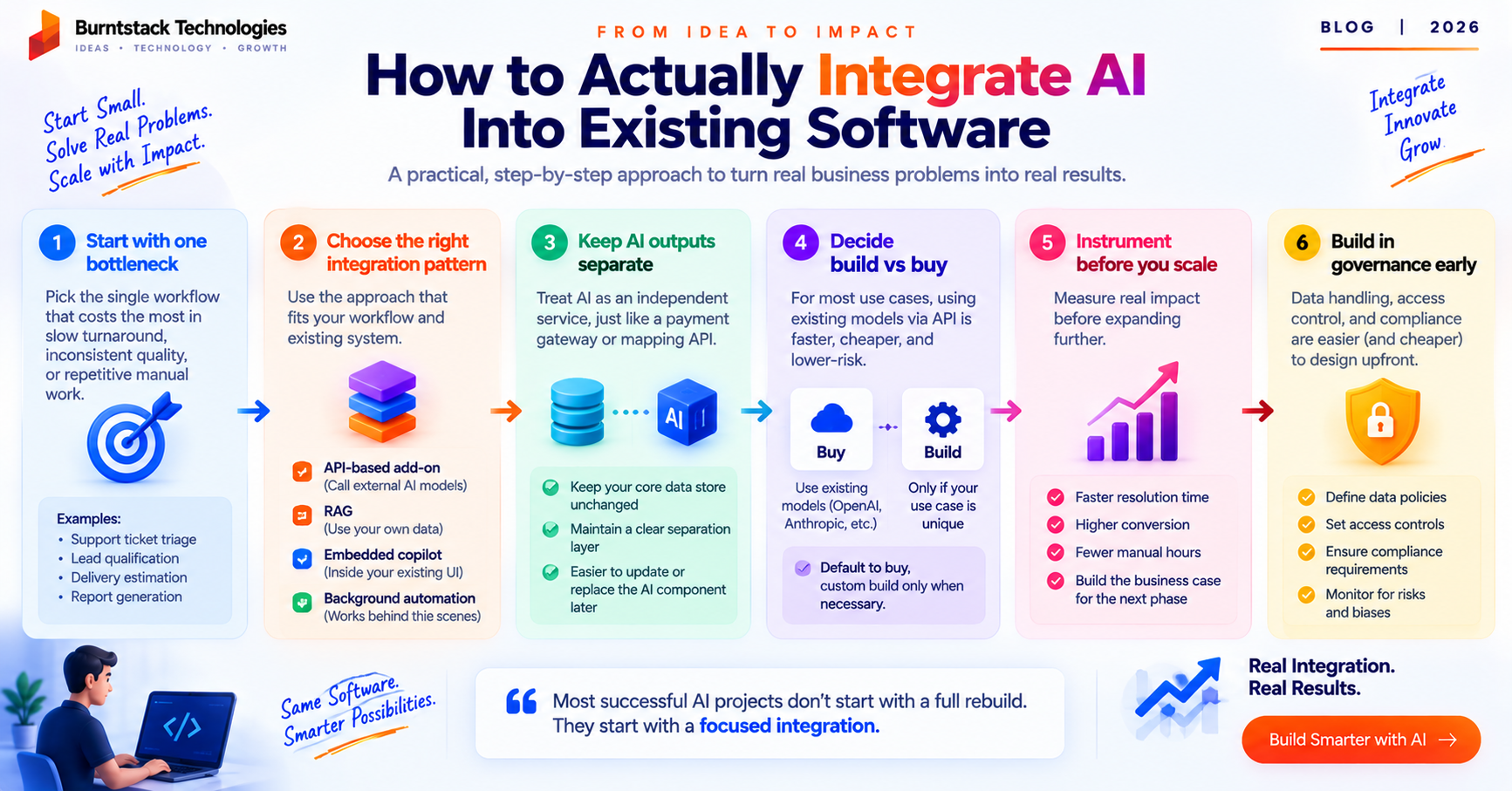
1. Start with one bottleneck, not a platform strategy. Pick the single workflow costing you the most in slow turnaround, inconsistent quality, or repetitive manual work. A support team drowning in ticket triage, a sales team manually qualifying leads, a dispatch system estimating delivery windows by hand. Build for that one thing first.
2. Choose the right integration pattern for that workflow. Most business AI integrations fall into a handful of patterns:
API-based add-on: call an external AI model (OpenAI, Anthropic, etc.) from your existing backend, the way you'd call any third-party service
Retrieval-augmented generation (RAG): let the AI answer questions using your own company data, without retraining a model
Embedded copilot: surface AI assistance directly inside the existing interface your team already uses daily
Background automation: run AI as a middleware layer that acts on data quietly, without a user-facing chat interface at all
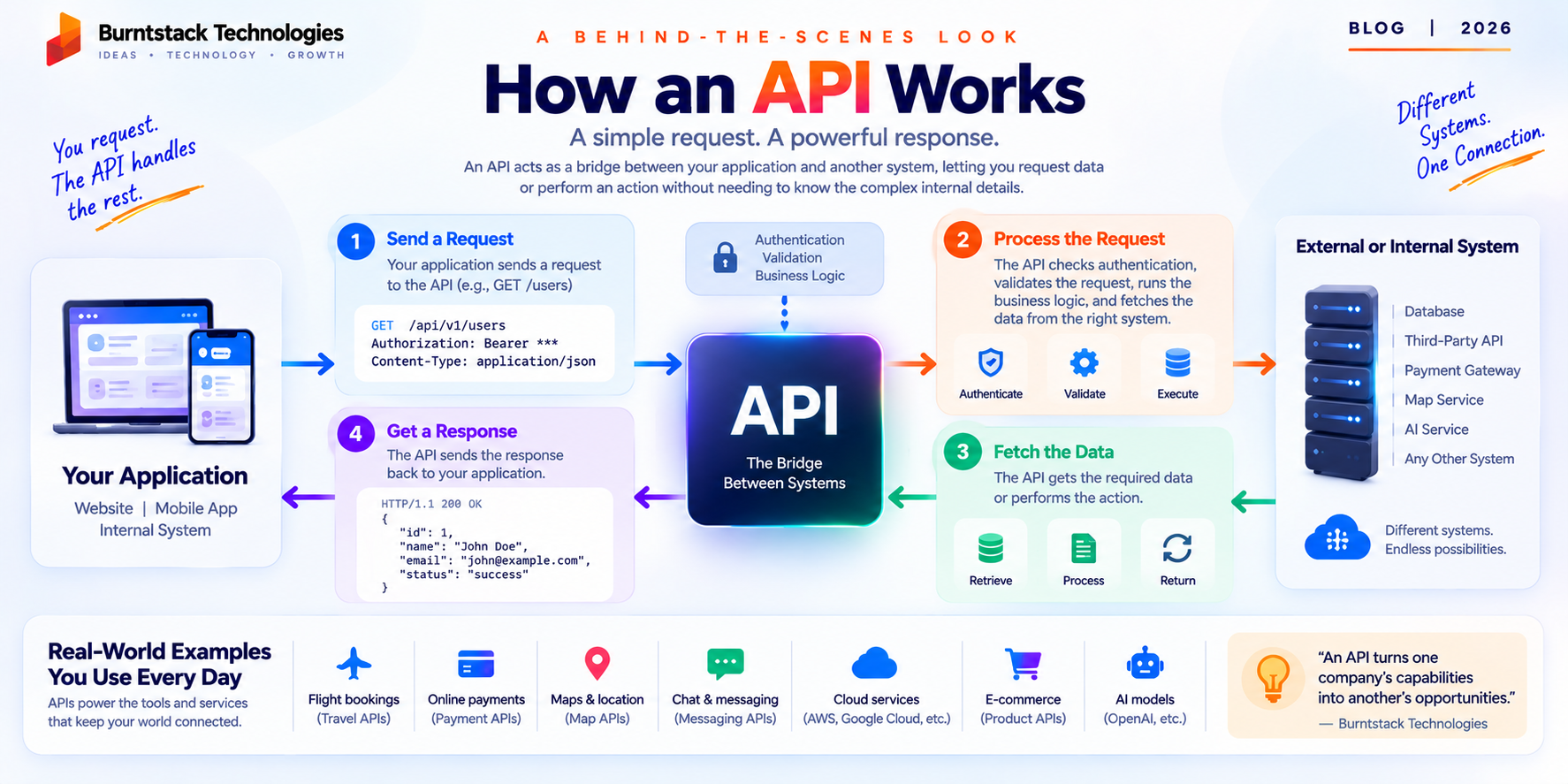
3. Keep AI outputs separate from your core data store. This is the detail that saves teams from a rebuild later. Treat the AI as an independent service your existing application calls, the same way it calls a payment gateway or a mapping API, rather than weaving model calls directly through your core business logic. If the AI component needs to change later, that separation is what keeps the rest of the system stable.
4. Decide build versus buy for the model layer. For most business use cases in 2026, calling an existing model through an API is faster, cheaper, and lower-risk than training or hosting your own. Reserve custom model work for cases where your data or use case is genuinely unusual, not as a default starting point.
5. Instrument before you scale. Measure the actual lift, faster resolution time, higher conversion, fewer manual hours, before expanding the integration further. This is also how you build the internal case for the next investment.
6. Build in governance from day one. Data handling, access control, and compliance requirements are far cheaper to design in at the start than to retrofit after the integration is already touching customer data.
Integration vs. Full Rebuild: The Real Trade-off
Teams that default to "we need to rebuild this system to make it AI-native" are almost always overestimating what the AI part requires and underestimating what a rebuild costs. In practice:
Timeline: a focused integration typically ships in a matter of weeks; a full AI-native rebuild typically runs six months to well over a year
Upfront cost: integration is moderate; a rebuild is substantially higher
Architecture risk: integration touches one workflow; a rebuild risks the business logic, edge cases, and user trust already built into years of production software
Rollback: a poorly performing integration can usually be turned off; a rebuild that underperforms is much harder to walk back
A production application already carries years of accumulated business logic and edge-case handling that a rebuild has to recreate from scratch, and inevitably gets some of it wrong the first time. Integration lets you prove the value of an AI capability, in production, against real usage, before committing to anything larger.
What This Looks Like in Practice
A pattern that keeps showing up across industries in 2026: a company assumes adding an AI capability means rebuilding an aging, business-critical module. Instead, the AI ships as a single new API endpoint that the existing system calls at one specific point, for example, requesting a predictive estimate before displaying it in an interface that otherwise hasn't changed. The core system stays untouched. The AI runs as an independent service. What would have been a year-long rebuild becomes a project measured in weeks.
Common Mistakes When Integrating AI Into Existing Software
Treating AI as a bolt-on without separating it from core logic. This is what turns a small integration into an accidental rebuild six months later.
Ignoring token cost and latency until after launch. AI API costs scale with usage in a way traditional software costs don't, and it's easy to build something that works in a demo but is too slow or too expensive at real volume.
Skipping evaluation before shipping to users. Without a way to measure output quality, teams often don't notice a model is underperforming until customers do.
Treating governance as a later problem. Data privacy and access control are far harder to add retroactively once an AI feature already has real customer data flowing through it.
Trying to integrate everywhere at once. The projects that get cancelled are disproportionately the ones with no bounded scope from the start.
How Burntstack Approaches AI Integration
We treat AI integration as an engineering discipline, not a demo. Every AI integration project we take on follows the same five principles:
One workflow first. We scope every engagement around a single, measurable bottleneck, not a platform-wide AI initiative.
Decoupled by design. AI components are built as independent services your existing system calls, never woven directly through core business logic.
API-first model choice. We default to proven, hosted models unless your use case genuinely justifies something custom.
Measured, not assumed. We instrument every integration so the ROI is visible, not theoretical, before we recommend expanding it.
Governance from day one. Data handling and access control are part of the initial build, not a phase two.
FAQ
Do I need to rebuild my software to add AI? Almost never. Most AI capabilities that reach production do so through integration into existing systems, not a full rebuild. Rebuilding is rarely the right first move unless your existing architecture genuinely can't support any new integration points.
How long does it take to integrate AI into an existing system? A focused integration around one workflow typically takes a matter of weeks. Timelines stretch out mainly when the scope isn't bounded, teams try to integrate AI everywhere at once instead of proving value on one workflow first.
Is it better to use an AI API or host my own model? For most business use cases, calling an existing model through an API is faster, cheaper, and lower-risk. Hosting or training a custom model only makes sense for specific, unusual use cases where off-the-shelf models genuinely fall short.
What's the biggest reason AI integration projects fail? Unbounded scope. Projects that try to become a company-wide AI platform from day one are far more likely to stall or get cancelled than projects scoped around a single, measurable workflow.
Where to Start
The businesses seeing real returns from AI in 2026 aren't the ones with the most ambitious AI strategy. They're the ones that picked one costly, repetitive workflow and integrated AI into it cleanly, measured the result, and only then decided what came next. Burntstack Technologies builds AI integrations into existing business software the same way: one workflow, cleanly decoupled, measured before it scales.
This post reflects publicly available industry research and analyst data as of September 2026. Adoption and ROI figures vary by source and should be treated as directional benchmarks, not guarantees for any specific business.