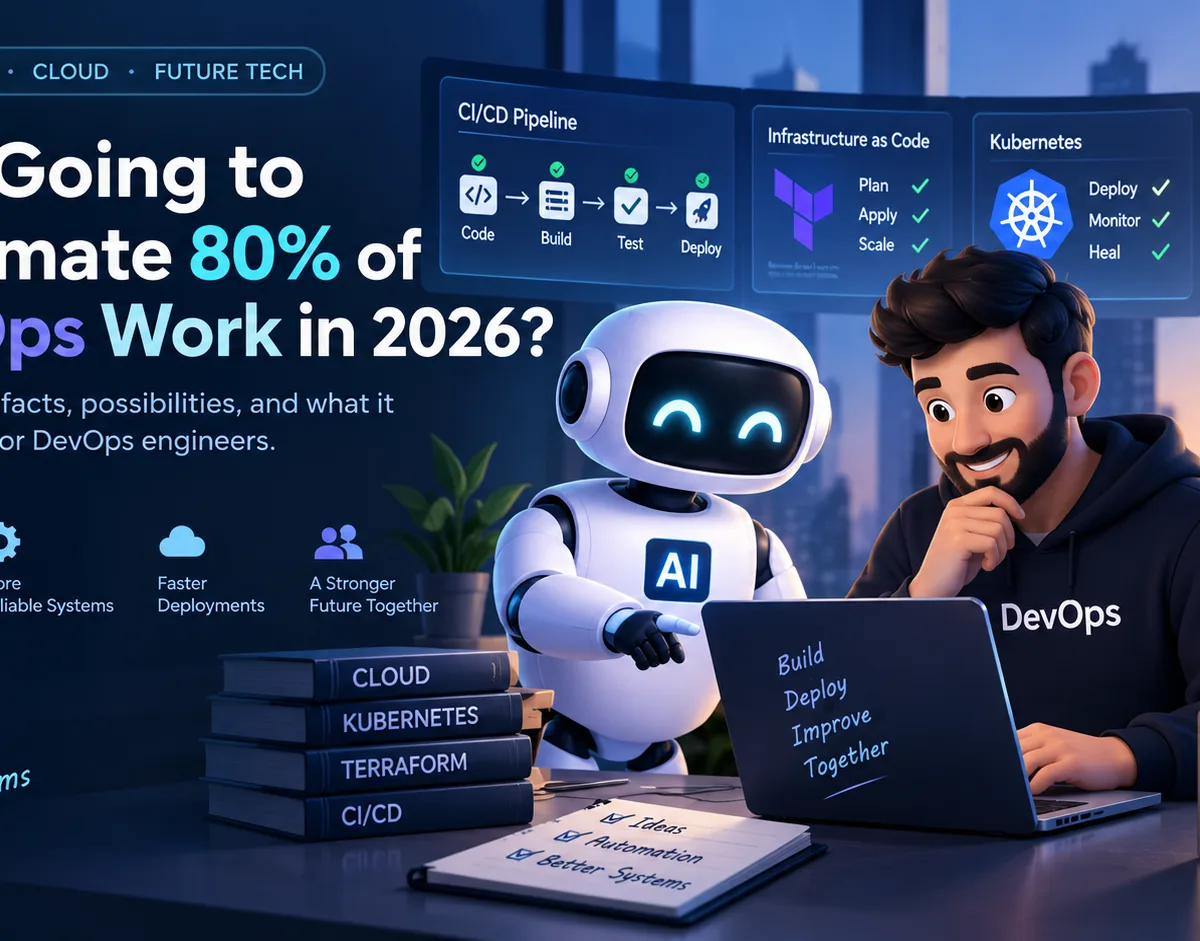
AI in DevOps 2026: How Much of DevOps Will AI Actually Automate?
Search for “AI in DevOps 2026” and you will find the same prediction everywhere:
AI will write CI/CD pipelines. AI will generate Terraform. AI will monitor Kubernetes. AI will analyze logs. AI agents will respond to incidents.
Eventually, some predictions suggest that AI could automate 80% of DevOps work.
But there is an important difference between AI automating 80% of DevOps tasks and AI replacing 80% of DevOps engineers.
They are not the same thing.
DORA's latest research found that 90% of technology professionals use AI at work, while more than 80% report productivity improvements. Puppet's 2026 research found that 66% of organizations are already applying AI in infrastructure workflows, while 31% report fully autonomous operations.
So AI-powered DevOps is no longer just a future concept.
The real question is:
How much of DevOps is actually becoming automated—and what will DevOps engineers do when it does?
What Is AI in DevOps?
DevOps combines software development and IT operations to help teams build, test, deploy and operate applications reliably.
A traditional DevOps workflow looks something like:
Code → Build → Test → Deploy → Monitor → Fix
AI can now assist with almost every stage.
AI DevOps automation can help with:
CI/CD pipeline generation
Infrastructure as Code
Log analysis
Monitoring and observability
Kubernetes troubleshooting
Incident investigation
Security analysis
Routine remediation
This is often connected with AIOps, which means using artificial intelligence to analyze IT operations data such as logs, metrics, events and alerts.
The important change is that AI is moving beyond simply generating code.
It is beginning to help engineers understand and operate production systems.
Where AI DevOps Automation Makes Sense
Think about a production deployment failing at 2 AM.
Traditionally, an engineer might need to:
Open monitoring dashboards.
Check application logs.
Check the latest deployment.
Search for errors.
Compare versions.
Identify what changed.
Decide what to do.
An AI-assisted system could instead provide an initial explanation:
“Deployment failed six minutes after release 4.8. Error rates increased by 18%. The new version introduced a database connection error. Rollback to 4.7 is recommended.”
The engineer still needs to verify the conclusion.
But AI has already reduced the time spent answering the first question:
“What happened?”
That is where AI monitoring, AI observability and AI incident response become valuable.
AI + CI/CD: Less Typing, More Reviewing
CI/CD—Continuous Integration and Continuous Delivery/Deployment—automates the process of taking code from development to production.
AI can generate pipelines, explain failed jobs, create tests and suggest fixes.
However, generated code is not automatically production-ready.
For example, an AI system might see a deployment timeout and recommend:
“Increase the deployment timeout.”
But perhaps the deployment isn't actually slow.
The real problem could be:
A database migration is stuck.
A service cannot connect to the database.
A Kubernetes pod is restarting.
A network rule is blocking traffic.
Increasing the timeout could hide the actual problem.
Therefore, the DevOps role is shifting from:
“Write the pipeline.”
to:
“Understand what the pipeline should safely do.”
That difference matters.
AI + Terraform: Faster Infrastructure, Human Decisions
Terraform is an Infrastructure as Code (IaC) tool. It allows engineers to define cloud infrastructure using code instead of creating everything manually.
AI can generate Terraform configurations for resources such as:
VPCs and subnets
Security groups
Load balancers
EC2 instances
RDS databases
Auto Scaling
IAM policies
This can save significant development time.
But generated infrastructure can still contain serious problems.
For example:
Excessive IAM permissions
Exposed databases
Poor network segmentation
Missing backups
Unnecessary cloud resources
Weak security controls
Higher-than-necessary cloud costs
So:
AI makes Infrastructure as Code faster. It does not automatically make infrastructure safe.
DevOps engineers still need knowledge of cloud architecture, networking, security, IAM, reliability and disaster recovery.
AI + Kubernetes: Connecting the Dots
Kubernetes produces huge amounts of operational information:
Pods → Events → Logs → CPU → Memory → Restarts → Deployments → Network traffic
The challenge is often connecting these signals.
For example:
Deployment changed
↓
Memory usage increased
↓
Pod restarted
↓
OOMKilled event
↓
Application errors increased
AI can potentially correlate these events and explain the relationship.
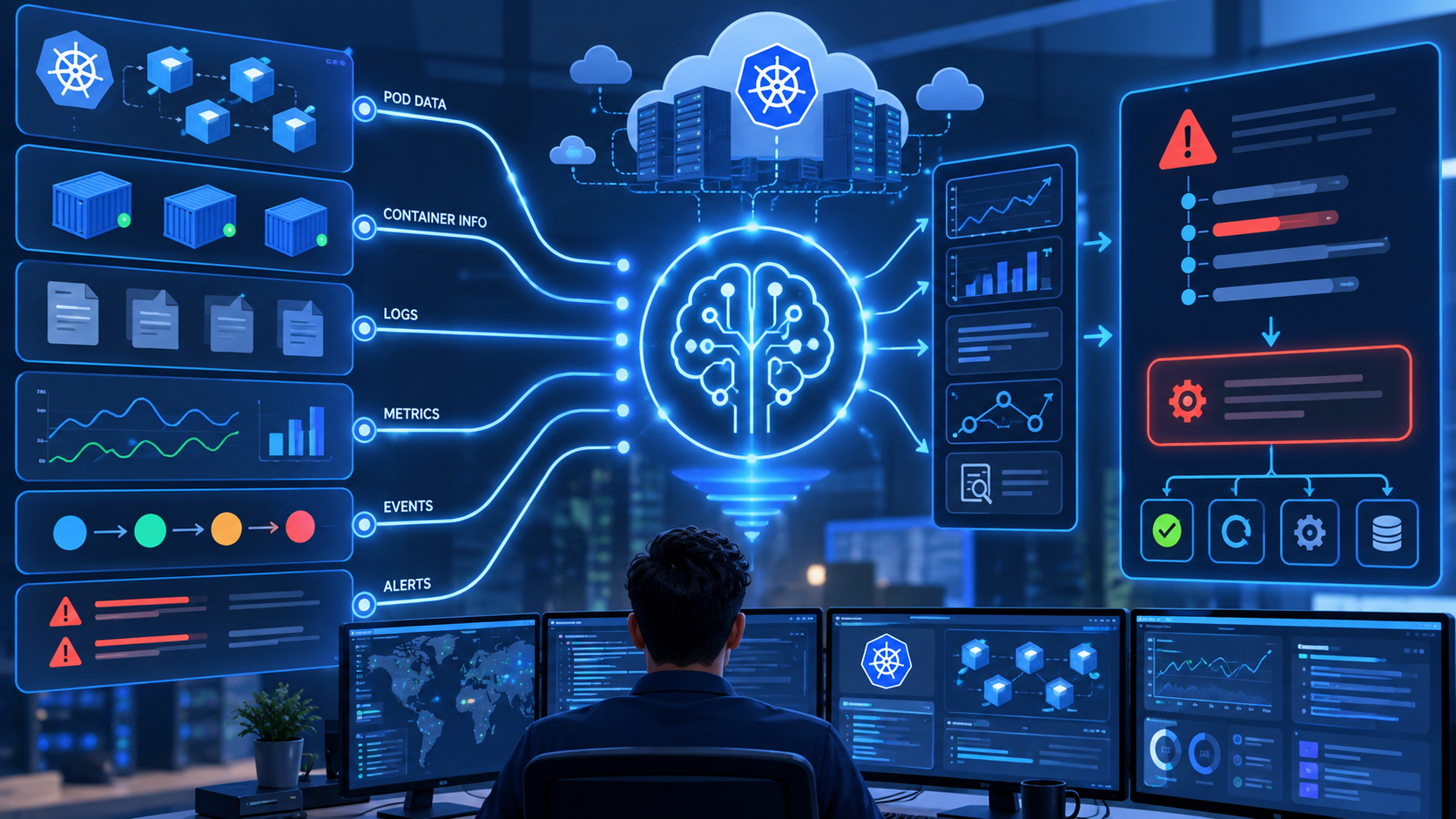
This can dramatically reduce troubleshooting time.
But AI can say:
“This deployment appears to be causing the problem.”
The engineer still needs to decide:
“Should we roll it back?”
That decision could affect thousands of users.
AI Agents in DevOps: From Assistant to Operator
The next major development is AI agents in DevOps.
A normal AI assistant primarily answers questions.
An AI agent can potentially perform a sequence of actions:
Observe → Analyze → Act → Verify
An AI agent could potentially restart a container, investigate an alert or perform an approved rollback.
But unrestricted production access would be dangerous.
A production AI agent should operate with:
Least-privilege permissions
Approval workflows
Policy controls
Audit logs
Monitoring
Rollback mechanisms
Human oversight
The key question is not simply:
“Can AI do it?”
It is:
“Should AI be allowed to do it automatically?”
Can AI Really Automate 80% of DevOps?
Possibly for specific workflows.
But that does not necessarily mean AI will automate 80% of the entire DevOps profession.
AI may automate pipeline generation, log analysis, alert correlation, configuration suggestions and routine remediation.
Humans may still need to decide:
What architecture should we use?
What security model is appropriate?
Should an infrastructure change be approved?
What is the disaster recovery strategy?
How much should the system cost?
What happens if the automated fix fails?
Puppet's 2026 research indicates that AI adoption is more mature in organizations with standardized platforms and governance.
DORA similarly describes AI as an amplifier. Strong engineering systems can benefit from AI, while weak processes can have their problems amplified faster.
So the future is less likely to be:
AI replaces DevOps.
It is closer to:
AI handles more repetitive work while DevOps engineers handle more important decisions.
What Should DevOps Engineers Learn in 2026?
If AI can generate Terraform, pipelines and troubleshooting suggestions, what should engineers learn?
The answer is not to avoid AI.
It is to learn DevOps fundamentals and AI automation together.
A modern DevOps engineer should understand:
Linux
Networking
AWS, Azure or GCP
Docker
Kubernetes
Terraform
CI/CD
Cloud security
Monitoring and observability
SRE
Incident response
Platform engineering
AI agents and automation
The valuable skill is moving from:
“I know the command.”
to:
“I understand the system.”
Knowing how to restart a Kubernetes deployment is easy.
Understanding why it needs restarting, what impact it has on users, whether the problem will return and whether the restart hides a deeper issue requires engineering judgment.
That is where human expertise remains important.
The DevOps Engineer of the Future
A modern AI-powered DevOps workflow could look like this:
Developer pushes code
→ AI reviews the change
→ CI/CD runs
→ Tests and security checks execute
→ Terraform validates infrastructure
→ Kubernetes deploys the application
→ AI monitors the environment
→ An anomaly appears
→ AI investigates
→ Safe remediation is suggested
→ Engineer approves
→ AI performs the action
→ System verifies recovery
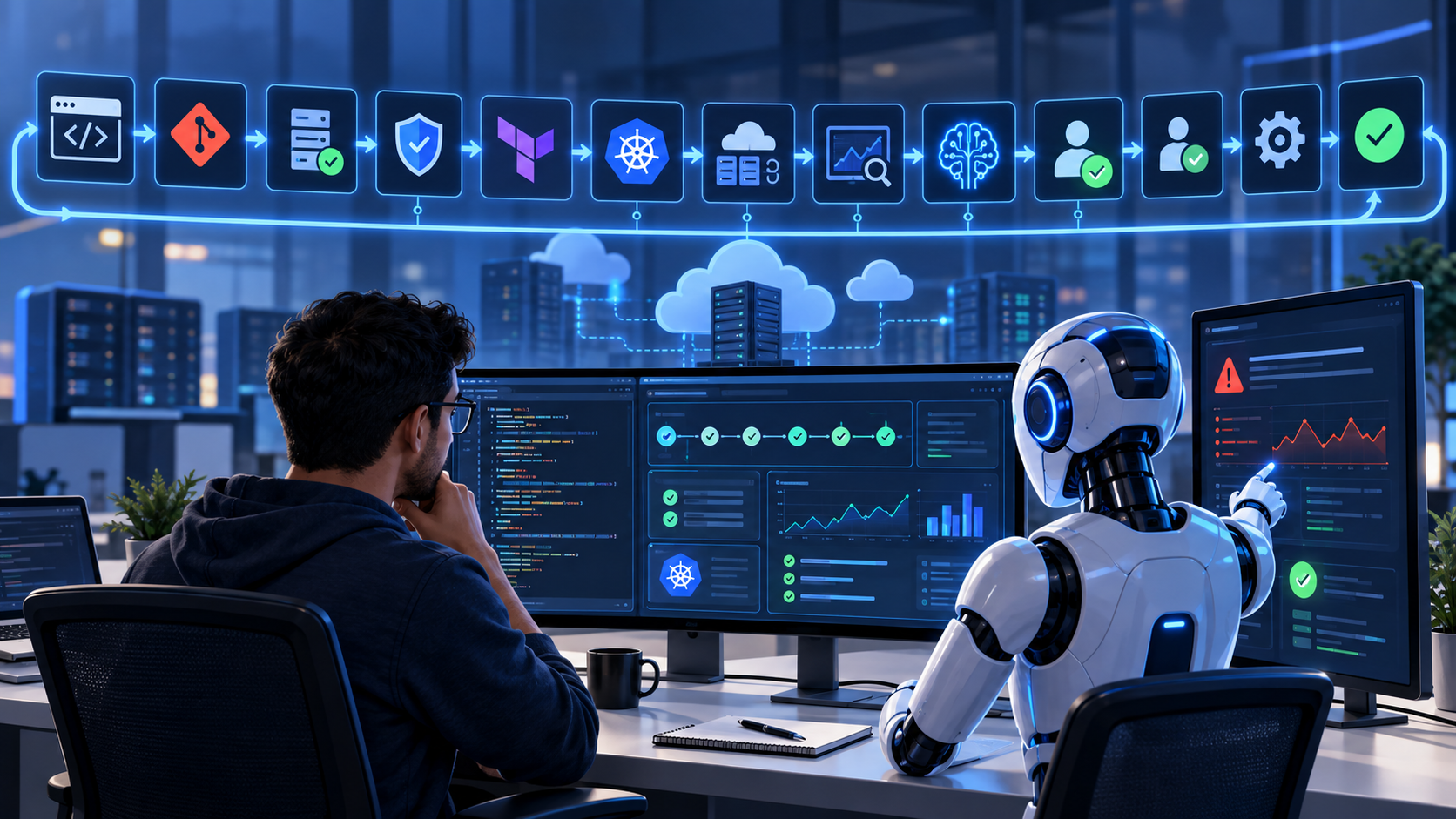
One engineer could potentially supervise significantly more infrastructure than before.
That is the real opportunity.
Not replacing engineers. Giving engineers more leverage.
What Beginners Should Learn
If you are completely new to DevOps, don't start by building an autonomous AI agent.
Build the foundation first:
Linux → Networking → Cloud → Docker → Kubernetes → Terraform → CI/CD → Security → Observability → AI automation
Once you understand how these systems work, AI becomes much more useful.
You can then use AI to generate configurations, investigate incidents, analyze logs and automate repetitive workflows—while still being able to verify whether its suggestions are correct.
The Honest Summary
AI is going to automate a lot of DevOps work.
Some of that automation is already happening.
But the biggest change isn't that AI can write YAML faster.
The bigger change is that AI is starting to participate in the entire operational loop:
Detect → Understand → Recommend → Act → Verify
That means repetitive DevOps work may become less valuable, while architecture, security, reliability, platform engineering and system thinking become increasingly important.
So, will AI automate 80% of DevOps?
Maybe 80% of some workflows. Probably not 80% of the entire profession based on what we know today.
The more interesting question is:
How much more infrastructure will one good DevOps engineer be able to manage when AI handles the repetitive work?
That is where the future of AI in DevOps gets really interesting.
Frequently Asked Questions
Will AI replace DevOps engineers?
AI is already automating parts of DevOps, but current evidence does not establish that the profession is disappearing. The role is shifting toward architecture, security, reliability, platform engineering and supervising automated systems.
What is AI DevOps automation?
It is the use of AI to automate or assist with CI/CD, Infrastructure as Code, cloud infrastructure, monitoring, log analysis, Kubernetes troubleshooting and incident response.
What are AI agents in DevOps?
AI agents can potentially observe systems, analyze problems, perform approved actions and verify the results.
Can AI manage Kubernetes?
AI can assist with Kubernetes monitoring, troubleshooting and configuration analysis. Production changes should have appropriate permissions, validation and safeguards.
Should I learn DevOps in 2026?
Yes. Learn the fundamentals first—Linux, networking, cloud, Docker, Kubernetes, Terraform, CI/CD and security—then learn how AI can automate those workflows.