Every business leader we talk to in 2026 is asking the same question in different words: "Should we plug into an AI agent platform, or build our own?"
It sounds like a technical decision. It isn't. It's a business decision about speed, control, cost, and how much of your competitive edge you're willing to rent from someone else.
Gartner expects 40% of enterprise applications to include task-specific AI agents by the end of 2026. So the real question isn't whether you'll use AI agents. It's how you'll own them.
This guide cuts through the hype with a side-by-side comparison, a 3-year cost reality check, a 60-second decision scorecard, and the hybrid path smart companies are quietly taking.
What's the Difference? (In Plain English)
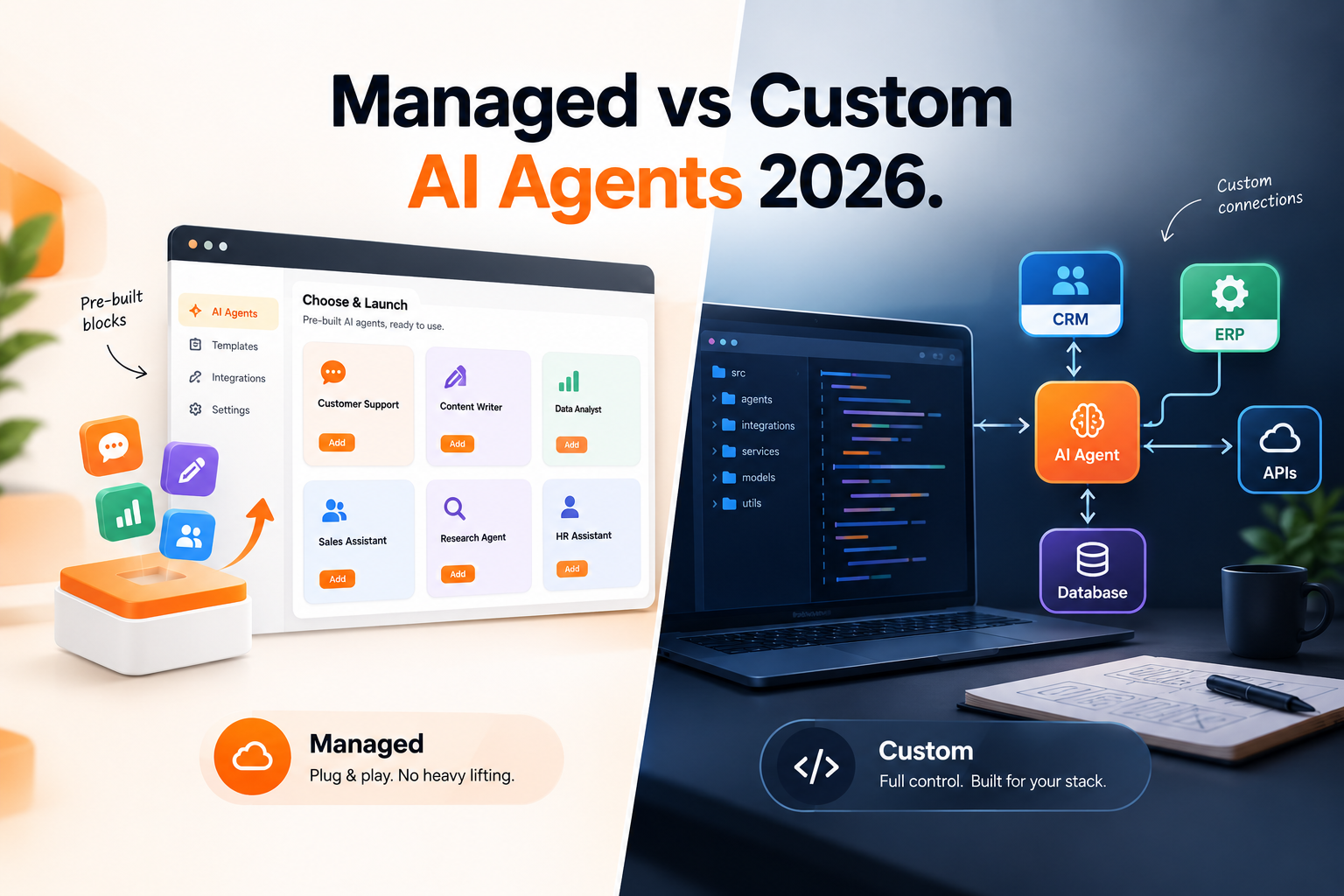
Managed AI agents run on a vendor's platform, such as Salesforce Agentforce, Microsoft Copilot Studio, or hosted agent runtimes from AI model providers. The vendor handles hosting, memory, security layers, monitoring, and model upgrades. You configure; they maintain.
Custom AI agents are built around your business: your data, your workflows, your systems. You (or your development partner) choose the model, design the logic, and own the architecture end to end.
Think of it this way: Managed is renting a fully furnished office. Custom is building your own headquarters. One gets you moving on Monday; the other is designed around exactly how you work.
Managed vs Custom AI Agents: Side-by-Side Comparison
Factor Managed AI Agents Custom AI Agents Time to launch Days to weeks Weeks to months Upfront cost Low Medium to high Ongoing cost Usage fees that grow with volume Infrastructure and upkeep, predictable at scale Customization Limited to platform features Unlimited Integrations Pre-built connectors Any system, including legacy tools Data control Shared with vendor Full ownership AI model choice Vendor decides Choose, switch, or combine models Vendor lock-in High Low Competitive edge Same tools as competitors Unique to your business
Key takeaway: Managed wins on speed. Custom wins on ownership. The right choice depends on which matters more for each specific workflow.
When Managed AI Agents Are the Smart Choice
The use case is common: FAQs, meeting notes, ticket triage, basic lead qualification.
Your data already lives inside one ecosystem, like Salesforce or Microsoft 365.
You need to prove value in weeks, not quarters.
You don't have an in-house AI or DevOps team.
Managed platforms have matured fast. Session memory, tool calling, logging, and guardrails that once took weeks to build now come switched on.
When Custom AI Agents Pay Off
The agent must work across multiple systems: CRM, ERP, databases, internal tools.
It handles sensitive data in healthcare, finance, or legal, where you must document exactly how data is used.
The workflow is what makes your business different, like your pricing logic or fulfilment process.
Volume is high enough that per-task fees start to hurt.
You want freedom to switch AI models as better ones launch.
This is where most businesses get stuck, not on the "why" but on the "how." At BurntStack Technologies, we build custom AI agents that plug into the software you already run, from CRMs and ERPs to legacy databases, without a costly rip-and-replace. See the AI and software products we've built →
The 3-Year Cost Reality Check
Most comparisons stop at upfront cost. That's where expensive mistakes happen.
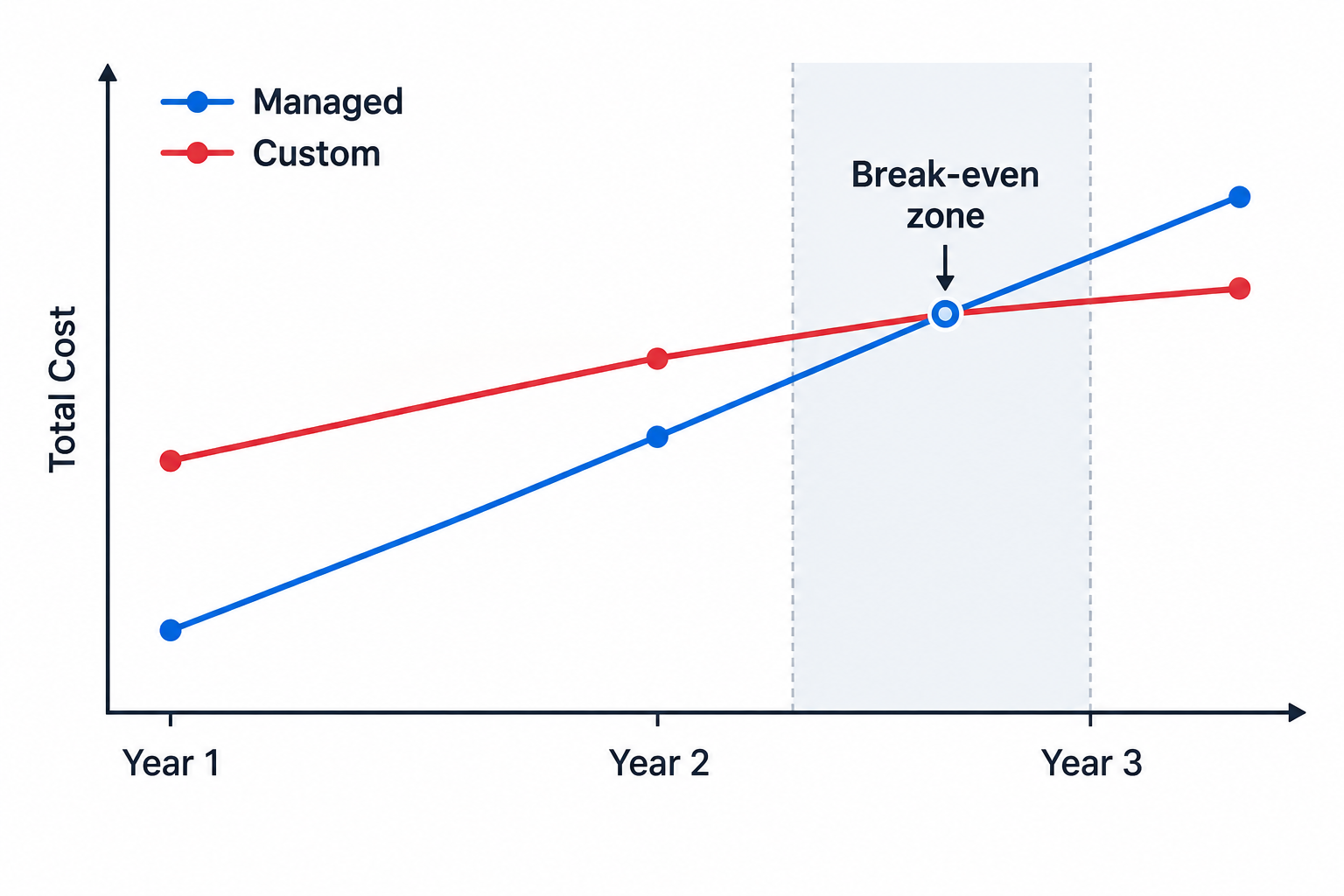
Year 1: Managed looks cheaper. Low setup, quick wins, a predictable monthly bill.
Year 2: Adoption spreads and usage fees climb. You start paying for workarounds the platform doesn't support natively.
Year 3: For high-volume workflows, custom often catches up or pulls ahead, because you pay for infrastructure, not per task. Meanwhile, your managed agent's logic sits on a platform you can't easily leave.
The lesson: Don't compare launch costs. Compare the cost of running the agent at your expected scale in three years, and the cost of leaving if you ever need to.
The 60-Second Decision Scorecard
Give yourself 1 point for every "yes":
Does the agent need to connect to 3+ internal systems?
Does it handle regulated or sensitive customer data?
Is this workflow a core part of how you beat competitors?
Will it handle thousands of tasks per month?
Do you need control over which AI model it uses?
Would vendor lock-in be a serious risk?
Score Your Best Fit 0–2 Start with a managed AI agent 3–4 Go hybrid 5–6 Build custom. Renting will cost you more long-term
The Hybrid Path: What Smart Companies Actually Do
Here's what the "vs" debate misses: well-run companies rarely pick just one.
They use managed agents for everyday tasks like knowledge search and email drafting, and build custom agents for workflows that make money or carry risk, like order processing, claims, or customer onboarding.
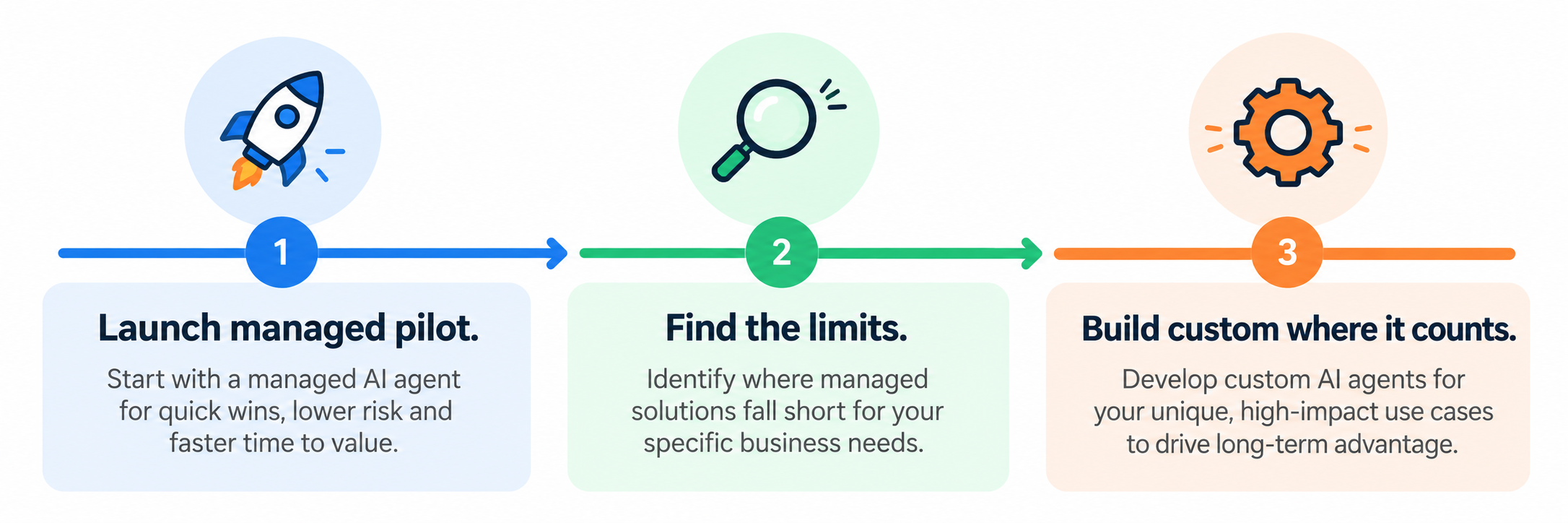
Phase 1 (Weeks 1–6): Launch a managed agent on one low-risk workflow. Measure time saved.
Phase 2 (Months 2–4): Find where the platform hits limits in integrations, cost, or control.
Phase 3 (Months 4+): Build a custom agent for that high-value workflow.
The secret is designing for portability from day one, using standard APIs and protocols like MCP so agents can connect and move as your needs change.
BurntStack helps businesses plan this roadmap end to end: auditing which workflows belong on a platform, which deserve a custom build, and how to connect both through secure APIs so nothing lives in a silo.
5 Questions to Ask Before You Commit
Who owns the data, prompts, and agent logic if we leave?
How do costs change when usage grows 10x?
Can it connect to our legacy systems, or only popular SaaS tools?
How will we monitor accuracy and errors in production?
What happens when a better AI model launches next quarter?
If a vendor or developer can't answer these clearly, that's your answer.
Final Verdict: Which Should You Choose?
There's no universal winner, only the right fit for each workflow.
Choose managed AI agents for speed, standard use cases, and teams without AI engineers.
Choose custom AI agents for proprietary workflows, sensitive data, deep integrations, and long-term cost control.
Choose hybrid for quick wins now and a real competitive edge later.
The businesses that win with AI in 2026 won't have the most agents. They'll own the agents that matter.
Not sure which path fits your business? Talk to the BurntStack team. We'll review your workflows, recommend managed, custom, or hybrid, and give you a clear plan with realistic costs and timelines. Book a free consultation with BurntStack →