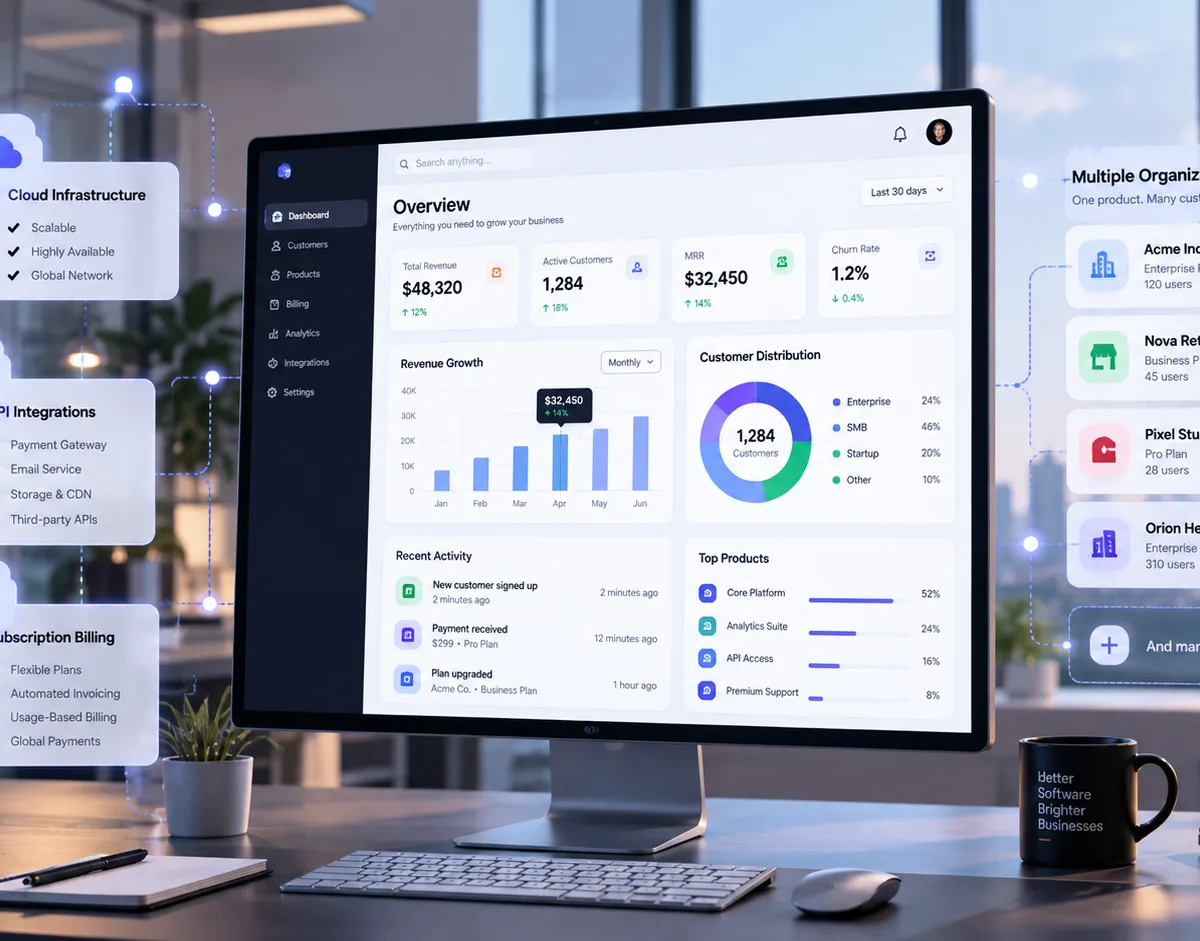
Building a SaaS product is more than creating a web application and putting it online.
A successful SaaS platform needs reliable architecture, user authentication, secure data management, subscriptions, integrations, scalable infrastructure and an experience customers can actually understand.
In 2026, AI-assisted development is making it faster to prototype and launch software. But speed alone doesn't make a SaaS product successful. Product validation, architecture, security and scalability still matter.
SaaS application development services in India help startups and businesses turn an idea, business workflow or existing application into a production-ready software product.
Here's what the process actually involves.
What Is SaaS Application Development?
Software as a Service (SaaS) is a software model where customers access an application through the internet instead of installing and maintaining it themselves.
Examples include:
CRM platforms
Project management tools
Accounting software
HR platforms
Marketing tools
AI-powered applications
Industry-specific business software
Unlike a normal website, a SaaS product is an ongoing application. Users log in, store data, use features, invite team members, change subscriptions and interact with the product continuously.
That's why SaaS development requires more than frontend and backend development.
What Does SaaS Development Include?
A typical SaaS development project can include:
Product discovery and planning
UI/UX design
MVP development
User authentication
Role-based permissions
Multi-tenant architecture
Subscription and payment integration
APIs and third-party integrations
Cloud deployment
Security and backups
Monitoring and maintenance
Not every product needs everything from day one.
The right approach is to identify what the first useful version actually needs.
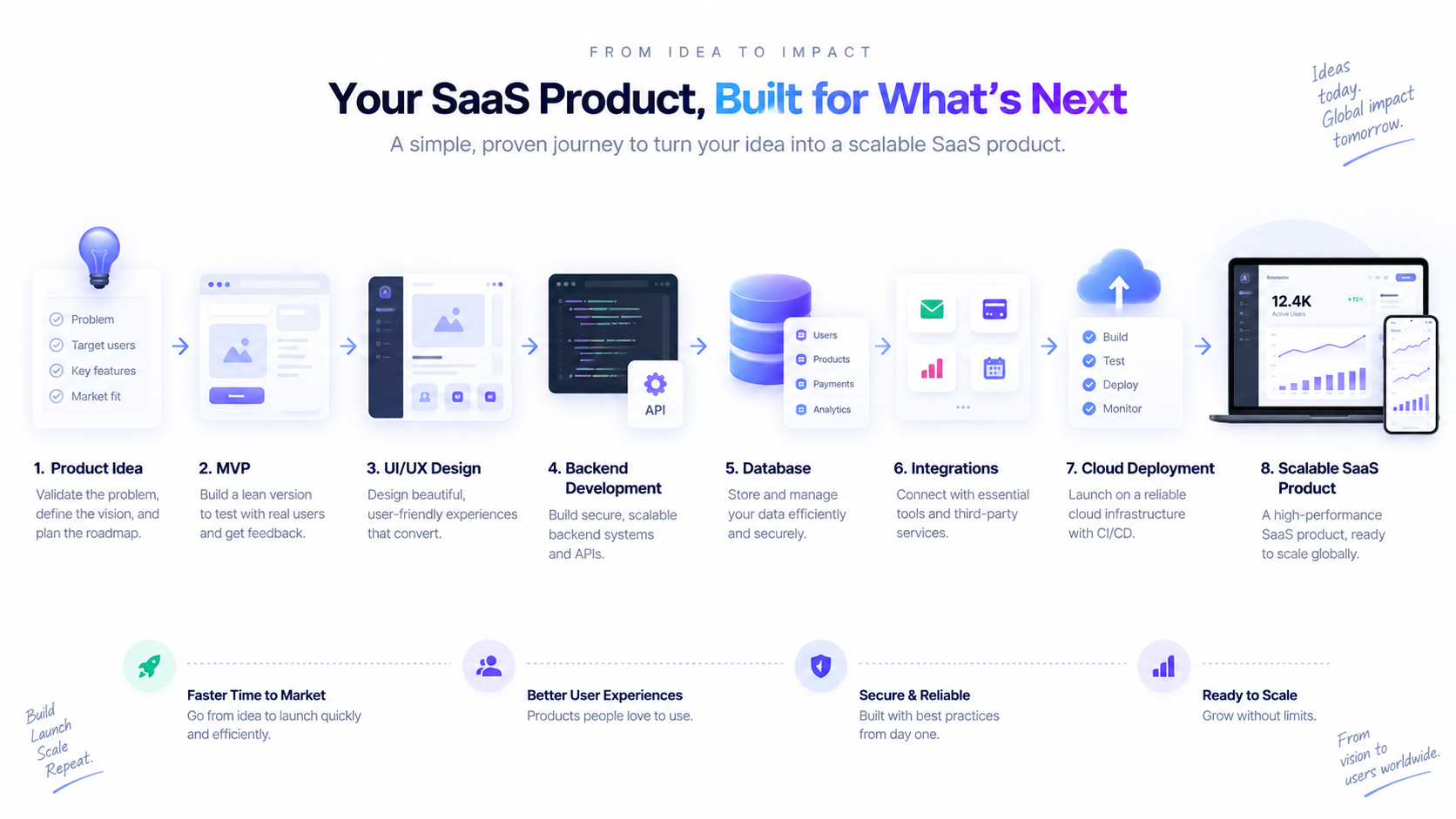
How to Build a SaaS Product
1. Start With the Problem, Not the Technology
Before choosing React, Django, Node.js, AWS or any other technology, understand the problem you're solving.
Ask:
Who has this problem?
How are they solving it today?
How frequently does it occur?
What would make them switch?
Would they pay for a better solution?
This prevents one of the most common SaaS mistakes: spending months building features before validating whether customers actually need them.
2. Build a Focused MVP
Your MVP should contain the smallest set of features required to deliver the product's core value.
For example, an appointment-management SaaS might initially need:
Business account creation
Staff login
Appointment scheduling
Customer records
Calendar
Basic notifications
It probably doesn't need advanced analytics, ten integrations and a mobile application immediately.
Build the core workflow first. Learn from real users. Then expand.
3. Design the SaaS Architecture
Architecture determines how your product handles users, data, integrations and future growth.
A SaaS application may use a monolithic architecture, modular monolith, microservices or a combination of approaches.
You don't automatically need microservices because your product is a SaaS.
For many early-stage products, a well-structured application can be simpler and more practical. Architecture should depend on the product's requirements, expected traffic, team, security requirements and future plans.
AWS's SaaS guidance also emphasizes that there isn't one architecture that fits every SaaS product.
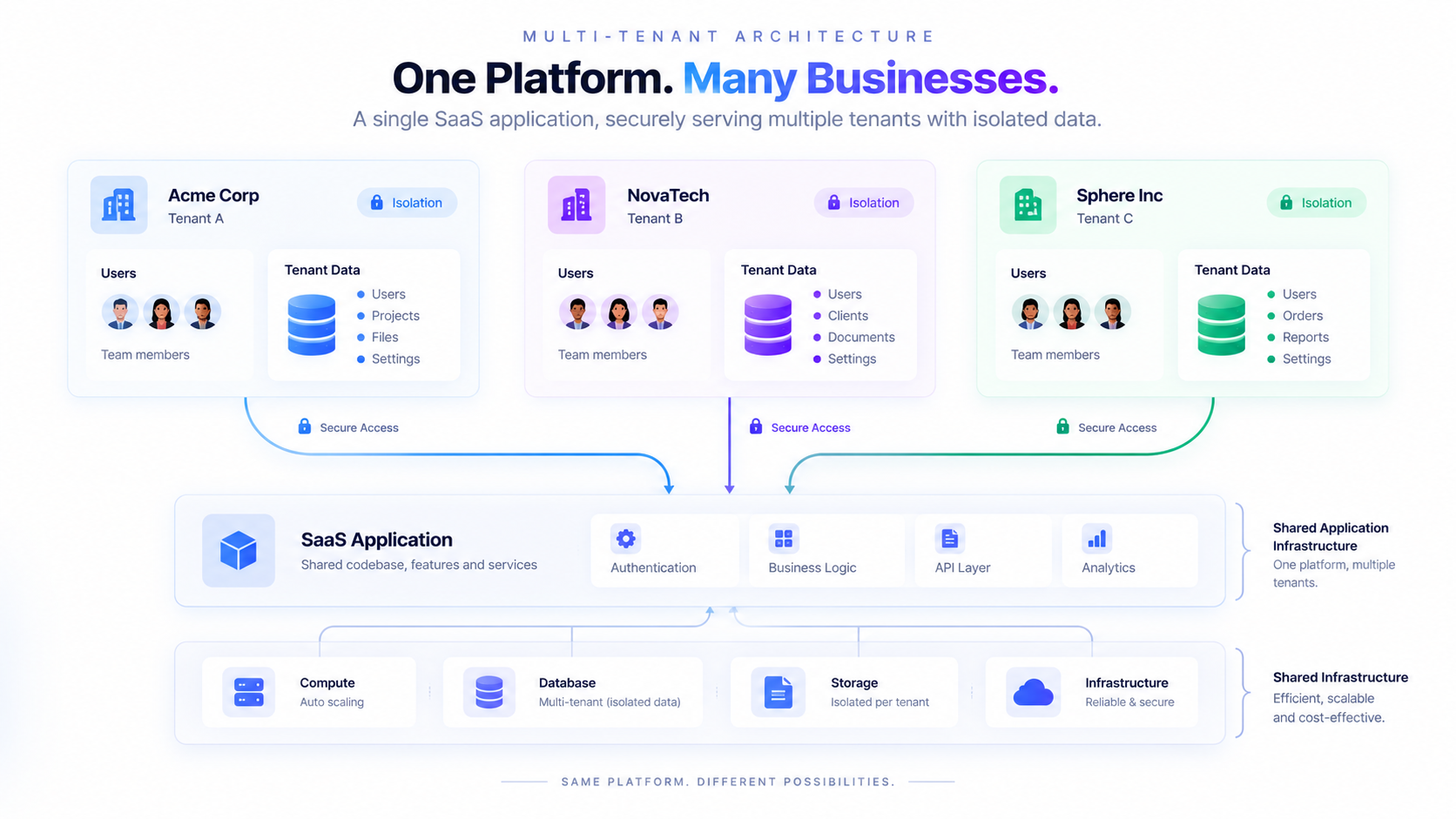
4. Handle Multi-Tenancy and Data Isolation
If your SaaS serves multiple businesses, you need to determine how customer data will be separated.
For example:
Company A → Users → Data
Company B → Users → Data
Company C → Users → Data
All three companies can use the same application while their data remains isolated.
Common approaches include shared databases with tenant-aware records, separate databases, or hybrid models.
The correct approach depends on security, compliance, scale, cost and operational requirements.
AWS provides detailed guidance around tenant isolation and different SaaS isolation models.
What About Authentication and User Roles?
A B2B SaaS application often needs more than basic login.
You may have:
Owners
Administrators
Managers
Employees
Viewers
The system needs to understand both who the user is and which organization they belong to.
For example:
User → Organization → Role → Permissions → Data
This relationship should be handled consistently across authentication and backend authorization.
SaaS Subscription and Payment Integration
If your SaaS operates on a subscription model, billing becomes part of the product.
Depending on your business model, you may need:
Monthly and annual plans
Free trials
Upgrades and downgrades
Cancellations
Invoices
Coupons
Usage-based billing
Platforms such as Stripe provide subscription and usage-based billing infrastructure that developers can integrate into SaaS products.
Your billing architecture should match how you actually charge customers.
A simple subscription product and an AI SaaS platform charging based on usage will require different approaches.
SaaS APIs and Third-Party Integrations
Modern SaaS products rarely operate alone.
A product may need to connect with:
CRM systems
Payment platforms
Email services
Calendars
Analytics tools
AI APIs
Accounting software
Communication platforms
For example, an appointment SaaS could connect with a calendar service, while an AI SaaS product could connect to an AI API and track customer usage.
Good API design also makes it easier to add new integrations and applications later.
How Do You Make a SaaS Application Scalable?
Scalability doesn't mean building the most complicated infrastructure possible on day one.
It means creating a foundation that can evolve as usage increases.
As a SaaS grows, it may eventually require:
Caching
Background jobs
Queues
Database optimization
Load balancing
CDN
Automated deployments
Monitoring
Horizontal scaling
But an MVP doesn't necessarily need all of these.
Start with the expected workload and identify the components that are most likely to become bottlenecks.
Security Should Be Part of SaaS Development
A SaaS application may store customer information, business documents and other sensitive data.
Security considerations can include:
Authentication
Authorization
Tenant isolation
Encryption
Secure APIs
Input validation
Rate limiting
Secrets management
Backups
Monitoring
Security shouldn't be something added immediately before launch.
It should be considered while designing the application architecture.
How Much Does SaaS Development Cost in India?
There isn't one fixed price for SaaS development.
A small MVP with authentication, a dashboard and a few core workflows is very different from an enterprise platform with complex permissions, billing, AI features, integrations and advanced analytics.
The cost usually depends on:
Product complexity
Number of core features
UI/UX requirements
Integrations
Architecture
Security requirements
Development team
Infrastructure
The most reliable way to estimate cost is to define the MVP first and then break the project into discovery, design, development, testing and deployment.
How Long Does It Take to Build a SaaS Product?
The timeline depends on the scope.
A focused MVP can be launched much faster than a mature SaaS platform with multiple integrations and complex workflows.
Instead of asking:
"How many months does SaaS development take?"
Ask:
"What is the smallest version we can launch that solves the customer's main problem?"
That usually produces a more practical roadmap.
Frequently Asked Questions
Does every SaaS product need multi-tenancy?
No. It depends on the product and business model. Multi-tenancy is common when one application serves multiple organizations.
Should a SaaS MVP use microservices?
Not necessarily. A well-structured monolith can be suitable for many early-stage SaaS products. Microservices can be introduced when there is a clear technical reason.
Does every customer need a separate database?
No. Shared, isolated and hybrid approaches are possible. The decision depends on security, compliance, scale and cost.
Can AI be added to a SaaS application?
Yes. AI can be used for chatbots, recommendations, document processing, search, automation, content generation and other product features.
Can an existing application be converted into SaaS?
Often, yes. The application may need changes to support organizations, tenant isolation, permissions, subscriptions and scalable infrastructure.
Final Takeaway
A SaaS product is not simply a website with a login page and subscription button.
It is a software product that needs to work reliably as customers, data and usage grow.
The process is simple at a high level:
Validate the problem → Define the MVP → Design the architecture → Build → Secure → Launch → Measure → Improve → Scale
The goal isn't to build everything on day one.
Build the right foundation, launch the core product and let real customer feedback guide what comes next.
If you're planning to build a SaaS product in 2026,