Description Meta: A guide to the best enterprise sales tools in 2026, including Salesforce, Gong, Clari, Outreach, ZoomInfo, and others with actual prices, categorizations, and an evaluation process for identifying those that are truly worth your money.
Keywords: enterprise sales tools 2026, best sales software for enterprises, enterprise sales tech stack, sales tool price comparison, CRM vs sales engagement tools
TL;DR
Enterprise business-to-business (B2B) deals now involve 13 or more stakeholders on the buying side, and 89% of those deals cross multiple departments within the customer's organization, according to research from Forrester.
By 2026, more than 60% of B2B sales teams will rely on machine learning (ML) based intent scoring to identify and prioritize which prospects are most likely to buy, according to Gartner.
There is no longer a single "best" enterprise sales tool to buy. The market has split into eight separate purchasing categories: customer relationship management (CRM), sales engagement, conversation intelligence, revenue forecasting, sales intelligence and data, sales enablement, demo automation, and account intelligence.
The list price advertised on a vendor's pricing page is rarely the final price you will actually pay. Add-on modules, implementation and onboarding fees, and premium support tiers commonly add another 30–60% on top of the base subscription cost.
The 8-Layer Enterprise Sales Tech Stack, 2026
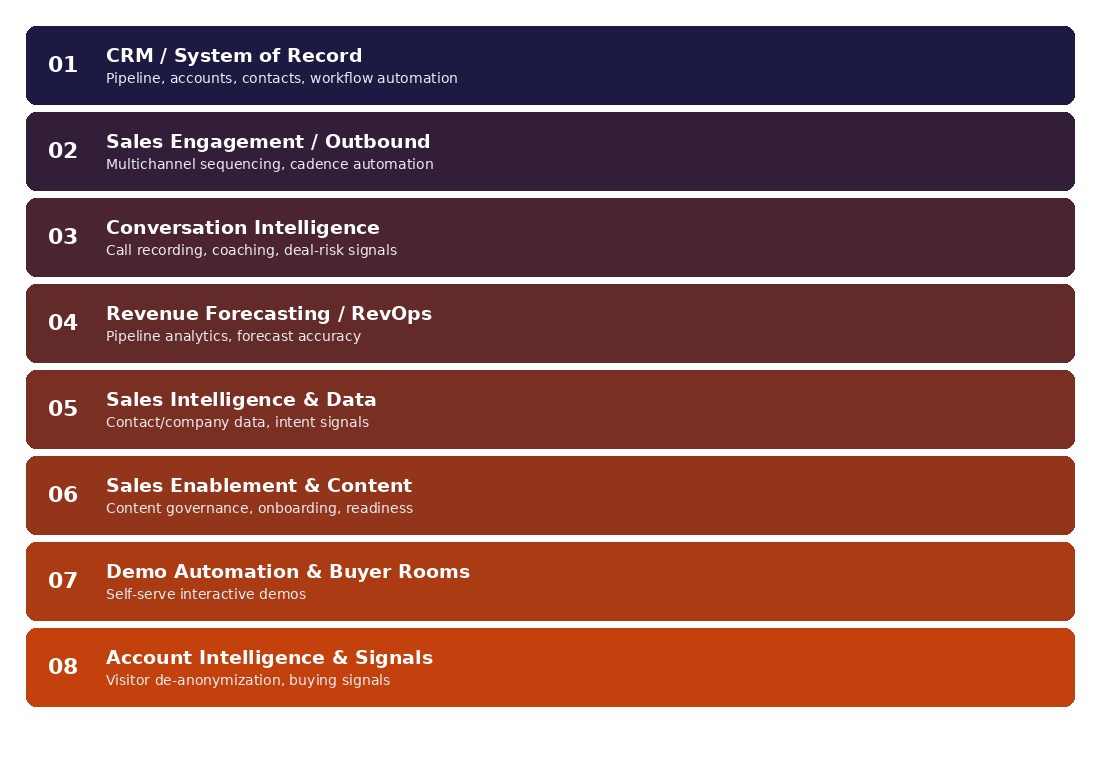
CRM (System of Record) — Pipeline, accounts, contacts, workflow automation. Leading tools: Salesforce, HubSpot
Sales Engagement / Outbound — Multichannel sequencing, cadence automation. Leading tools: Outreach, Salesloft, Saleshandy, Salesforge
Conversation Intelligence — Call recording, coaching, deal-risk signals. Leading tools: Gong, Chorus (ZoomInfo), Clari Copilot
Revenue Forecasting / RevOps — Pipeline analytics, forecast accuracy. Leading tools: Clari
Sales Intelligence & Data — Contact/company data, intent signals. Leading tools: ZoomInfo, Cognism, LinkedIn Sales Navigator
Sales Enablement & Content — Content governance, onboarding, readiness. Leading tools: Highspot, Seismic, Mindtickle
Demo Automation & Buyer Rooms — Self-serve interactive demos. Leading tools: Consensus, Walnut, Guideflow
Account Intelligence & Signals — Visitor de-anonymization, buying signals. Leading tools: Warmly, Salesmotion, 6sense, Demandbase
Choosing the right enterprise sales tools in 2026 is no longer about finding one platform that does everything. Modern B2B sales teams rely on a connected technology stack covering CRM, sales engagement, conversation intelligence, revenue forecasting, sales intelligence, enablement, demo automation, and account intelligence.
In this guide, we compare leading platforms including Salesforce, HubSpot, Gong, Clari, Outreach, ZoomInfo, and emerging AI-native sales tools. We’ll look at what each category does, approximate pricing, where these platforms can provide value, and how enterprise teams can decide what is actually worth paying for.
2026 Pricing Snapshot
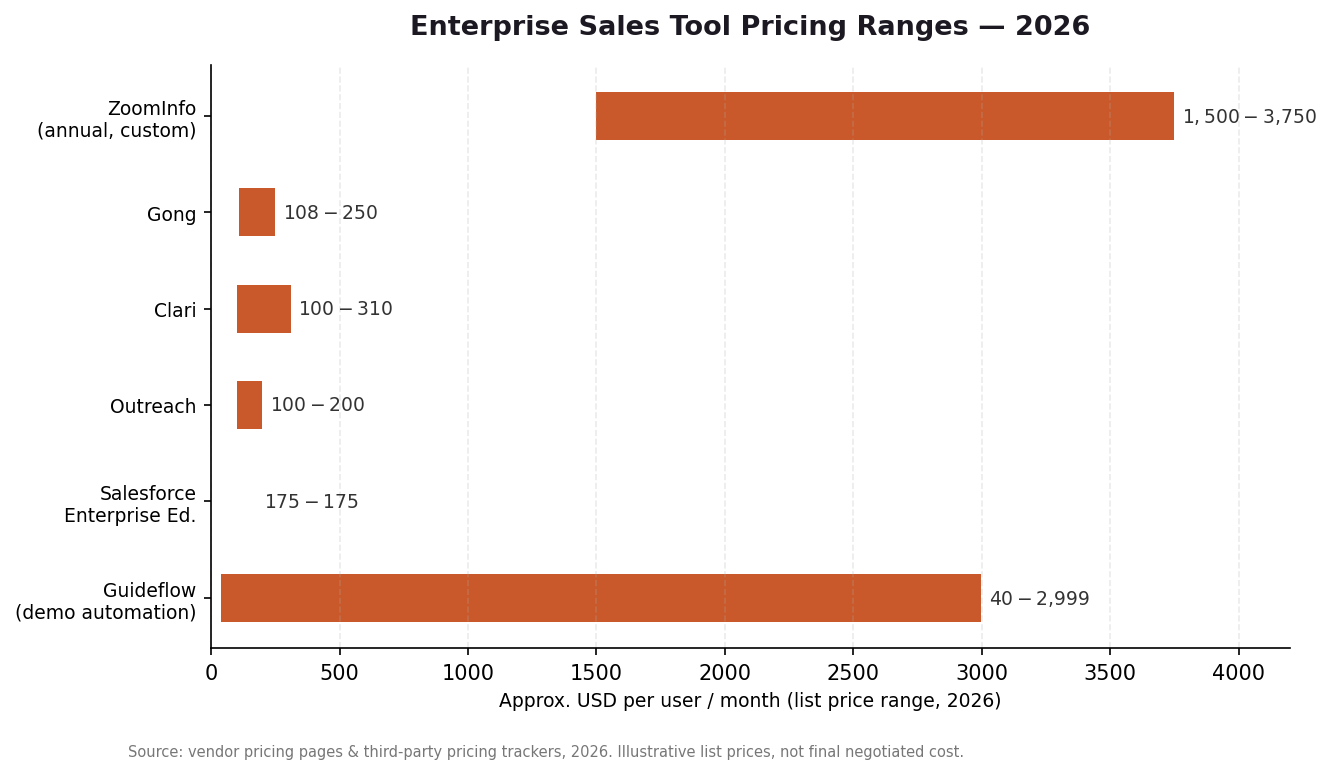
Salesforce Sales Cloud (CRM): $25–$550/user/mo. Enterprise Ed. ≈ $175/user/mo; Agentforce 1 ≈ $550/user/mo
Gong (Conversation Intelligence): $108–$250/user/mo. Plus $15K–$65K implementation on full-stack deals
Clari (Forecasting / RevOps): $100–$310/user/mo. 6 modular tiers, from Core to Enterprise
Outreach (Sales Engagement): $100–$160/user/mo. Kaia add-on for lightweight conversation intelligence
ZoomInfo (Sales Intelligence): ~$18K–$45K+/year. Enterprise data + intent bundles priced per contract
Guideflow (Demo Automation): $40–$2,999/mo. Free tier available; Enterprise from $2,999/mo
Prices are approximate, publicly tracked 2026 list prices — always confirm current, negotiated rates directly with vendors.
Category Breakdown: What's Worth It, What's Not
1. CRM — Salesforce vs. HubSpot
Salesforce: deep customization and approval workflows, but core features (sequencing, conversation intelligence, full sandbox) often sit behind paid add-ons — a 5-seat SDR team can realistically land at $1,250–$8,000+/month once fully provisioned.
HubSpot: faster time-to-value and easier adoption, with less flexibility for highly complex workflows.
Verdict: Worth it if you need governance and customization depth — budget for add-ons from day one.
2. Sales Engagement — Outreach, Salesloft, Saleshandy, Salesforge
Outreach ($100–$160/user/mo) and Salesloft lead on CRM sync and multichannel sequencing.
Newer AI-native platforms like Saleshandy and Salesforge bundle prospecting, sequencing, and (with Salesforge) an autonomous AI SDR agent at a lower blended cost.
Verdict: Worth it once outbound volume is real — smaller teams often get better ROI from the AI-native all-in-one platforms.
3. Conversation Intelligence — Gong vs. alternatives
Gong's 2026 modular pricing (Foundation + Engage + Forecast) now runs $240–$250/user/mo plus $15K–$65K implementation, and its valuation reset from $7.25B to ~$4.5B has pushed real customer migration to alternatives.
Chorus (ZoomInfo) and Clari Copilot deliver much of the same value at a lower blended cost, especially if you already pay for ZoomInfo.
Verdict: Worth it at scale; mid-market teams should evaluate the bundled alternatives first.
4. Revenue Forecasting — Clari
$100–$310/user/mo across six modular tiers, built for RevOps and CRO-level pipeline visibility rather than rep productivity.
Verdict: Worth it once you're forecasting off more than spreadsheets — skip it under ~20 quota-carrying reps.
5. Sales Intelligence & Data — ZoomInfo, Cognism, LinkedIn Sales Navigator
ZoomInfo ($18K–$45K+/year) has the largest contact/intent database; Cognism leads on GDPR-compliant EMEA coverage; Sales Navigator offers native LinkedIn signal.
Verdict: Worth it — but audit match rate and data freshness for your vertical and region before signing.
6. Sales Enablement — Highspot, Seismic, Mindtickle
An estimated 58% of enterprise pipelines stall because reps don't deliver the right content at the right moment (Landbase).
Verdict: Worth it for 100+ rep organizations with content sprawl — overkill for small, aligned teams.
7. Demo Automation — Consensus, Walnut, Guideflow
Guideflow runs free → $499/mo (Growth) → $2,999/mo (Enterprise) and lets technical buyers self-navigate demos asynchronously.
Verdict: Worth it when your buying committee includes technical evaluators who explore on their own schedule.
8. Account Intelligence & Signals — Warmly, Salesmotion, 6sense, Demandbase
De-anonymizes website visitors and tracks buying-committee-level signals like hiring surges and leadership changes.
Verdict: Pilot it — the category is young and consolidation is likely within 18–24 months.
Our Evaluation Framework at Burntstack
We run every sales tool through the same five checks before recommending it to a client:
API-first — if integration sits behind "contact sales," treat that as a real cost.
Total cost of ownership — add-ons and implementation typically add 30–60% on top of list price.
Compliance — SOC 2 Type II, ISO 27001, and GDPR are assumed, not negotiated.
Adoption cost — a tool reps won't use has negative ROI regardless of features.
Time to value — longer implementations need proportionally bigger, more certain payoffs.
Bottom Line: What to Actually Pay For in 2026
Buy:
A right-sized CRM (Salesforce for depth, HubSpot for speed)
One sales engagement platform, chosen for deliverability + CRM sync
Conversation intelligence, once rep count makes coaching consistency measurable
A forecasting/RevOps layer, once pipeline outgrows spreadsheets
Demo automation, if buyers include technical evaluators
Pilot only:
Account intelligence / signal-based orchestration platforms
Standalone AI SDR agents — evaluate against your own reply-rate data first
FAQ
Q1. What is the best enterprise sales tool in 2026?
There's no single "best" tool — the stack now spans 8 categories (CRM, engagement, conversation intelligence, forecasting, data, enablement, demo automation, account intelligence). The right mix depends on rep count, deal complexity, and existing CRM investment.
Q2. How much do enterprise sales tools cost in 2026?
Most platforms price $100–$550/user/month, with data platforms like ZoomInfo billed annually at $18,000–$45,000+. Budget an extra 30–60% for add-ons and implementation.
Q3. Is Salesforce still worth it for enterprise sales teams in 2026?
Yes, for teams needing deep customization and complex approval workflows — but core features like sequencing and conversation intelligence are often paid add-ons above the base edition.
Q4. What's replacing traditional CRM add-ons in 2026?
AI-native, all-in-one platforms (like Salesforge's autonomous SDR agent) increasingly bundle prospecting, sequencing, and AI outreach into a single platform at lower blended cost.
This post reflects publicly available vendor pricing and third-party market research as of September 2026. Enterprise software pricing changes frequently — always confirm current rates directly with vendors before budgeting.