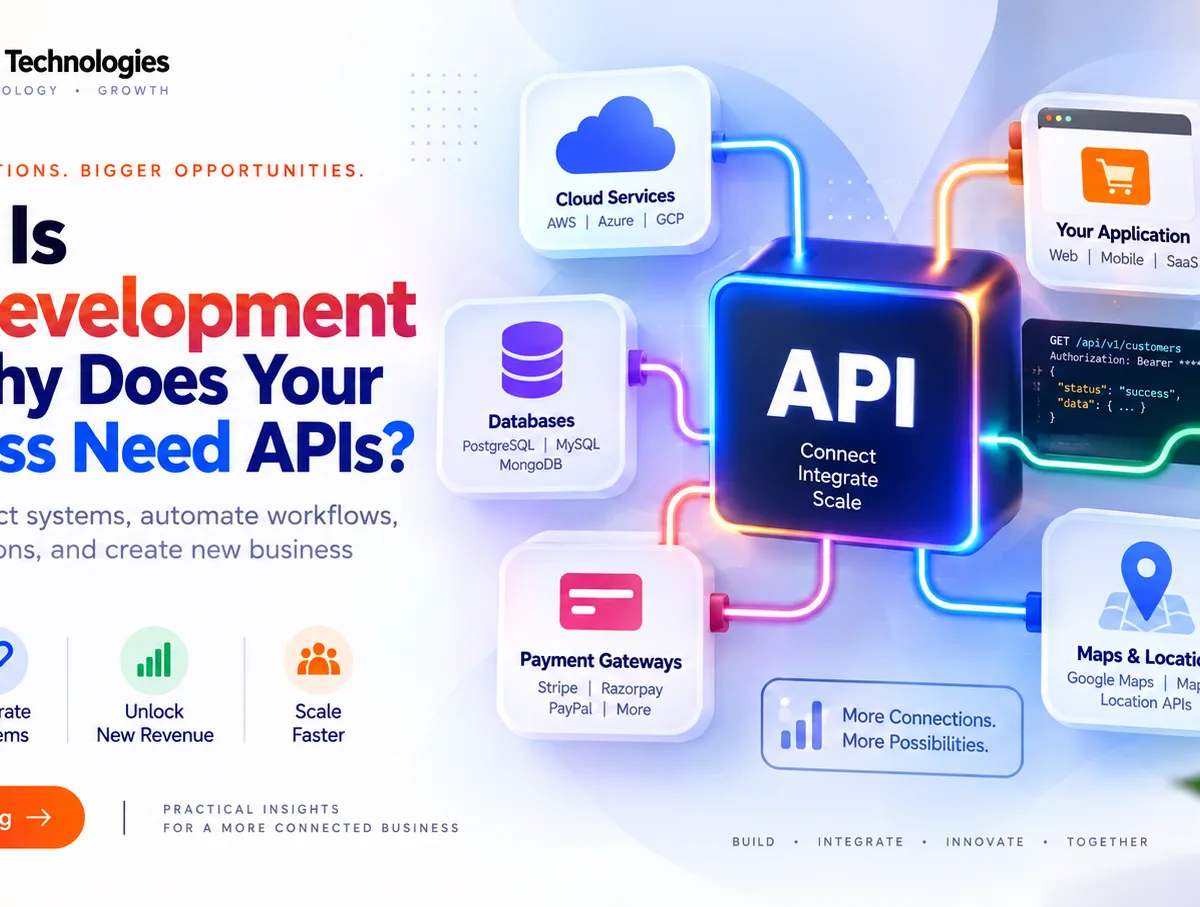
Every time you check a flight price on a travel site, pay for something with a saved card, or see a map embedded in a restaurant's website, an API just did the work quietly, in milliseconds, without you ever knowing it was there. That invisibility is exactly why APIs are one of the most underrated line items in a modern technology budget. They don't show up in a demo the way a slick UI does, but they're often the reason the rest of the business works at all.
The numbers back this up. The global API economy is on track to grow from roughly $17 billion in 2025 to about $20 billion in 2026, and 82% of organizations now describe themselves as having adopted an API-first approach to building software, up sharply from just a few years ago. API development isn't a developer trend anymore. It's how businesses connect to customers, partners, and their own internal teams, and it's quickly becoming a core part of business APIs strategy rather than a back-office technical detail.
What Is an API, Really?
API stands for Application Programming Interface, but the acronym hides how simple the idea actually is. An API is a defined way for one piece of software to request something from another piece of software: data, an action, a calculation, without needing to know how that other system works internally.
Think of it like a restaurant menu. You don't need to know how the kitchen is organized, what order the chef works in, or which supplier the ingredients came from. You just need the menu: a clear, limited list of what you're allowed to ask for, and what you'll get back. An API is that menu, sitting between your software and someone else's, or between two parts of your own systems.
What Does "API Development" Actually Involve?
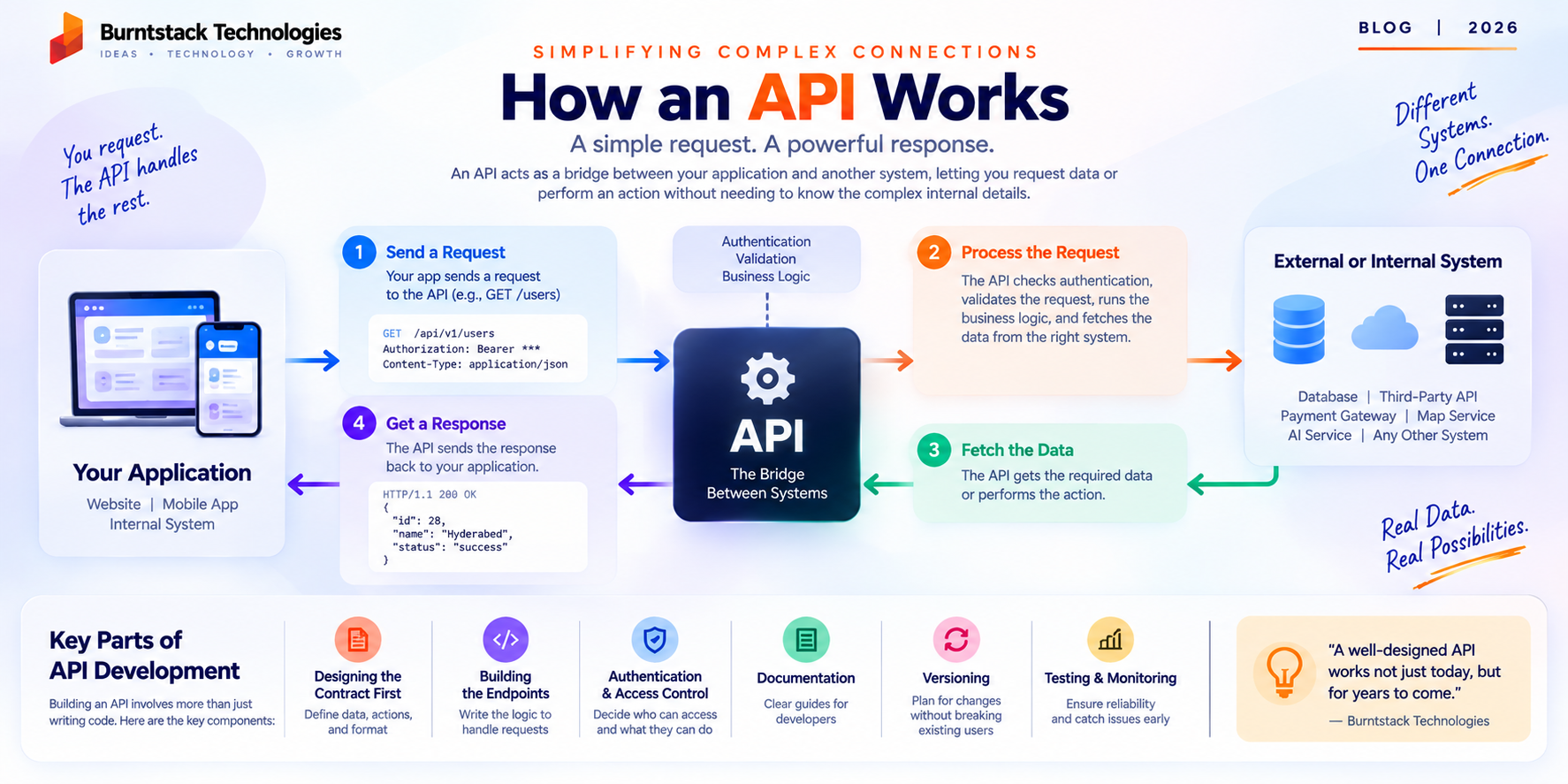
Building an API well is a different discipline from building a feature. It's less about "does this work" and more about "will this still work when a hundred other systems depend on it, some of which you'll never meet." In practice, API development typically covers:
Designing the contract first: deciding what data and actions the API will expose, in what format, before writing implementation code
Building the endpoints: the actual logic that receives a request and returns a response
Authentication and access control: deciding who's allowed to call the API, and what they're allowed to do
Documentation: a clear reference so other developers (including your own future team) can actually use it without guessing
Versioning: a plan for changing the API later without breaking everyone who already depends on it
Testing and monitoring: verifying it behaves correctly under real conditions, and catching failures before customers do
Skip any one of these, and the API might work in a demo but fail the moment it meets the real world.
The Business Case: Why This Isn't Just a Developer's Problem
Here's the part that tends to surprise non-technical leaders: for a growing number of major companies, APIs aren't supporting infrastructure. They're a direct revenue line.
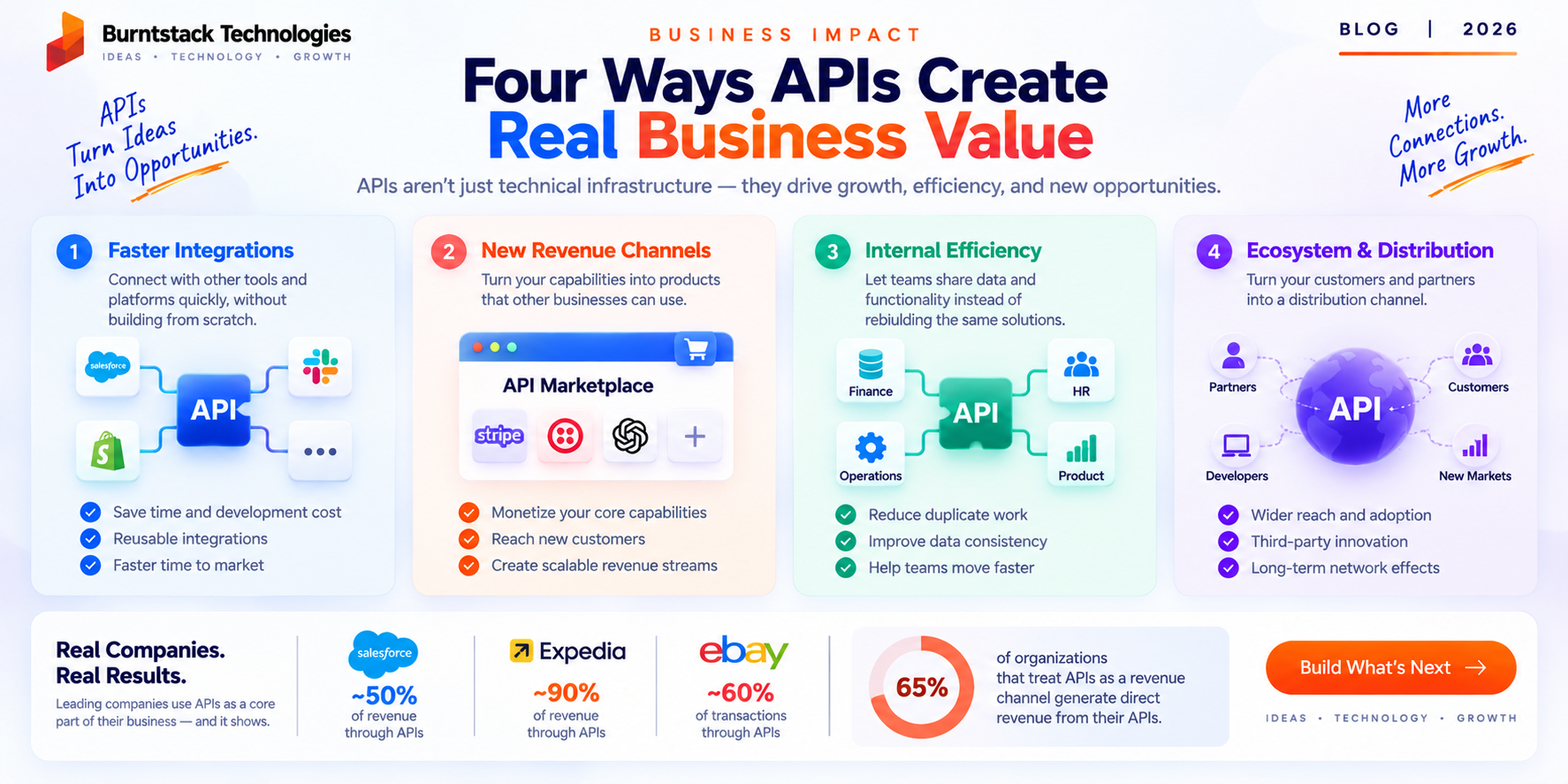
Salesforce generates roughly half of its revenue through APIs, powering the integrations that let its CRM plug into thousands of other business tools.
Expedia built approximately 90% of its revenue around its API, letting travel sites and apps embed its booking engine directly.
eBay generates around 60% of its transactions through API-driven access, not its own website.
Across organizations that treat APIs as a revenue channel rather than plumbing, 65% now generate direct revenue from their APIs, and for nearly three-quarters of those companies, that revenue makes up at least 10% of total income.
That's the pattern worth sitting with: the companies furthest ahead didn't add APIs as an afterthought. They built their product as an API first, then wrapped interfaces around it.
Four Ways APIs Directly Create Business Value
1. Faster integrations. Instead of building a custom, one-off connection every time a customer wants your product to talk to Salesforce, Slack, or their own internal database, a well-built API lets you support that integration once and reuse it indefinitely.
2. New revenue channels. Stripe doesn't sell payment software; it sells an API that other companies build their payment flows on top of. Twilio did the same for messaging, and OpenAI is doing it for language models. In each case, the API is the product.
3. Internal efficiency. APIs aren't only for external partners. Amazon's internal mandate, famously requiring every team to expose its data and functionality through an API rather than sharing it ad hoc, is credited as part of the foundation that let AWS become possible at all. Internal APIs stop teams from quietly rebuilding the same logic five different times.
4. Ecosystem and distribution. A public API turns your customers and partners into a distribution channel. Every developer who builds something on top of your API is, in effect, doing a small amount of your marketing and product development for you.
The Three Kinds of APIs Businesses Actually Use
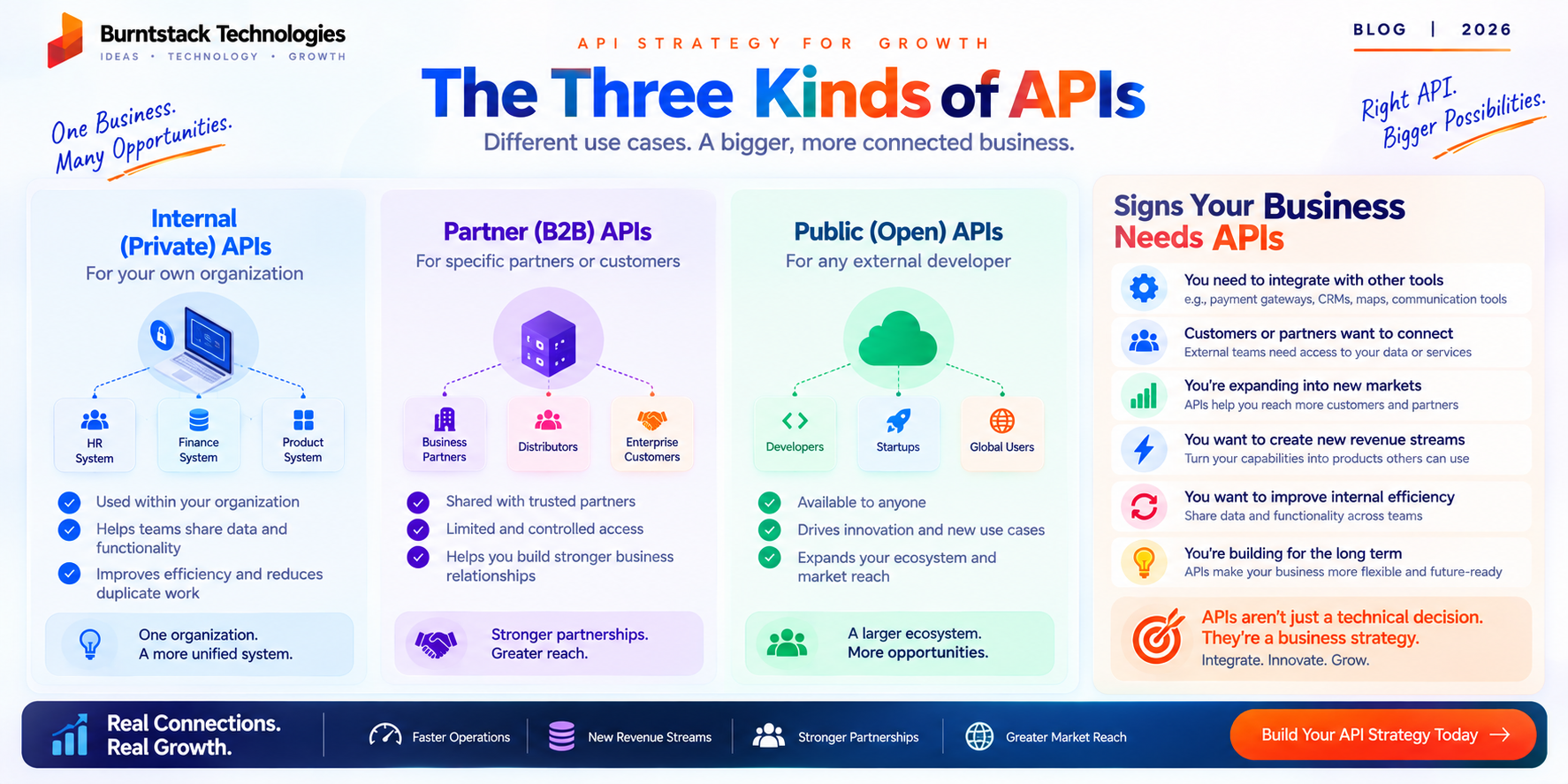
Internal (private) APIs: used only within your own organization, to connect internal systems, teams, and applications to each other
Partner APIs: shared with specific, approved business partners under a formal agreement, often for integrations like payment processing or logistics
Public (open) APIs: available to any developer, sometimes free and sometimes monetized, designed to let external teams build on your platform
Most companies that treat APIs seriously use all three at once, just for different purposes. On the technical side, REST remains the dominant style by a wide margin, used in roughly 93% of API implementations, because it's simple, well-understood, and works over standard web infrastructure. Alternatives like GraphQL have a place for specific use cases with complex, nested data needs, but REST is still the safe, default choice for most business applications.
Signs Your Business Needs an API Strategy
You probably need to take API development seriously if any of the following sound familiar:
Your team manually re-enters the same data into two or more different systems
Customers or partners have asked to "integrate" with you and you didn't have a clean way to say yes
You're planning a mobile app that needs to talk to the same backend as your website
Adding a new feature means touching code in five unrelated places
Your sales team has lost a deal because a prospect asked "can this connect to X" and the honest answer was no
None of these are emergencies on their own. Together, they're a sign that the cost of not having a proper API is quietly compounding.
How Burntstack Approaches API Development
We treat API work as infrastructure, not a feature ticket. Five principles guide every API we build for a client:
Design before code. We define the contract (endpoints, data shapes, authentication model) before writing implementation, so the API is shaped by what consumers actually need, not by whatever was easiest to build first.
Security by default, not by request. Authentication and access control are built in from day one, not bolted on after a client asks about it.
Documentation is a deliverable. An undocumented API is only usable by the person who built it. We treat clear docs as part of "done," not a nice-to-have.
Versioning discipline. We plan for how the API will change before it needs to, so future updates don't break every integration built on top of it.
Built to scale past the first customer. An API that only works at low traffic isn't finished; we design for the load the business expects to have, not just the load it has today.
Common Mistakes Businesses Make with APIs
Shipping without authentication. It's a more common problem than most leaders assume: a meaningful share of API traffic industry-wide still runs without proper authentication in place, which is a direct security liability.
Treating documentation as optional. Inconsistent or missing documentation is one of the most frequently cited blockers API teams report, and it quietly taxes every future integration.
Skipping the design phase. Writing code before agreeing on the data contract almost always means rebuilding it once real consumers show up with real requirements.
No versioning plan. Without one, every future change risks breaking every system that already depends on the API, which makes teams afraid to improve it at all.
Treating an API as a one-time project. APIs are more like a product than a feature; they need monitoring, support, and a plan for what happens when something breaks in production.
FAQ
What's the difference between an API and a website? A website is built for people to read and click through in a browser. An API is built for other software to send and receive structured data, no visual interface required. Many products have both: a website for humans, and an API doing the same job for other applications.
Does a small business actually need an API? Not always immediately, but the moment you want your product to connect to another tool, support a mobile app, or let a partner integrate with you, an API stops being optional. Building it deliberately early is almost always cheaper than retrofitting one later.
How long does it take to build a business API? It depends entirely on scope. A simple internal API connecting two systems might take a few weeks; a public, documented, versioned API meant for external developers is a larger undertaking closer to a full product launch. The design phase matters more to the timeline than most people expect.
Can APIs be a security risk? Yes, if built carelessly. A poorly secured API is effectively an open door into your systems. That's exactly why authentication, access control, and monitoring need to be part of the build from the start, not added after something goes wrong.
Building APIs That Actually Support the Business
The best API development strategy isn't the one with the most endpoints. It's the one that removes a real bottleneck: the manual data entry your team does every day, the integration your customers keep asking for, the internal tool five different teams have quietly rebuilt on their own. Burntstack Technologies designs and builds business APIs and system integrations around the way your company actually operates, not a generic template.
This post reflects publicly available market research and industry survey data as of September 2026. Figures on API adoption and revenue share are illustrative benchmarks from cited sources, not guarantees for any specific business.