How to Build an MVP in 2026: From Idea to Launch
Search how to build an MVP and every guide says the same thing. Define the problem. Prioritise with MoSCoW. Pick a tech stack. Build in sprints. Launch. Iterate. Then a cost table at the bottom.
That advice was written for a world where writing code was the expensive part.
That world is gone. By early 2026, close to half of all new code shipped was written by AI, and 84% of people using AI coding tools have no engineering background at all.
So the real question is no longer how do I build a minimum viable product. It is this:
What do I build — and will it survive being right?
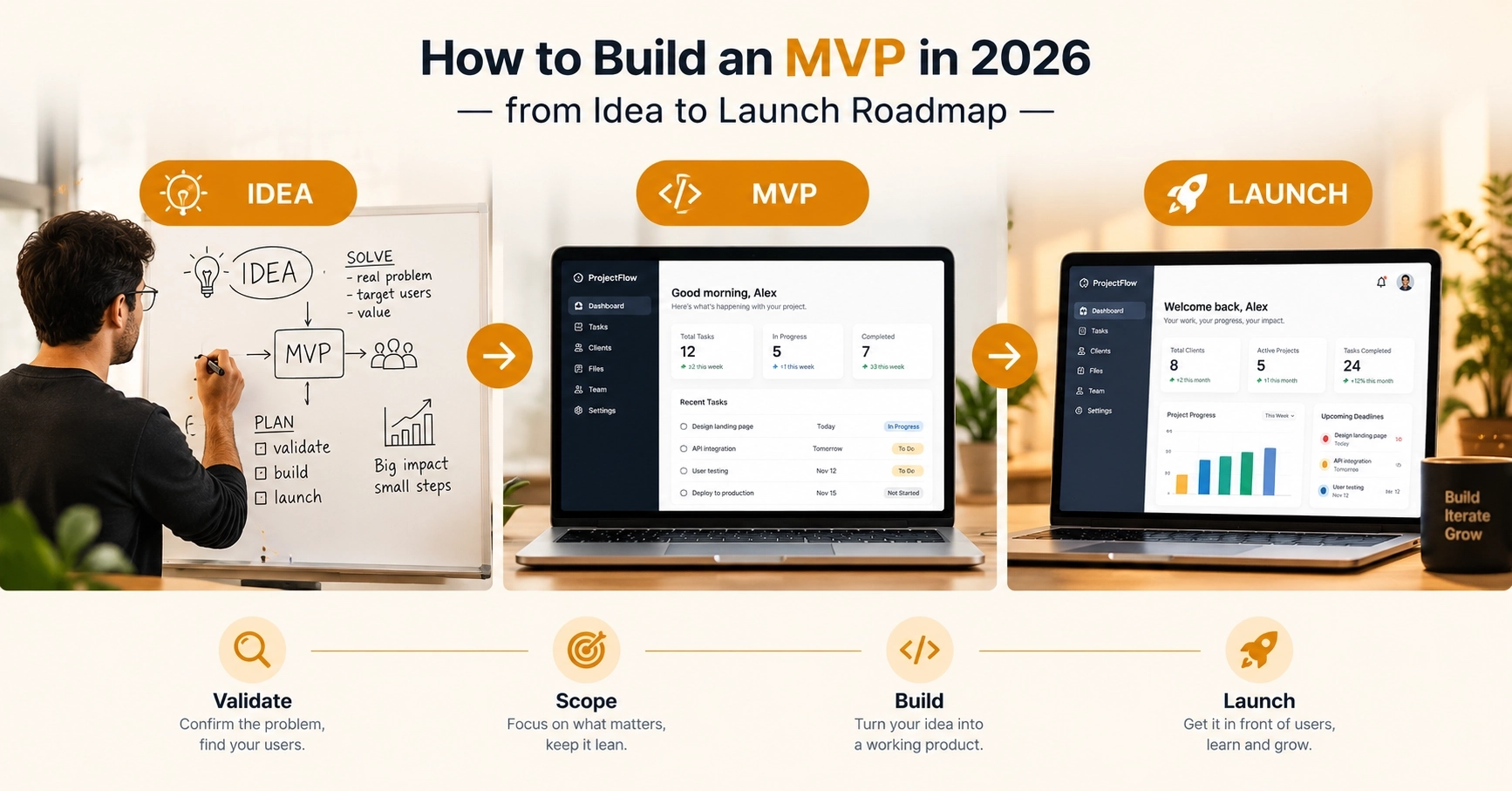
What changed in MVP development between 2021 and 2026
MVP in 2021 MVP in 2026 Hardest part Writing the code Deciding what to build Time to first version 3–6 months 3–6 weeks Main cost Developer salaries The rebuild after traction Biggest risk Running out of runway Shipping something that can't scale What stops you Engineering capacity Scope discipline
The bottleneck moved. Most MVP guides haven't noticed.
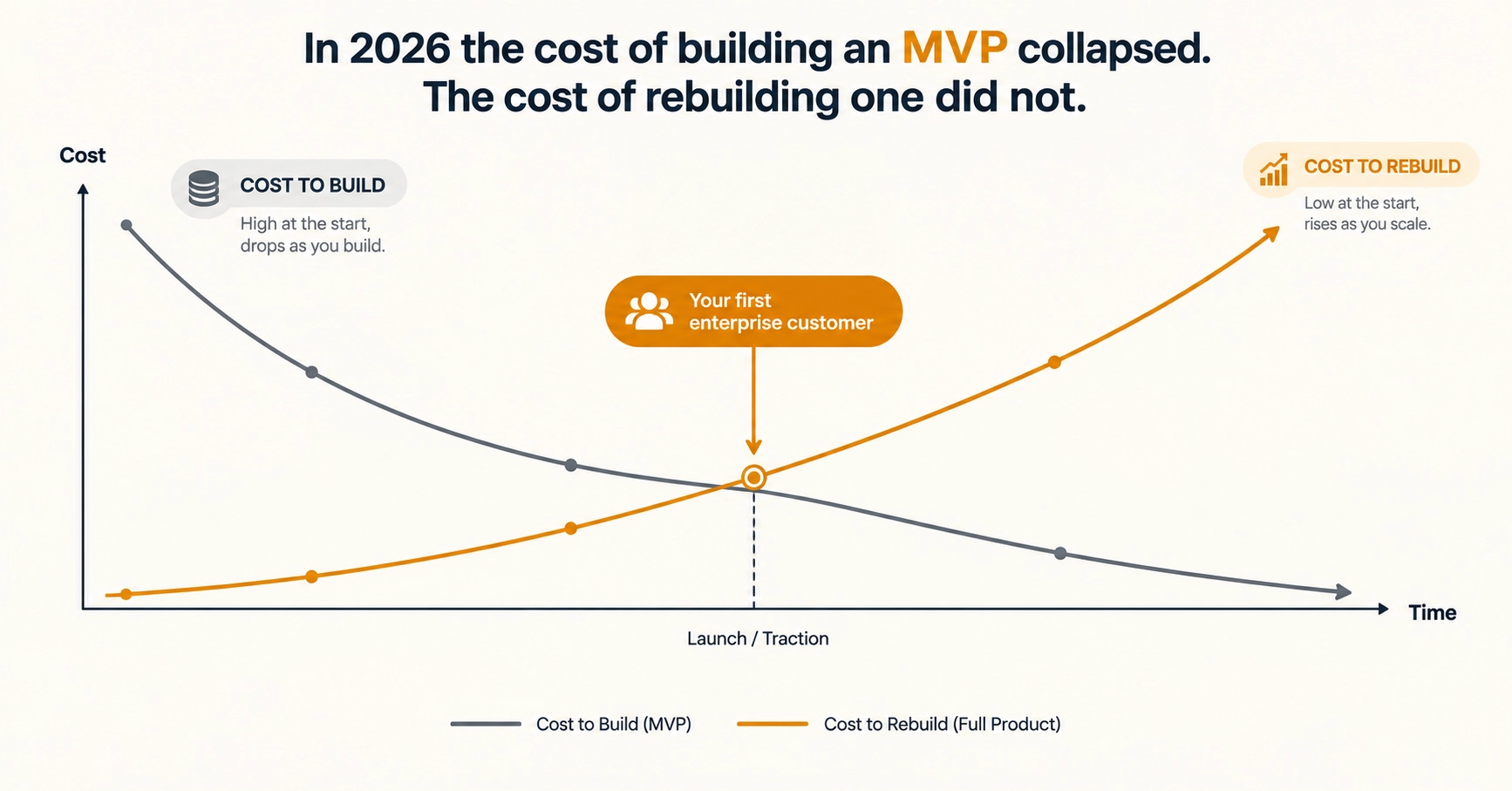
Here's the number nobody puts in the cost table: scans of AI-built production apps found 65% contained security issues and 58% had a critical vulnerability. A study of 8.1 million pull requests measured technical debt rising 30–41% after AI adoption.
Building a minimum viable product got cheap. Rebuilding one did not.
Step 1: Start with your riskiest assumption, not a feature list
Most guides begin with feature prioritisation. That's one step too late a feature list assumes you already know what the product is.
Write down every belief your business depends on, then sort them by what happens if this is wrong. One is usually load-bearing:
"Restaurant owners will pay monthly for inventory software."
"Recruiters will trust an AI shortlist."
Your MVP exists to test that one belief and nothing else. Dropbox's first MVP was a three-minute video because its riskiest assumption was demand, not whether file sync could be engineered.
The test: if your riskiest assumption proves false next month, how much of what you're building becomes worthless? If the answer is "most of it," your MVP scope is wrong.
Step 2: Scope your MVP by evidence, not opinion
MoSCoW has one flaw it sorts MVP features by what the founder feels matters. Founders are consistently wrong about this, which is why roughly 64% of features in shipped software are rarely or never used.
Use an evidence rule instead. A feature earns its place only if you can name the user behaviour it will produce and how you'll measure it.
❌ "Users need a dashboard."
✅ "If users check inventory four or more times a week, they renew."
Aim for three to five core features. Talk to 15–20 target users first, and watch what they already do rather than what they say they want. The workaround they've built themselves the spreadsheet, the notebook is the most honest product brief you'll get.
This is where outside engineering judgement pays for itself, and it's why Burntstack treats product discovery as a paid, scoped engagement rather than a free sales call. Deciding what not to build is the highest-leverage work in the project and far cheaper than finding out in code.
Step 3: Build an MVP that survives success
You can prototype in a weekend with AI tooling and you should. But there's a difference between a prototype that proves an idea and a system that holds real customers, real money and a real security review.
The failure mode is well documented: scanned AI-built apps turned up 400+ exposed secrets and 100% missing CSRF protection and security headers.
None of that matters at 40 users. All of it matters the moment you sign an enterprise pilot or enter due diligence where Bain's 2026 M&A report found 20% of deals were abandoned over AI-related risk.
The fix isn't over-engineering your MVP tech stack. It's drawing a line:
Ship fast and messy here landing pages, dashboards, admin screens, reporting, notifications. All cheap to throw away.
Engineer properly here authentication, data model, payments. Expensive to retrofit, and they outlive every pivot.
Where that line sits depends on your architecture. Our guide on what cloud computing actually means in 2026 covers the infrastructure side of this decision in detail.
Step 4: Instrument your MVP before you launch, not after
An MVP that ships without analytics isn't an experiment. It's a guess with a deployment pipeline.
Instrument these four events before launch. Together they tell you whether people understood your product, valued it and came back.
1. Activation: the moment a new user reaches your core value for the first time. Not signup. Pick the single action that proves they got it: first invoice sent, first report generated, first booking confirmed. If you can't name it in one sentence, your product isn't focused yet.
2. The aha action: the behaviour that separates users who stay from users who vanish. You don't guess it, you find it: log three or four candidate actions, then compare what retained users did in week one against what churned users didn't. Slack's was 2,000 messages sent; yours will be equally unglamorous.
3. Week-one return: did they come back within seven days without an email or notification prompting them. This tests whether the problem you solve is frequent enough to build a business on.
4. Week-four return: are they still using it after 30 days. This separates a novelty from a habit. Week-one numbers flatter you; week-four numbers tell the truth.
Then wire a feedback channel to a real inbox. The events tell you what users did; the replies tell you why.
One day of work and the difference between learning and hoping.
Step 5: Launch narrow and track the right MVP metrics
Launch to 20–50 users who have the problem badly, not to Product Hunt. A small cohort that genuinely needs the thing beats a thousand curious visitors as signal.
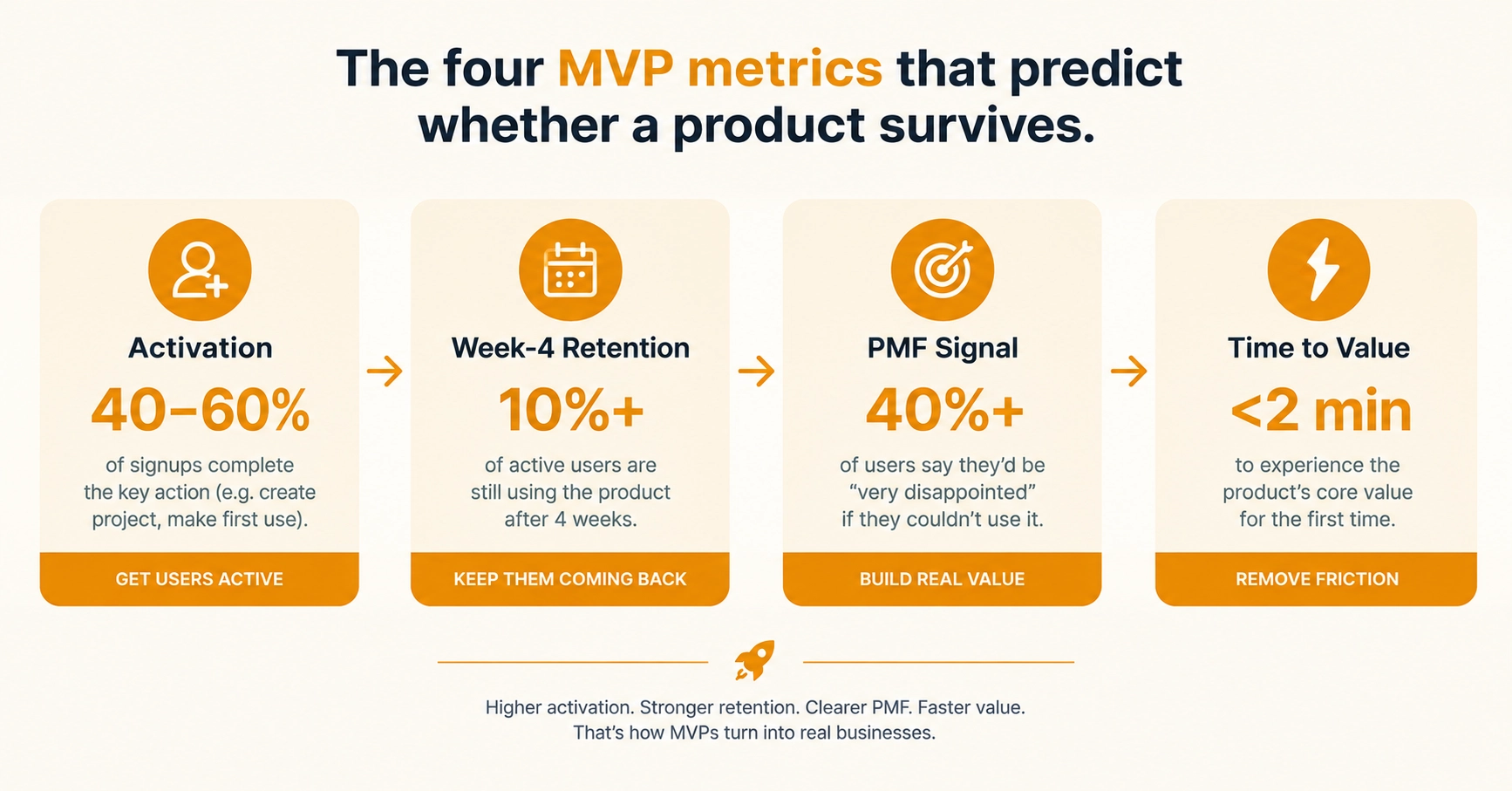
Then read the numbers that predict survival:
MVP metric Healthy benchmark If you're below it Activation rate 40–60% (B2B SaaS) Your onboarding is the problem, not the product Week-4 retention 10%+ You have a one-time-use tool, not a business "Very disappointed" if it vanished 40%+ No product-market fit yet don't scale spend Time to aha moment Under 2 minutes Users quit before they see the value
Strong activation but collapsing retention is a product problem. Weak activation but passionate users is a positioning problem. Both look identical on a revenue chart and need opposite responses.
Step 6: Decide your rebuild trigger before you need it
Most MVP guides end at "iterate." The real fork comes around month four, when the MVP works but the code that got you there starts fighting you. Name your trigger in advance:
The first enterprise security questionnaire
The first compliance requirement
The first time a release takes longer than the feature took to write
Founders who name these triggers schedule the work. Founders who don't discover it mid-funding-round.
The honest summary
In 2026, anyone can build an MVP. The founders who win know which assumption they're testing, refuse to build anything that doesn't test it, instrument properly, and engineer the load-bearing parts to survive success.
If you have the idea and the evidence but want engineering judgement on scope and architecture talk to Burntstack. We'd rather help you build less, correctly, than more, twice.
Frequently asked questions about MVP development
How long does it take to build an MVP in 2026?
Four to twelve weeks for most products. Anything beyond three months usually means the scope isn't minimal you're building a product, not testing an assumption.
How much does it cost to build an MVP in 2026?
Roughly $8,000–$25,000 for a focused web MVP and $25,000–$60,000 where payments, compliance or mobile are involved. The bigger variable isn't the build it's whether the architecture survives your first real customers.
What's the difference between an MVP, a prototype and a proof of concept?
A proof of concept tests whether something can be built. A prototype tests whether people understand it. An MVP tests whether they'll use and pay for it, it's the only one with real users and real data.
What tech stack should I use for an MVP?
The one your team already knows. A proficient developer on a familiar stack ships faster than a novice on a theoretically superior one. Reserve your architectural effort for authentication, the data model and payments.
How many features should an MVP have?
Three to five. Every additional feature adds build time, surface area for bugs and noise in your validation data while roughly 64% of shipped features go unused.